


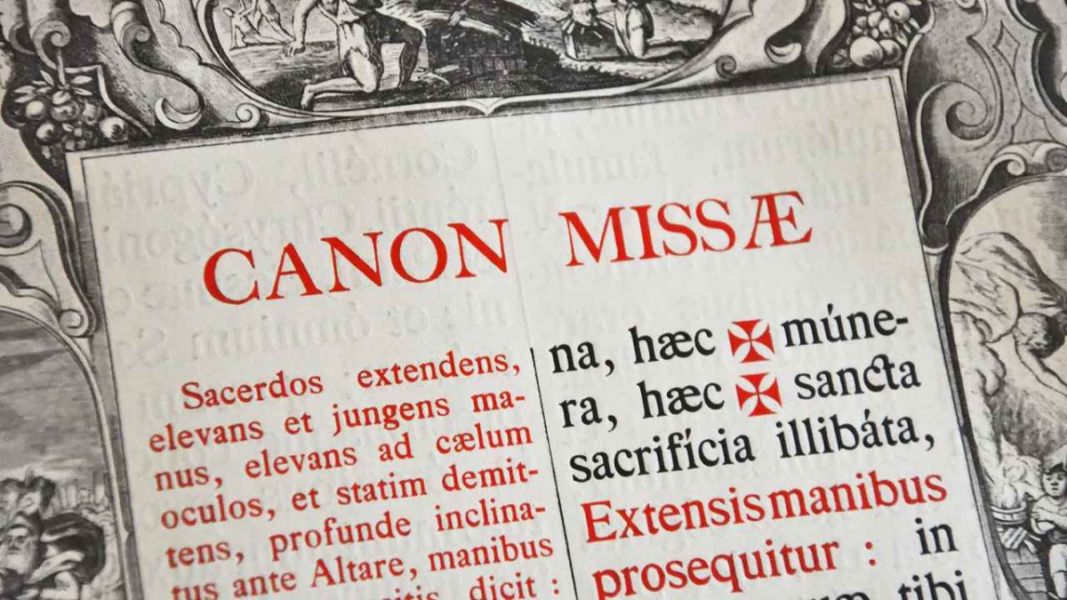
The Roman liturgy is not an arbitrary set of pious formulas. Every word has been fixed over centuries precisely to express a particular theology with exactitude. The Roman Canon—the current Eucharistic Prayer I—is perhaps the clearest example of this precision. Its essential structure was already consolidated in Rome by the sixth century and for more than a thousand years remained practically unchanged. Therefore, when examining some modern translations, it is surprising to see to what extent certain doctrinal nuances are diluted or change in meaning.
One of the places where this phenomenon is clearly perceived is the very beginning of the Canon, in the prayer known as Te igitur. There the priest asks God to accept the Eucharistic sacrifice offered by the Church and immediately adds a clause that expresses the hierarchical communion in which the Eucharist is celebrated. The Latin text reads as follows:
Te igitur, clementissime Pater… in primis quae tibi offerimus pro Ecclesia tua sancta catholica: quam pacificare, custodire, adunare et regere digneris toto orbe terrarum; una cum famulo tuo Papa nostro N. et Antistite nostro N. et omnibus orthodoxis atque catholicae et apostolicae fidei cultoribus.
The structure is very precise. The sacrifice is offered for the universal Church, so that God may pacify it, guard it, unite it, and govern it throughout the world. And it is immediately specified in what visible communion that sacrifice is celebrated: with the Pope, with the local bishop, and with all those who hold to the true faith.
The current Spanish translation formulates that last part in this way:
“with your servant the Pope N., with our bishop N., and all the other bishops who, faithful to the truth, promote the Catholic and apostolic faith”.
At first glance, it may seem like a reasonable translation. However, a careful examination of the Latin reveals a significant grammatical change that alters the original meaning.
The Latin text does not contain an explanatory subordinate clause. It says literally: et omnibus orthodoxis atque catholicae et apostolicae fidei cultoribus. The expression catholicae et apostolicae fidei is a genitive that determines the noun cultoribus. That is, the text identifies the subjects in a restrictive manner: it refers to those who profess the Catholic and apostolic faith. It is not a descriptive observation about the bishops; it is a doctrinal delimitation.
In other words, the Latin states that the sacrifice is offered in communion with the Pope, with the local bishop, and with all who are orthodox and profess the Catholic and apostolic faith.
The Spanish translation introduces a different structure: “the other bishops who… promote the Catholic and apostolic faith.” The effect is subtle but real. The clause becomes an added explanation, not a criterion that delimits the liturgical communion. The phrase stops identifying who is included and instead describes what they supposedly do.
This type of shift is not trivial. In the Roman liturgical tradition, the mention of the Pope and the local bishop in the Canon had a very specific ecclesiological function: to express the visible communion of the Church. From the early centuries, the deliberate omission of the Pope’s or bishop’s name in the liturgy was interpreted as a sign of broken communion. In fact, during the Christological controversies and ecclesial divisions of antiquity, the inclusion or exclusion of certain names in the Canon was one of the clearest indicators of belonging or separation.
The last phrase of the Te igitur is inserted exactly in that context. It is not enough to be within the hierarchical structure; liturgical communion is established with those who hold to the true apostolic faith. That is why the text uses two very precise terms: orthodoxis and cultoribus catholicae et apostolicae fidei. Both refer directly to the classical notion of orthodoxy: the right confession of the faith transmitted by the apostles.
The Spanish translation, by turning that delimitation into an explanatory phrase, softens that doctrinal nuance. The text no longer identifies those who profess the apostolic faith but seems limited to describing the bishops as promoters of the faith.
This phenomenon is not isolated. It is part of a broader trend in some liturgical translations of recent decades: replacing precise theological formulations with broader or interpretive expressions. Something similar happened for years with the term consubstantialem from the Creed, translated as “of the same nature,” or with other expressions where the original syntax was transformed into more explanatory than defining phrases.
However, liturgical Latin—especially in the Roman Canon—is neither redundant nor ornamental. Each term has a doctrinal function. The Latin Church preserved these formulas for centuries precisely because they clearly expressed the theological structure of the faith and ecclesial communion.
That is why the issue of translations is not a minor matter. The liturgy is not only a pastoral vehicle; it is also a normative expression of the Church’s faith. When translations alter the precision of the original text, even unintentionally, the result can be a less clear formulation of what the tradition intended to affirm.
This is not about introducing unnecessary technicalities or turning the liturgy into a philological exercise. It is simply about respecting the exactitude of a text that for more than fifteen centuries has transmitted the Church’s faith with extraordinary precision. If in some points the current translations introduce ambiguities or changes in meaning, the reasonable thing is not to ignore it, but to revise it.
Fidelity to the liturgical text is not an aesthetic issue. It is, ultimately, a matter of fidelity to the faith that text proclaims.