


According to various studies and sources, Pentecostalism is the fastest-growing religious movement in the world. There are already 300 million people”.
And it seems the same in the Catholic Church, and very rapidly, with the charismatic style of prayer and the movement itself; at least, in Spain. Pablo Ginés, in the article we have been citing from the beginning – and in his recent reply to these texts – proudly asks: “How many charismatic Catholics are there today? Impossible to count them, but it is the largest spiritual current within the Church. It is estimated that there are between 100 and 130 million Catholics who would define themselves as charismatic or who have been spiritually nourished in charismatic groups”. As if the numbers per se were something positive; but it is the situation we have, sadly. In the Catholic Church for some time now the number legitimizes a certain spiritual tendency, no matter how much it grates against the tradition of the Church, our sensus fidei and makes our hair stand on end.
Thus, I would like to conclude this triptych by addressing two issues: 1) this vast expansion of the Charismatic Renewal, especially through the Life in the Spirit Retreats, and 2) the relationship of the current ecclesiastical hierarchy with the movement.
The Expansion of the Charismatic Renewal: the Life in the Spirit Retreats
The CR lives and extends its particular spirituality in four settings, as can be read on its own website: 1) with the weekly group: open to everyone, even non-Christians; in it people pray, sing, praise, thank God for his goodness, ask him for things; the brothers pray for each other; something from the Bible is commented on, a short talk is given. It lasts between one and two hours; 2) with the retreats: there are two- or three-day ones, or a whole week. 3) With “special” prayer gatherings: healing or deliverance masses, prayers to ask for healings, miracles, prayers of rejection of evil, of physical or spiritual or emotional healing… “Special” gatherings can also be adoration and praise ones, with praise music, sometimes with the Blessed Sacrament exposed. 4) With the “Life in the Spirit seminars”, also called “Seven Weeks”: inspired in part by the Cursillos de Cristiandad, but with kerygmatic contents (first announcement of Salvation and conversion) and of the Holy Spirit. They are announced and taught in parishes, and include a “prayer of effusion of the Spirit”.
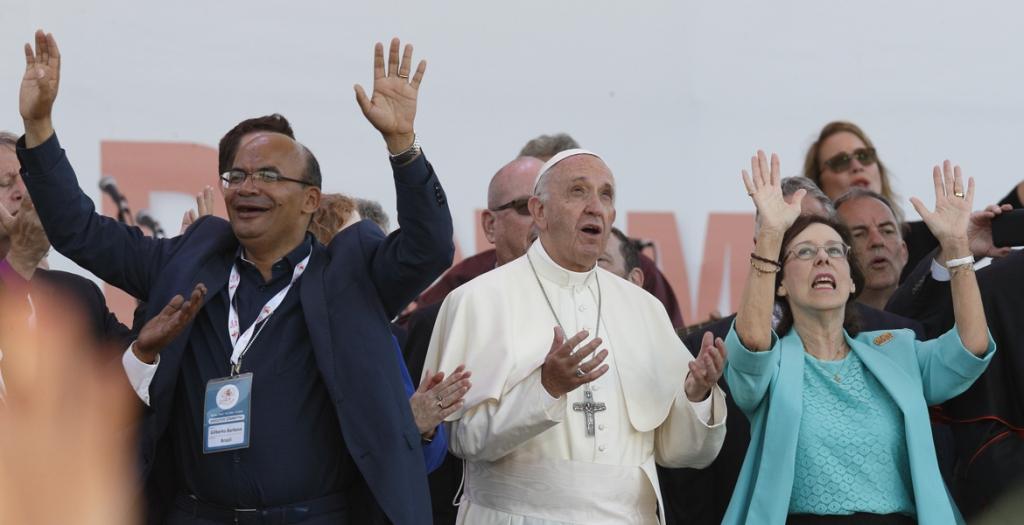
Ginés explains how the CR is very democratic and highly decentralized, but evidently has basic structures to coordinate in this dizzying expansion and the penetration of this charismatic way of praying into parishes and even diocesan gatherings. I myself participated years ago in an ENE (Encounter of New Evangelization, organized by Alpha Spain and the charismatic community Faith and Life), and in its evolution, the weekend Dive In, from Alpha Spain, and I could witness that the way of praying was absolutely charismatic; something that, at that time, was not so widespread in parishes. However, now it is. We see this same way of praying everywhere, with arms raised, with crying, hugs, with laypeople singing or preaching alongside the Blessed Sacrament exposed. An example of this is the parish of Santa Inés in Barcelona, very lively and once much more austere; an upper-class neighborhood parish with a very high presence of Opus Dei families, which in recent years has turned the celebration of Pentecost into a real witches’ sabbath – as you can see on their YouTube channel.
I imagine that, in the Spanish case at least, this is due to the aforementioned Life in the Spirit Seminars, which have been taught in parishes, in the desperate attempts of pastors to slow down the agony. I am going to pause briefly on these retreats.
The Charismatic Renewal’s website defines the Life in the Spirit Seminars (LSS) so succinctly: “The Life in the Spirit seminars are an instrument of evangelization of the Charismatic Renewal to actualize the sacrament of baptism, or prepare for it in case it has not been received. It is not a course, nor a theory, but a direct experience of God, who is present in the heart, through the Holy Spirit given to us. The Life in the Spirit Seminar is an experience of evangelization. In it the love of God is proclaimed, Jesus is announced clearly and unequivocally as Lord, and Christians are invited to lead a renewed life, dynamized by the presence of the Holy Spirit. We call it “life in the Spirit” to allude to the fundamental role that the Holy Spirit plays in it, and to indicate that those who try to live it can no longer live without Grace”.
But, what about the dynamic of these retreats and why in any parish can one encounter worshipers with arms raised, laying on of hands among laypeople, fainting spells, crying, laughter and hugs in the charismatic style, while hyper-sentimentalist music plays non-stop? The online newspaper El Debate, from the Catholic Association of Propagandists (ACdP), offered a while ago an article congratulating itself that “thousands of people have already gone through these retreats, increasingly in vogue, where the Holy Spirit is asked to renew the heart, society and the Church with «a new Pentecost»”. The text highlighted how the LSS are one of the most popular retreats in recent years. And not only because of the involvement of well-known faces like Tamara Falcó or the sisters Ana and Casilda Finat, but because word of mouth transmits a myriad of stories of inner renewal and a cascade of «you have to do one». Apparently, people without faith, baptized who had abandoned the Church, lifelong Catholics who have never had an experience of God, believers going through «dark nights», and even priests, religious men and women from very different ecclesial sensitivities attend the Life in the Spirit seminars. The only requirement to participate is «an attitude of abandonment to open oneself to the Holy Spirit and thus be able to experience a new Pentecost». Through meditations –«teachings»–, testimonies and moments of prayer, praise and adoration of the Blessed Sacrament, those who participate in the Seminar open themselves to a surprising and, at times, cathartic experience.
Once we have seen how they work, we can ask ourselves what the secret of the boom in these Life in the Spirit Retreats is, the reason – as the El Debate article asks – why an experience that was born within a specific movement has broken the barrier of the Charismatic Renewal itself and arouses the interest of more and more people. From the CR they consider that «we are witnessing an event of Pentecostal revival in the Church».
The Seminars are not only for laypeople, but there are also specific ones for priests. From the CR they congratulate themselves on the number of priests and consecrated who throw themselves into living this experience. So, if you have ever been surprised to see a parish turned into a Protestant hall, here is the explanation. Here you can read an example.
The key moment of the retreat is, of course, the “effusion of the Spirit”: it is a moment of prayer and praise, in which the servants –the members of the CR who organize the Seminar– intercede for those participating in the encounter, asking the Lord to send them his Holy Spirit. From the Charismatic Renewal they emphasize that this moment has nothing to do with those television shows of evangelical sects (¿?): «The confusion with other movements, sects or experiences that have nothing to do with the Church –they explain from the CR – may come from the external forms, such as prayer with laying on of hands; or there could also be an eagerness of other groups to identify with the experience of healing prayer or charismatic manifestations that we see in the Church».
I don’t know, Rick, this issue of emotivity taken to the limit reminds me a lot of the Emmaus retreats (which I already talked about here, https://caminante-wanderer.blogspot.com/2024/08/la-experiencia-brutal-de-los-retiros-de.html), and basically to – almost – every event organized in the Church today.
The Ecclesiastical Hierarchy and the Charismatic Renewal Today
Pope Francis, in a multitudinous encounter with the Charismatic Renewal in Rome in 2015, exhorted: “I ask each and every one of you, as part of the current of grace of the Charismatic Renewal, to organize Life in the Spirit seminars in your parishes, seminaries, schools, in the neighborhoods, to share baptism in the Spirit, so that, through the work of the Holy Spirit, the personal encounter with Jesus that changes our lives may take place”.
And in this the CR seems to have been very diligently focused, for in these last ten years we have seen the “charismatic” way of praying spread like a hydra through movements and parishes. Arms raised, songs, crying. In a word, an overflowing emotivism.
And, in this situation, it has caught us all off guard the doctrinal note from the Commission for the Doctrine of the Faith of the Spanish Episcopal Conference Cor ad cor loquitur, on the role of emotions in the act of faith, published on March 3.
The truth is that we have been entertained since it appeared: the CEE, which had adopted the dynamic of “praise” music with the Blessed Sacrament exposed in multitudinous events, with the crowd “praising” with arms raised; replacing temples with large venues to gather thousands of people; with influencers, little talks and food trucks… suddenly, without prior notice and without any hint that something like this could happen, alerts in this note of the risk of emotivism in faith.
The note describes how “in recent years signs are appreciated that indicate a rebirth of Christian faith, especially among young Spaniards of the so-called “generation Z”, those digital natives born between the mid-90s and the first decade of the 2000s. The Church values the creativity of the various first announcement initiatives that the Holy Spirit has aroused in many ecclesial movements and associations to facilitate so many people the encounter with Christ or the revitalization of their faith. These new methods or tools of evangelization represent a breath of fresh air for the Church, which, as Mother, time and again «sets out on the path to rescue men from the desert and lead them to the place of life, to friendship with the Son of God, to him who gives us life, and life in abundance. Feelings play an important role in human and spiritual life, and are fundamental in the inner life of every human person. The Christian faith, rooted in the incarnation, cannot ignore them or set them aside”.
However, the doctrinal note warns, “in all these methods, to a greater or lesser degree, emotions and feelings have an important weight, which provoke a first “impact” in the person and lead to conversion and adherence to Christ. This must be followed by the configuration of the lives of Christians with the Lord, discipleship in the Church and the apostolate as witnesses of Christ dead and risen in the midst of the world. However, not a few, even among the promoters of these experiences, have warned of the risk of a “emotivist” reductionism of faith, which leads many people to become consumers of impactful experiences and insatiable seekers of the complacency of spiritual feeling. The announcement of Christ does not seek directly to provoke feelings, but to witness an event that has transformed history and is capable of transforming the existence of every human being by occupying the center of their life”.
The bishops warn that, in our days, the experience of faith is centered in the emotional and sentimental universe of the person, which could be interpreted as one of the “signs of the times”; however, at the same time, they warn of the need to regulate and discern emotions because they can be an obstacle to spiritual growth, since a phenomenon of absolutization of the emotive in postmodernity has occurred that needs to be discerned and channeled so as not to fall into irrationality”.
The bishops’ note must have left more than one very disconcerted because it then goes on to describe the “postmodern man” as a subject who rejects rationalist objectivism to become an emotive subject. And this “emotivist” man experiences himself as fragmented, because emotions in themselves are disconnected and cannot offer him a holistic vision of reality. He perceives himself as disoriented, because he lets himself be carried away by emotions at every moment without any horizon and identifies with them; and he lives in immediacy and inconstancy by absolutizing the instant (as long as the emotion lasts). Applied to spiritual life, the “religious emotivist” makes faith depend on the intensity of the emotion, reducing it to the measure of feeling and how pleasurable it can be, which is reinforced when it comes to shared experiences. It is important not to confuse these experiences with mystical rapture or the experience of spiritual joy that accompanies private revelation in the saints (…). The “emotivist” is more easily manipulable, and therefore also in spiritual life there is the danger of trying to elicit certain behaviors through an “emotional bombardment”, which could be considered a form of “spiritual abuse”. Such abuse can manifest itself in the form of “group emotional pressure”, which makes individuals feel obligated to “feel” the same as the others so as not to self-exclude from the experience. And even through the use of false supernatural or mystical experiences (“false mysticism”), which distort an authentic vision of God, as means to exercise dominion over consciences by annulling people’s autonomy or to commit other types of abuses, which must be considered of special moral gravity.
For all this, the bishops conclude that “it is essential to find a balance within spiritual life between the intellectual, volitional and sentimental aspects (…); because, without truth, charity falls into mere sentimentalism. Love becomes an empty wrapper that is filled arbitrarily (…), it is prey to emotions and the contingent opinions of subjects (…)”.
The note was, to say the least, unexpected and truly surprising in its contents. And there were three reactions that I would like to highlight: the first, the one that has had the least repercussion, two articles by Pablo Ginés, a charismatic, in Religion en Libertad, taking it personally, I imagine, counter-arguing, in two texts published two days apart and only two days after the appearance of the episcopal document, titled respectively “Emotions, Holy Spirit, evangelization… it’s not clear what the bishops are asking for” and “Why I say that the bishops’ document on emotivism is confusing”. Basically, his argument can be summarized in that the note is neither clear nor delimited and will not be useful to anyone, because “it shoots with buckshot, very generally, without aiming, without naming names, without clarifying… «Someone does something not very well done and someone should do something so that it stops being done». It seems more like a pastoral document, not very fine-tuned, than one of doctrine (…). This note is terribly imprecise, and therefore imprudent and unfair«. It seems that the note has caused him a lot of stinging.
In addition to these two articles, there is the one by José Manuel Vidal in Religión Digital, “Cor ad cor loquitur: when the bishops dare to tell the new movements that feeling is not enough”, published the day after the appearance of the doctrinal note, on March 4. Vidal highlights that Cor ad cor loquitur “is, probably, the best text that the Episcopal Conference has produced in years on youth pastoral care. Balanced, subtle, not at all hysterical and, however, brave in its warnings. The bishops have been able to recognize the spiritual thirst of young people and the attractiveness of certain movements of the so-called “Catholic turn” –Hakuna, Effetá, Emmaus, the HAMs, Iesu Communio and other similar realities-, without surrendering to uncritical fascination or falling into anathema. A text like this was needed. In the face of massive concerts and hundreds of conversions, there was a need for someone with authority to say that not everything that excites in the name of Jesus leads to the truth of the Gospel or to real commitment to the Kingdom”. For Vidal, “the episcopal document puts its finger on the sore spot, when it warns of proposals that “attract young people through emotion, but do not lead them sufficiently to the truth of faith or to real insertion in the ecclesial community”. Translated: a lot of feeling, little mystagogy; a lot of group identity, little Gospel digested in an adult community; a lot of party and little commitment to the poor, the ‘flesh of Christ’. The warnings are veiled, yes, but the recipient appears clear between the lines. When the bishops speak of dynamics that “build strong belongings around charismatic leaders”, or of itineraries that absolutize a form of prayer or liturgical aesthetic as “the” authentic Christian experience, it is hard not to think of Hakuna, Effetá, the Ham, Iesu Communio and other new realities that orbit in the ecosystem of the “Catholic turn”. The author of the article has no choice but to finally recognize that “the truth is that they do not name them at all, but describe them precisely, by assuring that they recruit through emotional impact, that they generate very powerful identity bubbles and that, frequently, they live in an ambiguous tension with the ordinary pastoral care of the dioceses and parishes”.
It may be surprising that Religión Digital with this note-massage-defense of the bishops’ message, from which it is sustained by their economic contributions, although they have a very reduced and decreasing number of readers. Because it is actually very intentional, since, where the episcopal note does not mention any name, Vidal does in his article, shooting against neoconservative realities that displease a textbook progressive like him deeply. Thus, he attacks, shielded by the bishops’ note. Curiously, however, he does not mention the Charismatic Renewal…
Finally, a third article appeared, written by Jesús Bastante in the left-wing medium El Diario, which came to say that “the bishops denounce the emotional bombardment of Hakuna or Emmaus can end in spiritual abuse”. The CEE rushed to deny what it considered distorted its doctrinal note. However, the X message from the Episcopal Conference was later deleted, presumably by the Conference’s own Press Office.
Curiously, the CEE remained silent before Vidal’s article in Religión Digital, much more incisive. I don’t know if because no one reads it or because it is friendly fire and they prefer to look the other way. Personally, and even being at the antipodes of Vidal’s thinking, I agree with him. As a television character used to say: “sorry, but someone had to say it”. It was about time for the CEE to warn of the risk of irrationality and subjectivity of sentimentalism in the experience of faith, even though it throws the stone and hides the hand, not daring to mention any ecclesial reality that abuses the emotional component in its evangelization methods. But, come on, if they are not referring to Effetá or Emmaus, but what the CEE denounces are methods based on emotivism, what ecclesial reality exists more based on emotivism and its irrationality than the Charismatic Renewal, with its fainting spells, its hysterical crying and laughter, its glossolalia? If it has four legs, a tail, a trunk and two enormous tusks… What could it be?
***
P.S. For an in-depth understanding of the Charismatic Renewal, I highly recommend reading Charismania. The truth about the Charismatic Renewal, by Kennedy Hall.