


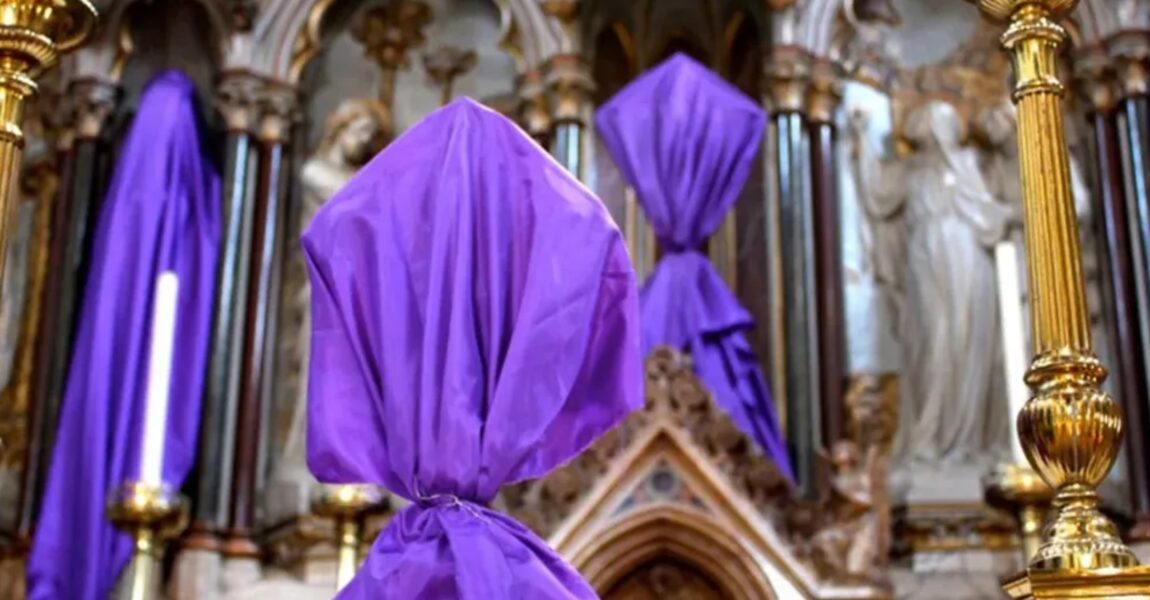
From this afternoon, with the first Vespers of Sunday, the Church enters the so-called Passion Time, the final stretch of Lent. There are two weeks left until Easter, and the liturgy changes tone clearly: it becomes more sober, more direct, and more focused on the mystery of Christ’s Passion.
It is worth specifying that this structure is clearly defined in the traditional liturgy, where there is properly a «Passion Time» as a differentiated phase. In the new form of the liturgy, however, this distinction disappears, and the entire Lent is presented in a unified manner, without an official division of periods.
Why the liturgy changes
The logic is simple: the Church stops adding elements and begins to remove them. For weeks it has prepared the faithful; now it concentrates everything on the essentials. That is why some elements of more expansive praise disappear, and the accessory is reduced.
In the traditional liturgy, this is seen clearly: certain formulas like the «Gloria Patri» are omitted at various moments, the initial psalm of the Mass disappears, and the whole acquires a more austere tone. Nothing important is lacking; what could disperse attention is eliminated.
In the current liturgy, these changes do not occur in an obligatory or systematic way. The Lenten tone is maintained, but without that progressive hardening so marked.
The most visible detail: covering the images
The most striking sign is the veiling of images and crosses with purple cloths. In the liturgical tradition, this must be done today, before the first Vespers of Passion Sunday. The crosses remain covered until Good Friday, and the images until the Easter Vigil.
Not everything is covered indiscriminately. The norm refers mainly to images intended for worship, especially those on the altars. Those with a decorative or catechetical function, like the Stations of the Cross on the walls, are not required to be covered. In addition, the veil must be opaque, precisely to prevent seeing the image.
In the liturgy reformed after the Second Vatican Council, this custom does not disappear, but it ceases to be obligatory. It is expressly permitted to cover the crosses and images starting from these days, but it is left to the discretion of each place. Therefore, in practice, there are parishes where it is maintained, others where it is applied partially, and many where it is simply not done.
What that «hiding» really means
The gesture has a precise meaning: to hide the visible in order to focus attention on the essential. In the Gospel of these days, Christ begins to withdraw; the liturgy reproduces that movement.
By removing the images, the Church forces one not to rely on the sensible. It is not a rejection of images, but a way to intensify the contemplation of the mystery of the Passion. What helps is removed, to force going further.
Fewer gestures, more focus
The same logic applies to other details. In the liturgical tradition, secondary gestures are eliminated, such as the incensation of images or certain inclinations toward them. Everything is directed toward the altar and the sacrifice being celebrated.
In the current form, these nuances are much less marked. The result depends more on the sensitivity of each celebration than on a strict common norm.
So, why are there processions?
It may seem contradictory that images are hidden inside the church while processions multiply outside. It is not. They are different planes.
The official liturgy reduces and concentrates. Popular piety, on the other hand, expresses the same mystery externally. What is withdrawn from the altar can appear on the street without conflict.