


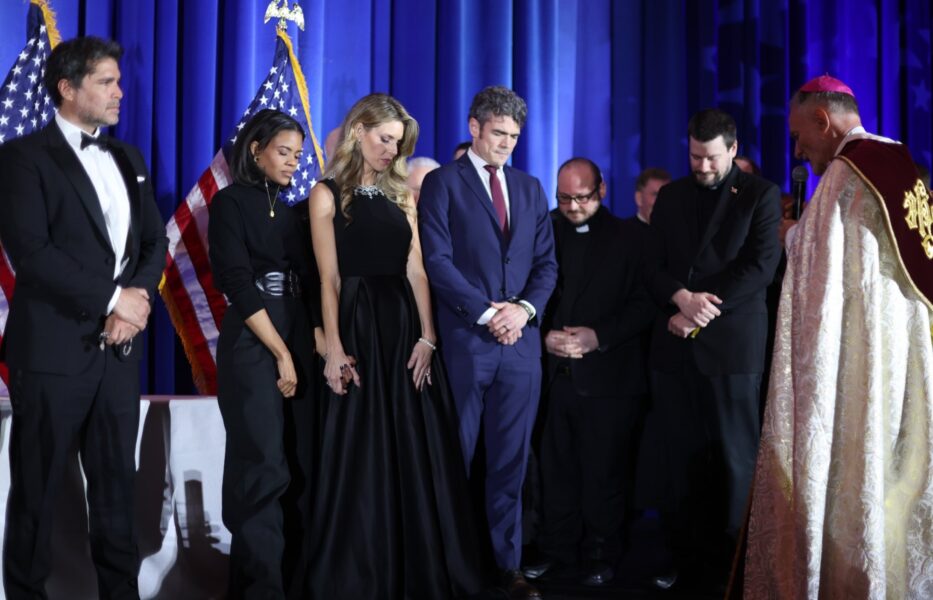
Washington hosted on March 19, the feast of Saint Joseph, a new edition of the Catholic Prayer for America Gala, organized by the Catholics for Catholics movement. The event took place at the Waldorf Astoria in the U.S. capital and brought together priests, lay faithful, communicators, and various public figures in a gathering that combined prayer, speeches, and the presence of relevant profiles from the American Catholic and conservative spheres.
A Prayer Gathering with Public Outreach
The gala was presented by its organizers as a prayer initiative for the United States at a time they consider decisive for the country, framed also in the context of the nation’s 250th anniversary. The event’s development included speeches, moments of reflection, and a final part of Eucharistic adoration, configuring a format that integrated spiritual dimension and public presence.
Far from being limited to a social encounter, the gathering sought to bring together committed Catholics involved in public life, emphasizing the importance of faith in shaping society and the need for Christian witness in the cultural and political spheres.
Presence of Priests and Eucharistic Moment
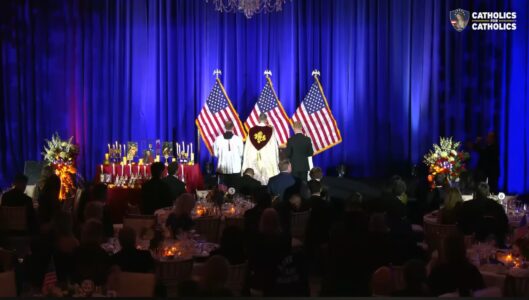
Numerous priests actively participated in the development of the event. The religious dimension reached its climax with the final Eucharistic adoration.
This moment was presided over by Monsignor Donald Lippert, OFM Cap., bishop of the Diocese of Mendi in Papua New Guinea. Lippert, a Capuchin friar and missionary for years in that country, is an American prelate who has developed much of his ministry in evangelization contexts. His participation brought a clearly ecclesial and missionary dimension to the event, underscoring the universality of the Church.
Prominent Participants from the Public and Cultural Spheres
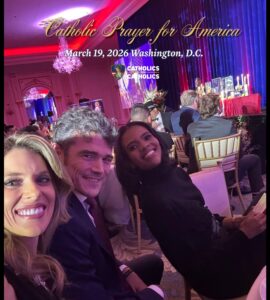
Among the attendees was Michael Flynn, a retired U.S. Army general and former National Security Advisor during the Donald Trump administration. Flynn is a well-known figure in the American political sphere and in recent years has participated in various civic and religious initiatives linked to the country’s public life.
Candace Owens was also present, a political commentator and communicator with a wide audience in the United States. Owens is known for her interventions in cultural and social debates, as well as for her defense of conservative positions in the media space.
Matt Walsh also participated, a writer and commentator linked to the digital media outlet The Daily Wire. Walsh has gained notoriety in recent years for his works and documentaries focused on anthropological, educational, and cultural issues, especially around family and identity.
Another relevant name was Eduardo Verástegui, a Mexican actor and producer, widely recognized for his pro-life activism and his involvement in initiatives defending human dignity and religious freedom. His presence added an international dimension to the encounter.
Carrie Prejean Boller also spoke, known in the United States for her public defense of marriage and Christian values, especially following her participation in beauty pageants and her subsequent activity as a speaker.
Cardinal Müller’s Intervention from Rome
Cardinal Gerhard Ludwig Müller, emeritus prefect of the Congregation for the Doctrine of the Faith, was not physically present in Washington but participated through a video message addressed to the attendees. Müller is one of the most relevant theological figures in the recent Catholic landscape, and his intervention brought doctrinal content and ecclesial reflection to the event.
His participation, though remote, allowed the gala to incorporate the voice of a cardinal with experience in the central government of the Church and a distinguished trajectory in the theological field.
A Lay Initiative with Broad Outreach
The Catholic Prayer for America Gala is configured as an initiative promoted from the lay sphere, without institutional participation from the U.S. episcopate. Even so, the presence of priests, a missionary bishop, and public referents from the Catholic and conservative world reflects the convening power of this type of gatherings.
The event once again showed the existence of a sector of American Catholicism particularly active in public life, which seeks to integrate faith, culture, and social commitment in the same space, with a proposal that combines prayer, reflection, and presence in the national debate.
Distance Between the Hierarchy and a Mobilized Catholic Base
The absence of official participation from the North American episcopate is not a minor element, but one of the features that best defines the moment we are living. While no institutional presence of U.S. bishops was recorded, there was a significant mobilization of faithful, priests, and relevant laypeople willing to occupy a visible space in public life.
This contrast reflects a growing distance between a part of the laity that perceives itself called to greater involvement and a hierarchy that, at times, opts for a less defined presence in the public sphere. In a context marked by accelerated cultural transformations and deep social tensions, this type of initiative evidences the willingness of certain sectors to assume a more active role, without necessarily awaiting institutional directives.