


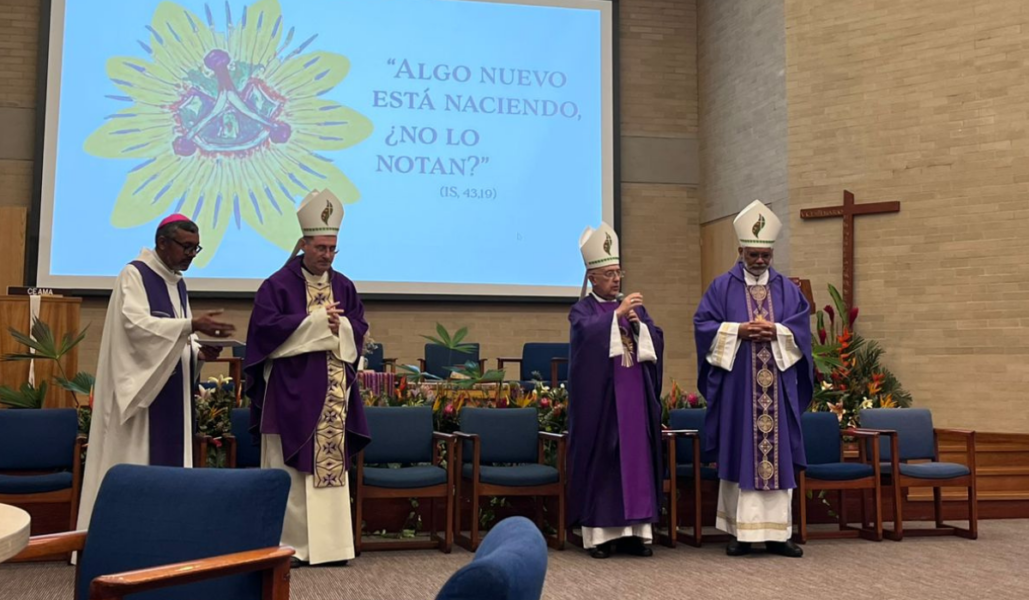
The Ecclesial Conference of the Amazon (CEAMA) has elected Brazilian Cardinal Leonardo Ulrich Steiner as the new president for the period 2026–2030, during its VI General Assembly held in Bogotá, as reported by Vatican News. The election is part of the continuity of the synodal process launched following the 2019 Amazon Synod.
The meeting, which brings together bishops, religious, laity, and indigenous representatives, aims to define pastoral lines for the coming years, within an ecclesial structure that continues to develop the model that emerged after the exhortation Querida Amazonia.
A synodal process that consolidates its structure
According to Agencia Fides, the assembly—which involves about a hundred people—seeks to approve the so-called “synodal pastoral horizons” for the period 2026–2030, as well as to redefine the roadmap for ecclesial institutions in the region.
The CEAMA, created after the Amazon Synod and established in 2021, presents itself as a regional coordination body that brings together various initiatives such as REPAM or educational and pastoral programs that have emerged in recent years.
All of this shapes an increasingly structured ecclesial network around the Amazon, with an approach that combines evangelization, social action, and ecological commitment.
The Pope encourages “opening new paths”
In a video message addressed to the participants, Pope Leo XIV encouraged continuing the path undertaken, emphasizing the need to “open new paths in the Church’s mission” in the region.
The Pontiff insisted on the importance of inculturation and of a Church that “walks poor with the poor,” while encouraging the tackling of the social, cultural, and environmental challenges of the Amazon territory.
The papal message, with a markedly symbolic and pastoral language, reinforces the horizon outlined after the 2019 Synod, focused on building a Church with an “Amazonian face.”
An expanding ecclesial model
The election of Cardinal Steiner—known for his closeness to indigenous communities and his Franciscan profile—strengthens this line, which emphasizes inculturation, lay participation, and the protagonism of local realities. He is not a neutral figure in the current ecclesial debate: Steiner has publicly defended the possibility of “reintroducing” the female diaconate, arguing that it would have existed in the early Church and proposing the convenience of continuing to advance in that direction. His election at the helm of the CEAMA thus consolidates a profile aligned with the more open currents that emerged after the Amazon Synod.
The vice presidency will fall to Peruvian priest Jesús Huamán, also linked to pastoral work in indigenous contexts.
The CEAMA itself has emphasized that its structure seeks to reflect the diversity of the region, incorporating representatives from religious life, the laity, and indigenous peoples into its governing bodies.
Between mission and the redefinition of the ecclesial model
Five years after its creation, the CEAMA is consolidating as one of the main institutional fruits of the Amazon Synod. However, its development has not been without questions about the scope of this model.
The insistence on concepts such as “new paths,” “Amazonian face,” or “synodal horizons” reflects an evolution that, beyond missionary action, also points to a broader transformation of ecclesial life in the region.
In this context, the Bogotá assembly not only defines pastoral priorities but also confirms the continuity of a process that continues to mark the course of the Church in the Amazon and that, according to the Pope himself, will have to contribute its experience to the ecclesial assembly planned in Rome in 2028.