


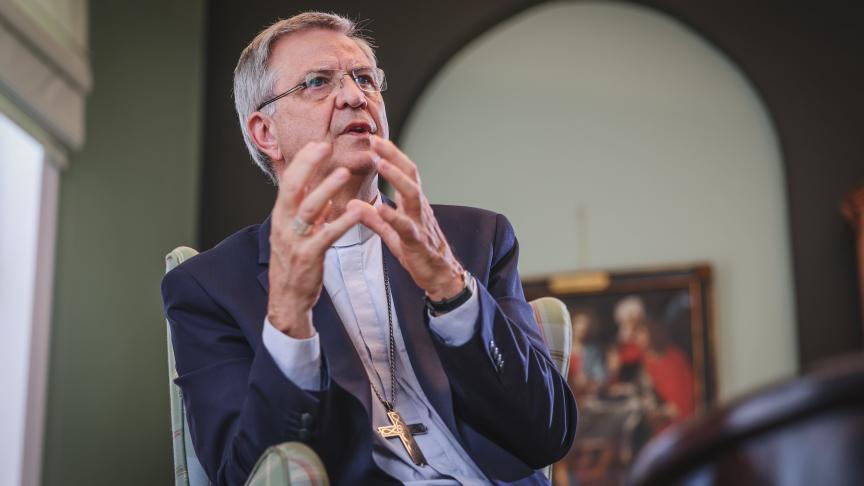
The Bishop of Antwerp, Monsignor Johan Bonny, has taken a further step in the debate on priestly celibacy by announcing his intention to ordain married men starting from 2028. The proposal, reported by the French portal Le Salon Beige, introduces a direct challenge to the current discipline of the Latin Church and places Rome before an uncomfortable decision.
In his pastoral letter «Implementation of the synodal process in the Diocese of Antwerp», Bonny does not limit himself to posing a theoretical reflection, but assures that he will actively work to identify candidates and prepare them in the coming years, with the explicit objective of carrying out these ordinations.
From Proposal to Concrete Plan
Unlike other similar debates, the Belgian bishop’s approach is not presented as an open hypothesis, but as a project with a timeline.
Bonny argues that the ordination of married men has «almost total consensus» within the People of God and states that the question is no longer whether it will be done, but when and how.
This approach turns an ecclesial discussion into a practical initiative that, if realized, would have direct implications for the universal discipline of the Church.
The Vocational Crisis as Justification
The central argument is the lack of vocations in Western Europe. The bishop describes a situation in which candidates for celibate priesthood are practically non-existent in some dioceses.
However, instead of proposing a revitalization of vocational pastoral care, the proposed response involves modifying the priestly model.
An option that, far from being neutral, implies a profound transformation in the understanding of the ministry.
The Exception Turned into Argument
Bonny resorts to the existence of married priests in the Eastern rites and among converts as the basis for his proposal.
But what has historically been a regulated exception now appears as a precedent for a possible widespread extension in a synodal key.
A Reassessment of the Priesthood
The letter goes beyond the disciplinary issue and points to a review of the priestly model, linking celibacy to problems of transparency, psychosocial health, and crises of trust following the abuses.
In this context, the priest ceases to be presented primarily from his sacramental configuration to be considered in terms of his social integration and closeness to the community.
Pressure in a Synodal Key
The bishop frames his proposal within the synodal process, to which he attributes the legitimacy to promote this type of change.
Thus, the ordination of married men appears as part of a broader reconfiguration of the Church in the West, driven from local dynamics but with universal aspirations.
Rome Before a New Challenge
The fronts are multiplying, and the Antwerp initiative thus places the Holy See before a new dilemma: intervene to halt the project or allow it to proceed, with the consequent impact on the entire Church.