


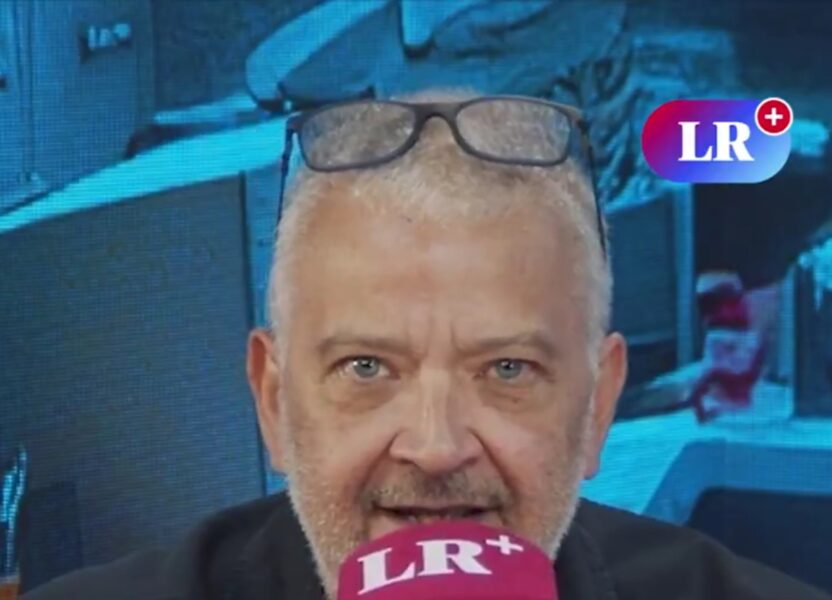
The Peruvian journalist Pedro Salinas—who, according to his own testimony, has been contacted by the Pope to help him organize a meeting with Gareth Gore, author of a critical book on Opus Dei— has decided to dedicate part of his radio space, broadcast on networks through the Peruvian newspaper La República, to harshly attack InfoVaticana.
He has done so, moreover, in a heated, violent tone, unbecoming of someone who boasts of closeness and collaboration with the Pope. Rather than arguing, he has shouted. And, what is more revealing, he has done so from a surprisingly poor understanding of what criticism means within the Church.
It is worth starting with the basics: we do not “demand” that the Pope apologize, but rather an official clarification of the situation regarding the photographs. Among other things, because we know perfectly well what our place is. What we do is express what we consider an error and explain the pain it causes. We also explain that in the Catholic tradition, asking for forgiveness is not always a humiliation or a defeat. It is an act of truth. Perhaps this type of category is foreign to someone who seems to analyze the Church with schemes more typical of political militancy than of ecclesial life. Salinas should evaluate whether going out ranting against forgiveness with that look of anger does a disservice to his defended one.
Because there lies, probably, the core of his confusion. For a Catholic, idolatry to the Pachamama is not an aesthetic or symbolic issue: it is something serious. And when events occur that can be interpreted in that key—as happens with the images published by LifeSite—the reasonable response is not insult to those who disagree, but reflection and, if appropriate, rectification.
But Mr. Salinas does not seem interested in understanding this. Rather, he conveys the impression of playing a role. It feels as though the Peruvian journalist is overacting to consolidate a position of proximity to Robert Prevost, through an artificial confrontation with those who, in his mind, are his enemies. As if he needed to build an antagonist—InfoVaticana—to reinforce a narrative with which to become a sort of clumsy media squire to the Pope. We understand that it is tempting given his position, but Mr. Salinas, calm down, don’t shout at us, and take care of your ego.
The problem is that the character has gotten out of hand. When one resorts to expressions like suggesting that we make “a cone” with our information and “stick it where we already know,” or qualifies our work as “idiocies” and “stupidities,” he stops situating himself in the realm of journalism—even the combative kind—to install himself in something much more primary.
Because Mr. Salinas seems not to have understood—still—something quite elementary: the Church does not function like a political party, nor like an ideological trench in which everything is reduced to blind loyalties, conspiracies, and enemies to be taken down. There are no perfect leaders or uncritical militancies here. Here there is a two-thousand-year tradition in which fraternal correction, founded criticism, and acknowledgment of error are part of the ordinary life of the faithful for two millennia.
InfoVaticana, by the way, is not the caricature he needs to sustain his narrative of conspiracy against the Pope. We are not spokespeople for any movement, nor are we funded by “conservative” structures to which he alludes lightly. In fact—and this might surprise him—we have been and are critical of the Sodalicio and Opus Dei. Probably with more depth, rigor, and continuity than Mr. Salinas himself is willing to acknowledge. I would dare say we have deeper and more detailed information than that of Gore himself. But of course, understanding this implies knowing aspects of the Church that Salinas, as a non-Catholic, still does not understand at all. Nevertheless, we extend a hand to him and are willing to explain them.
His approach, at bottom, is extraordinarily simplistic: Salinas imagines a kind of great internal battle in the Church, with two opposing blocs, crossed conspiracies, and himself occupying a prominent place as a defender of one side in power. The problem is that that battle exists more in his head than in reality.
There is no orchestrated smear campaign. There is no opus-sodálite conspiracy behind every criticism. Reality, as usual, is much more complex than his slogans. And it demands more than outbursts. If Bishop Prevost was very negligent in the sexual abuse case known as the «Lute case» in Chiclayo, we will continue to denounce it here (there is still a lot of information to publish and the story is lurid); if the priest Prevost participated in Pachamama worship rites, here we will request—due to the confusion it causes—rectification and public clarifications. And not for spurious interests—however hard it is for him to understand—but because we love the Church and want it to function: because to Mr. Salinas it might sound like science fiction, but for us the Catholic Church is the vehicle for the salvation of all souls.
We are not seeking a confrontation with Mr. Salinas. It would be easy, even profitable from a media standpoint, given his proximity to certain circles. But we are not interested in it at all. What does seem appropriate to say—with clarity, but without needing to shout—is that his intervention reveals more ignorance than authority, more nervousness than firmness, and more desire for protagonism than true interest in the truth.