


By David Warren
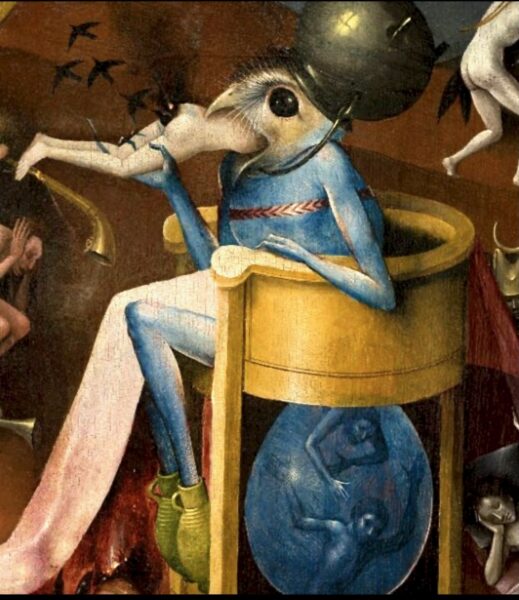
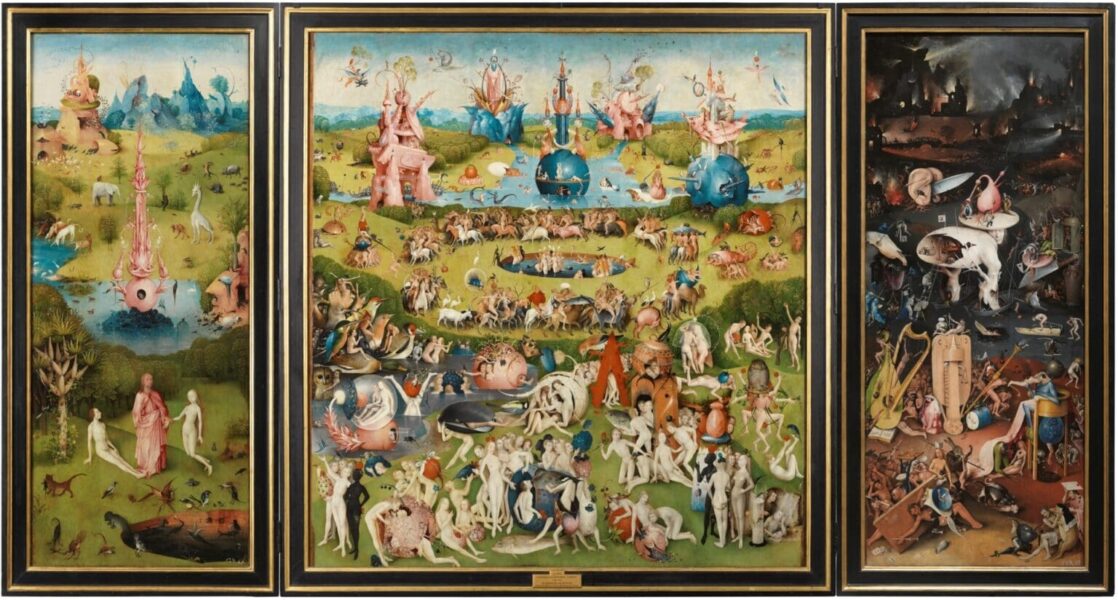
In an effort to understand El Bosco, I have been reading about the leaders and drivers who first conceived our modern world. El Bosco presents the fantasies of these heretics, I believe, without being entirely a heretic himself.
It is easier to see a heresy from a kilometer away than when you have it right under your nose. Or if you are an ingenious and amazing artist, like El Bosco, you can examine it up close.
In his book The Millennium of Hieronymus Bosch (translated in 1952), the author Wilhelm Fränger reconstructs that bygone era by visiting episcopal courts and, in particular, their records of ancient hippie movements and heresies.
Especially in the 13th and 14th centuries, there were Gnostic and paradisiacal cults that flourished in what would become Germany, the Rhineland, and the Netherlands, generally known by some variation of the name «Brethren and Sisters of the Free Spirit».
These self-proclaimed «Homines Intelligentiae» literally gathered in secrecy and were the woke or «woke-ists» of that time, believing themselves to be incarnations of the Holy Spirit and very devoted to their own esoteric and ever-changing notions.
But they were not truly creative. Their «paradise» would always, always deviate—generally through corruption and lust—from what exists in a true paradise or in the testimony of the true Mother of God. They strayed from reality, just as modern communists compulsively dictate a parody of the Christian faith.
A violent and evil parody, but a certainty, nonetheless, that there is an order in this world and in nature. Every deviant movement falls back into the same forms and cosmic or spiritual volumes that, I believe, are inevitably representations of immortal things.
This is because we are in a world and a nature that is, and was therefore built, from reality. There is no alternative, in effect, to being a copyist if there is only one reality to copy, no matter how vast and complex that reality may be.
And one can represent it accurately, in art and in science, or try to improve it and thereby produce something that is definitely wrong.
We thus discover alternative realities, but after thorough investigation what we unearth is rather a zero, a form of Nothingness.
The medieval scholastics realized that this Nothingness is like extreme cold. It is not really an alternative thing, but rather the absence of a thing, in this case of heat or of light.
It does not add, but subtracts; and when it has taken everything away, everything is, so to speak, frozen in darkness. And as heat is added—little or much—we begin to see how all the effects of nature come to life or are spontaneously exemplified.
The same happens when we focus on theology, or even on politics (to present politics in its religious form). As the heat—the heat of the divine—is removed, everything begins, instead, to resemble everything else.
To use the common analogy of deep space: there is no such thing as a spacewalk unless, for a very short period, one comes from heat and everything else needed inside a hygienically sealed and fitted suit.
Curiously, the same happens on moonwalks, or if one visits Mars. In practical terms, the expense of supplying everything we need to thrive on earth is, and will always be, very, very costly.
The same applies if, instead of a space or stellar walk (even if we could reach the nearest star in less than an eternity), we decide to replace our religion and invent a new one more attractive to ourselves (and not just attractive to an always absent God): we reach the point where we are freezing.
The Adamites and other heretical cells, from centuries ago or from yesterday itself, discovered that they were dealing with a world in which there are two, and precisely two, «biological» sexes.
And after one has decided on the picturesque and absurd principle of making them equal and interchangeable, or inventing some others, or dressing or undressing them, and calling, for example, nudity by the words «chastity» and «purity», and making everything else equal, one will feel a bit of cold.
Finally, you reach the point where there is nothing more you can do; you have «run out of other people’s money», as the late Mrs. Thatcher liked to say. You will need a bit of heat even to have an economy, as climate cult activists are learning.
And with the heat returns shame, and the «free love» of innocence means returning to shamelessness.
The orthodox of most religions understand this, and Catholicism is the one that understands it best of all. By giving new meanings to old established terms (think of gay, for example), the world does not change. It is simply a more fashionable form of the same outdated depravity, like ice on the road to Canada.
Progressives, both in the 13th and 21st centuries, mock such reasoning. The Adamites and their medieval «Brethren and Sisters» strove to ascend, while the respectable, then as now, always tend to descend.
I remember well, back in the hippie days, how the moral order was being inverted, as the «enlightened» always do before embarking on spacewalks. But it’s cold, and it’s getting colder.
People must be made to feel good about being bad, superior for being inferior, right for being wrong and wrong for being right.
This happens as each «social revolution» progresses. The Devil—that great cosmic Nothingness—waits patiently to inspire us. We find another lie when the old one expires.
For he (or she?) is in the business of accompaniment. He will escort the individual, or the entire society, to Hell, where Christian orthodoxy will no longer exist.
Truth will be replaced by a lie, but it is always like the old lie in which we free ourselves to follow strange new gods and find strange new rules with which to degrade ourselves.
About the author
David Warren was editor of the Idler magazine and a columnist in Canadian newspapers. He has extensive experience in the Near and Far East. His blog, Essays in Idleness, is now at: davidwarrenonline.com.