


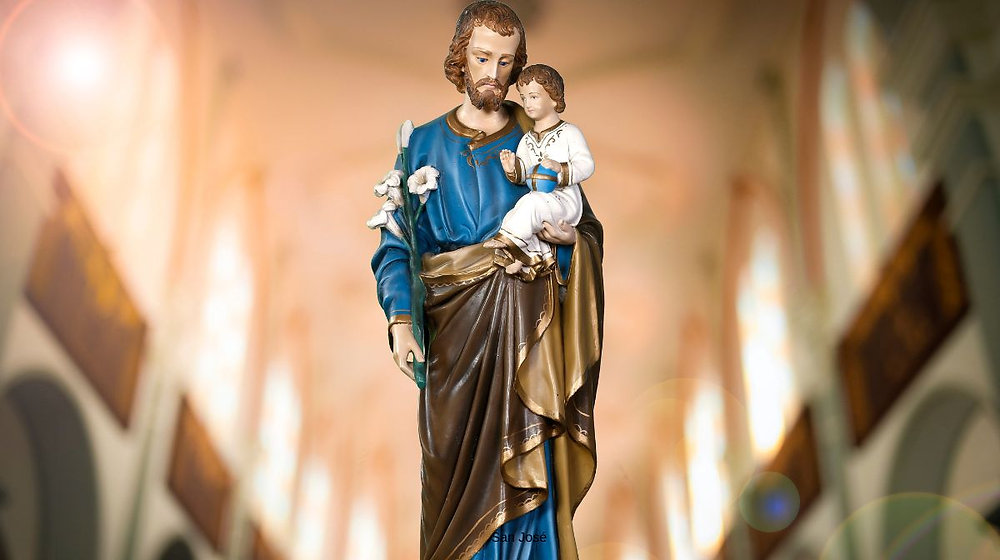
The solemnity of Saint Joseph, celebrated every March 19 during full Lent, brings to the forefront one of the most decisive and, at the same time, most silent figures in Christianity: the custodian of Christ and patron of the Church, whose devotion has marked spiritual and liturgical life for centuries.
A decisive saint… without a single word
The Gospels offer scarcely any data on Saint Joseph, but enough to outline a clear model: a just man, obedient and completely dedicated to the will of God. A descendant of the house of David, husband of Mary and foster father of Jesus, his mission was to protect and sustain the Holy Family in the most difficult moments.
He does not utter a single word in Scripture. But he acts.
From the flight to Egypt to save the Child from Herod’s persecution to his hidden life in Nazareth, everything in Saint Joseph points to a concrete holiness, made of everyday responsibility, work, and fidelity. That is why tradition has also recognized him as the patron of a happy death: he dies in silence, after having fulfilled his mission.
Protector of the Church and constant spiritual reference
Devotion to Saint Joseph is neither late nor marginal. From the missions in North America in the 17th century—where cities, lakes, and territories were placed under his patronage—to the spirituality of great saints like Saint Teresa of Ávila, Saint Bernard, Saint Alphonsus Liguori, or Saint Bridget of Sweden, his figure has been constant.
The Church has invoked him especially in difficult times. It is no coincidence that tradition presents him as custodian not only of the Holy Family, but of the entire Church. He who protected Christ on earth now protects his Mystical Body.
Saint Teresa of Ávila summarized this conviction with force: unlike other saints, Saint Joseph is granted to help in all kinds of needs. An affirmation that has sustained for centuries the practice of turning to his intercession in spiritual and material difficulties.
A feast between penance and celebration
In an article published in One Peter Five, Matthew Plese expounds on Saint Joseph’s relationship with the more austere life in times of Lent; according to the author, this solemnity has historically generated an interesting tension: how to celebrate without abandoning penance.
The Church’s tradition has been clear. Even when March 19 has coincided with a Friday, Lenten abstinence and fasting were maintained, unless expressly dispensed. The ancient discipline left no room for interpretations: feasts did not annul the penitential demands proper to this liturgical season.
This fact, which today may seem secondary, reflects a more demanding conception of Christian life, where celebration does not replace sacrifice, but integrates into it.
A holy day of obligation? A changing history
Plese provides a historical review; for centuries, the solemnity of Saint Joseph was considered a holy day of obligation in various parts of the world. This is recorded in ecclesiastical legislation from the Middle Ages, with lists that included dozens of mandatory days.
However, subsequent reforms progressively reduced these obligations. In the early 20th century, after the modifications introduced by Saint Pius X, the number of holy days of obligation was drastically limited, and Saint Joseph was excluded in many countries, such as the United States, although it was maintained in others.
Today it remains a holy day of obligation in some places, such as Spain, Malta, or Lebanon, which shows the disciplinary diversity that still persists in the universal Church.
Popular traditions: faith lived in the everyday
Despite the penitential context, the author recalls that the feast of Saint Joseph has generated a rich cultural tradition, especially in countries like Italy. There, practices such as the “St. Joseph’s tables” arose, altars laden with food—always without meat—that recall the help attributed to the saint during times of drought.
These celebrations include deeply religious symbols: breads in liturgical shapes, candles, flowers, images of the saint, and food shared with the needy. All of this within a framework that combines devotion, charity, and a sense of community.
Among the most well-known elements are typical sweets like zeppole, which, though festive, integrate into a tradition that respects the Lenten character through the absence of meat.
Saint Joseph the Worker: Catholic response to the modern world
The establishment in 1955 of the feast of Saint Joseph the Worker, on May 1, was not an isolated gesture. Pius XII wanted to offer a Christian alternative to the ideological instrumentalization of work promoted by communism.
Saint Joseph thus appears as a model worker: not as a figure of political claim, but as an example of dignity, discipline, and supernatural sense of work. His life reminds us that work is not only a means of subsistence, but a path to sanctification.