


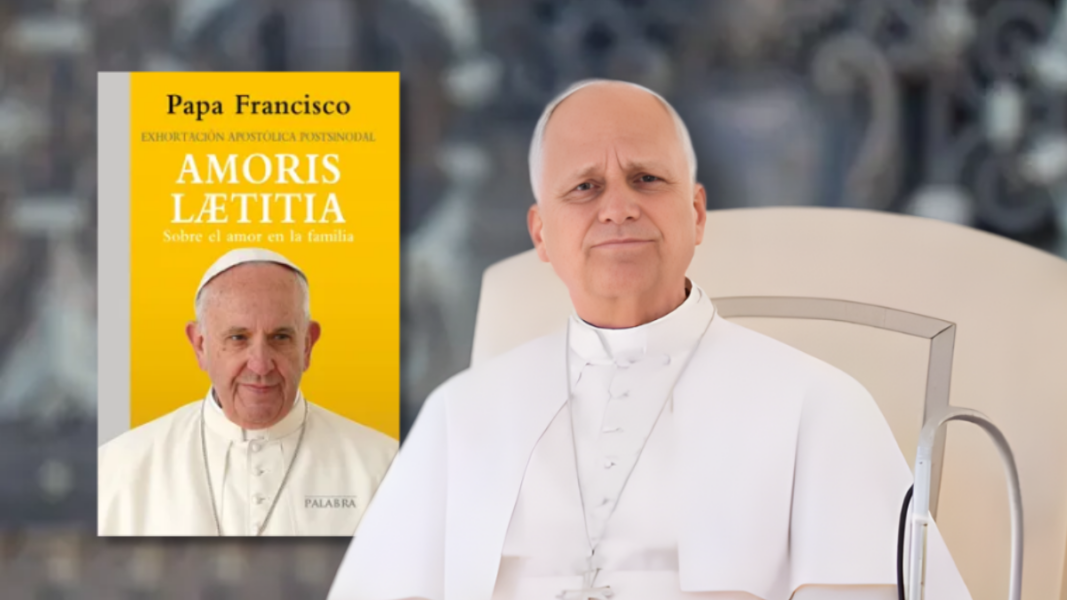
Pope Leo XIV has commemorated the tenth anniversary of the —controversial and debated— apostolic exhortation Amoris Laetitia by announcing the convening of a worldwide meeting of presidents of episcopal conferences in October 2026, with the aim of addressing family pastoral care in the current context. The initiative is framed within the continuity of the synodal process initiated during the pontificate of Francis and seeks to evaluate the steps to follow in the transmission of the Gospel of the family.
In his message, the Pontiff emphasizes the validity of Amoris Laetitia as a reference for pastoral action, highlighting the need to deepen accompaniment, discernment, and integration of family realities. Likewise, he insists on strengthening the role of the family as the “domestic Church” and on promoting a more intense experience of faith in the conjugal and family sphere, in a context marked by cultural and social transformations.
We leave below the complete message of Leo XIV:
Dear brothers and sisters:
On March 19, 2016, Pope Francis offered the universal Church a luminous message of hope on conjugal and family love: the apostolic exhortation Amoris laetitia, the fruit of three years of synodal discernment sustained by the Holy Year of Mercy. On this tenth anniversary, we wish to give thanks to the Lord for the impetus given to the study and pastoral conversion of the Church, and to ask him for the courage to continue the journey, always welcoming the Gospel anew, with the joy of being able to proclaim it to all.
As the Second Vatican Council teaches, the family is “the foundation of society,”[1] a gift from God and “school of the richest humanism.”[2] Through the sacrament of marriage, Christian spouses constitute a kind of “domestic Church,”[3] whose role is essential for education and the transmission of faith. Following the conciliar impetus, the two apostolic exhortations Familiaris consortio —published by St. John Paul II in 1981— and Amoris laetitia (AL) have stimulated the Church’s doctrinal and pastoral commitment in service to young people, spouses, and families.
Taking note of the “anthropological-cultural changes” (AL 32), which have intensified over the past thirty-five years, Pope Francis wished to commit the Church even more to the path of synodal discernment. His discourse, delivered during the XIV Ordinary General Assembly of the Synod of Bishops on the family, on October 17, 2015, invites “reciprocal listening” within the People of God, “all listening to the Holy Spirit, the ‘Spirit of truth’ (Jn 14:17), to know what He ‘says to the Churches’ (Rev 2:7).” And he specifies that it is not possible “to speak of the family without interrogating families, listening to their joys and hopes, their sorrows and anxieties.”[4]
Gathering the fruits of synodal discernment, Amoris laetitia offers valuable teaching that we must continue to deepen today: the biblical hope of God’s loving and merciful presence, which allows living “love stories” even when crossing “family crises” (cf. n. 8); the invitation to adopt “the gaze of Jesus” (cf. n. 60) and to ceaselessly stimulate “the growth, consolidation, and deepening of conjugal and family love” (n. 89); the call to discover that love in marriage “always gives life” (cf. n. 165) and that it is “real” precisely in its “limited and earthly” way (cf. n. 113), as the mystery of the Incarnation teaches us. Pope Francis affirms “the need to develop new pastoral paths” (n. 199) and to “strengthen the education of children” (cf. chap. VII), while inviting the Church to “accompany, discern, and integrate fragility” (cf. chap. VIII), overcoming a reductive conception of the norm, and to promote “the spirituality that springs from family life” (n. 313).
As I had the opportunity to say to the young people gathered at Tor Vergata during the Jubilee of Hope, “fragility […], is part of the wonder that we are.” We were not made “for a life where everything is firm and secure, but for an existence that is constantly regenerated in gift, in love.”[5] To fulfill the mission of proclaiming the Gospel of the family to the younger generations, we must learn to evoke the beauty of the vocation to marriage precisely in the recognition of its fragility, in order to awaken “confidence in grace” (AL 36) and the Christian desire for holiness. We must also support families, particularly those suffering so many forms of poverty and violence present in contemporary society.
We give thanks to the Lord for the families that, despite difficulties and challenges, live “the spirituality of family love […] made of thousands of real and concrete gestures” (n. 315). In this sense, I express my gratitude to pastors, pastoral agents, associations of the faithful, and ecclesial movements committed to family pastoral care.
Our time is marked by rapid transformations that, even more than ten years ago, make special pastoral attention to families necessary, to whom the Lord entrusts the task of participating in the Church’s mission to proclaim and bear witness to the Gospel.[6] In fact, there are places and circumstances in which the Church “can only become the salt of the earth”[7] through the lay faithful and, in particular, through families. For this reason, the Church’s commitment in this area must be renewed and deepened, so that those whom the Lord calls to marriage and family can live their conjugal love in Christ and the young may feel attracted by the intensity of the matrimonial vocation in the Church.
Recognizing the changes that continue to affect families, I have decided to convene in October 2026 the Presidents of the Episcopal Conferences from around the world, in order to proceed, in a climate of reciprocal listening, to a synodal discernment on the steps to take to proclaim the Gospel to today’s families, in the light of Amoris laetitia and taking into account what is being done in the local Churches.
I entrust this journey to the intercession of St. Joseph, Custodian of the Holy Family of Nazareth.
Vatican, March 19, 2026, solemnity of St. Joseph.
LEO PP. XIV
________________________________
[1] Second Vatican Ecumenical Council, Pastoral Constitution Gaudium et spes, 52.
[2] Ibid.
[3] Ibid., Dogmatic Constitution Lumen gentium, 11.
[4] Cf. Francis, Address on the Commemoration of the 50th Anniversary of the Institution of the Synod of Bishops (October 17, 2015).
[5] Homily at the Mass of the Jubilee of Youth (August 3, 2025).
[6] Cf. Apostolic Exhortation Familiaris consortio (November 22, 1981), 17.
[7] Second Vatican Ecumenical Council, Dogmatic Constitution Lumen gentium, 33.