


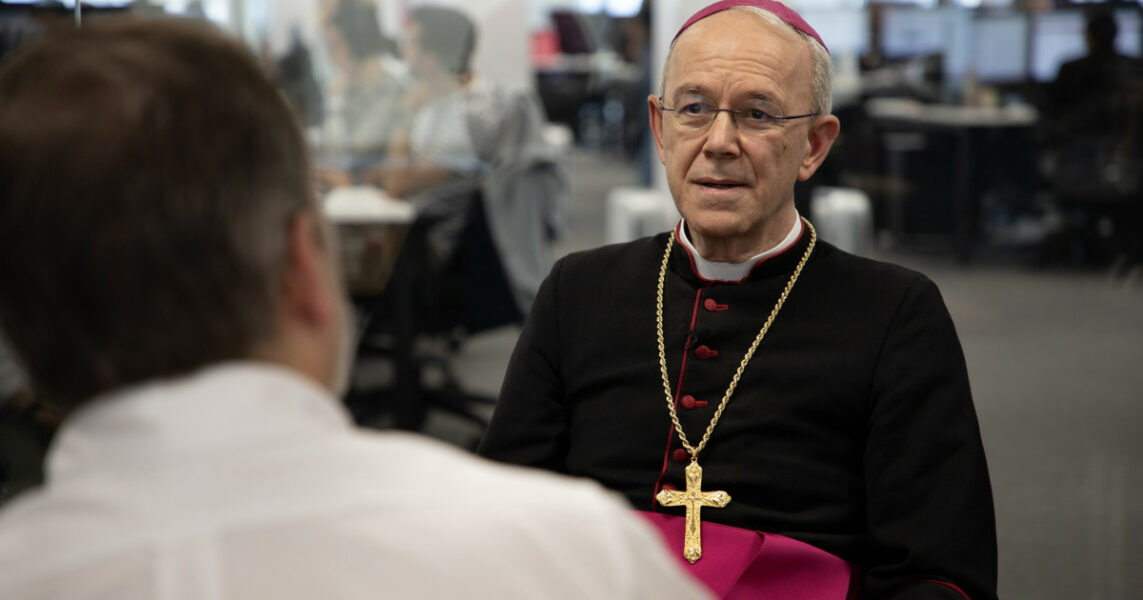
On the occasion of the presentation in Madrid of the new book by Monsignor Athanasius Schneider, Fleeing from Heresy. Catholic Guide to Ancient and Modern Errors, the auxiliary bishop of Astana has given a direct diagnosis of the current situation in the Church: a profound “doctrinal confusion” marked by relativism, naturalism, and religious syncretism.
Read also: Mons. Schneider celebrates the Traditional Mass in Murcia during his visit to Spain
In an interview granted to El Debate on the occasion of this event, Schneider expounds the main ideas of his work, in which he analyzes both historical heresies and their contemporary manifestations.
A Prolonged Doctrinal Crisis
Monsignor does not hesitate to affirm that the Church has been going through a situation of doctrinal ambiguity for decades. In his view, heresies are not a phenomenon of the past, but a present reality.
Schneider defines heresy in a broad sense as “a deviation from Catholic doctrine,” emphasizing that the faith cannot change because Christ is “the same yesterday, today, and forever.” In contrast, he recalls the testimony of the martyrs throughout history, who gave their lives to defend essential doctrinal truths, from the divinity of Christ to the uniqueness of salvation.
Relativism, the Root of the Problem
Among the current errors, the bishop places doctrinal relativism first, which he considers the root of the crisis. This approach holds that truth can change over time, an idea that, in the words of Mons. Schneider, is linked to modern philosophy and the rise of modernism.
As he explains in the interview, this approach would have penetrated the life of the Church for more than a century and has intensified in recent decades. Relativism, he warns, turns man into the judge of truth and breaks with the notion of an immutable doctrine.
The Return of Naturalism
The second error pointed out is naturalism, which Schneider identifies with a contemporary form of Pelagianism. This approach reduces Christian life to the merely human, minimizing the need for grace.
The bishop warns that this tendency manifests today in an excessive concern for temporal issues—such as climate or migrations—at the expense of the supernatural dimension. In his view, this imbalance puts at risk the authentic understanding of Christian salvation.
Syncretism and the Crisis of the Mission
In third place, Schneider denounces religious syncretism, a direct consequence of relativism. This vision holds that all religions would be equivalent paths to God, which, in his opinion, empties the Church’s evangelizing mission of content.
In the face of this drift, the bishop recalls Christ’s mandate to teach and baptize all nations, and cites as an example the missionary impulse of St. Francis Xavier.
Defense of the Society of St. Pius X
During the interview with El Debate, Mons. Schneider also addressed the situation of the Priestly Fraternity of St. Pius X (FSSPX), defending the need for an opening gesture on the part of Rome.
The bishop considers that this community maintains the doctrine, liturgy, and traditional formation of the Church without introducing novelties, and questions why it is not fully recognized while—according to him—problematic doctrinal positions are tolerated in other ecclesial spheres.
He also justified the Fraternity’s intention to consecrate new bishops without pontifical authorization, arguing that they seek to ensure their continuity in the face of the shortage of prelates favorable to the traditional liturgy.
Criticism of Vatican II and the Current Approach
Mons. Schneider also referred to the Second Vatican Council, noting that it was conceived as a pastoral and not dogmatic council. However, he criticized the current demand for full adherence to its approaches, even in aspects that, according to him, would not have a definitive character.
In this context, he denounced an apparent contradiction in the synodal discourse, which promotes inclusion but—in his view—does not apply it to traditional communities like the FSSPX.