


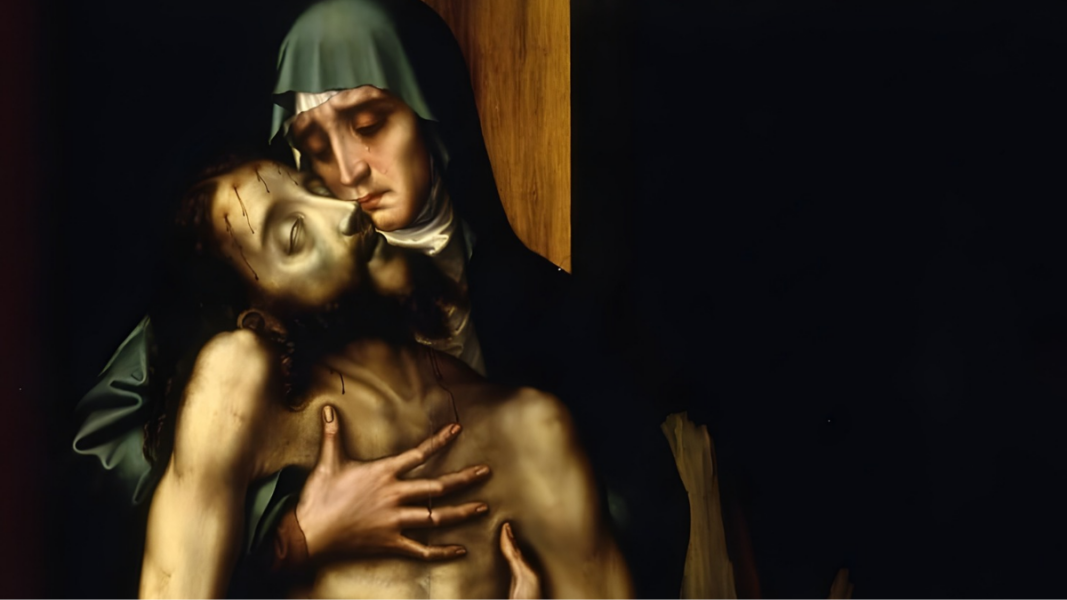
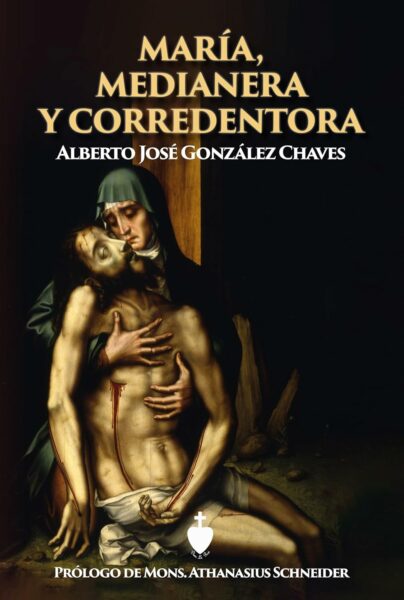
Barcelona will host the presentation of this work at the Hotel Catalonia (Rosselló street 249), next Saturday, March 21, when “spring returns to laugh”. The presence of its author, Monsignor Alberto José González Chaves, is eagerly awaited at an event that promises to be fruitful.
A book that is read… and savored
María Medianera y Corredentora is not only read and understood, but enjoyed and… prayed. Published by the young publishing house Páginas Contrarrevolucionarias, from the thriving Catalan movement Familia de San José, with the inexhaustible engine of Marcos Vera driving, among other things, the YouTube channel Tekton, this book arrives at a particularly opportune moment, when so many faithful seek clarity, depth, and beauty about the figure of the Virgin. Here there is neither superficial devotion nor easy controversy: there is substance, pulse, love. It is a book that thinks… and makes one think. Before starting, the reader receives a decisive key: «To You, Mary: my Mother, my Advocate, my Mediatrix, my Co-Redemptrix. THANK YOU!». It is not a formula, it is a confession. In those words is the entire tone of the book: gratitude, experiential filiation. It is not written by someone who analyzes a theme, but by someone who lives under the gaze of the Virgin.
Three sonnets that open the soul: the fiat that does not end
The book opens with a poetic proemium by the author where the spiritual drama of our time resonates: «Worse than denial is forgetfulness; more cruel is indifference than death». And also the response: a total love, without lukewarmness, without “half-wants”. Mary appears invoked with a fullness of titles that is, in reality, an experience: «my Mother and Companion… and my Queen, and my Lady, and my Mistress». And, above all, the great axis of the book emerges: «that thundering and majestic fiat» that “soaks the centuries”. Because the great merit of the work is this: not to reduce Mary’s mission to a moment, but to show it as a living continuity. The fiat of Nazareth was not an isolated instant, but the beginning of a total, sustained, and growing surrender. Mary is co-redemptrix because she said yes… and because she never stopped saying it. From the Annunciation to Calvary, yes; but also in the Resurrection, in Pentecost, and in the current life of the Church. Mary was not “mediatrix”: she is. She did not “collaborate” once: she continues to act. That golden thread runs through the book with luminous coherence.
A captivating journey: from the Bible to the saints
The 333 pages of the work unfold like a great fresco:
- Mary in Revelation: from Genesis to the Apocalypse
- The nascent Church and the Fathers
- The Middle Ages and the chisel of doctrine
- The Modern Age and great Mariology: Ligorio, Montfort…
- The 20th century and pontifical magisterium
- Vatican II and its developments
- Surprises, tensions, and current questions
- Liturgy, piety, and art
- Doctrinal synthesis
All of this leads to a particularly savory chapter: the testimony of the saints. Thirty major names parade here, among them: St. John of Ávila, St. Teresa, St. John of the Cross, St. Alonso de Orozco, St. Catherine Labouré, St. Gemma Galgani, St. Thérèse of Lisieux, St. John Henry Newman, the pastorinhos of Fatima, St. Maximilian Kolbe, St. Pedro Poveda, the Mexican Cristero martyrs, and the Spanish of the Crusade, St. Pio of Pietrelcina, St. Gianna Beretta, St. Teresa of Calcutta, St. Maravillas de Jesús, St. Josemaría Escrivá, St. Carlo Acutis… All witnesses to an intense experience of Marian mediation and co-redemption, they are not decorative quotes but historical evidence: the Church has always lived that truth with profound naturalness.
Prologue by Msgr. Schneider, and documentary solidity
In his beautiful prologue, Msgr. Athanasius Schneider states: «The Church contemplates the mystery of Mary as one who enters a silent sanctuary: with humility and love». From there, he recalls the teaching of Vatican II: Mary «cooperated with a maternal heart in the sacrifice of Christ», participating in a singular —but subordinate— way in the Lord’s unique mediation. And he summarizes with precision the core of the book: «the evangelical logic of the fiat and the stabat». Behind these pages there is serious and extensive study. In the 14 pages of bibliography appear weighty names: Bover, Royo Marín, Garrigou-Lagrange, Roschini, Laurentin, Gherardini, Hauke, Miravalle, among many others. But nothing overwhelms; everything is assimilated, turned into clarity. That is the difficult part. And here it is achieved.
A book that arrives at the right moment: return to Mary to breathe again
It is not surprising that it is selling very well, as it responds to the need to return to Mary without complexes, with foundation in science and love. It is not a book of trenches, but of the Church; it does not seek to stir, but to illuminate, recalling something essential: that Catholicism cannot be understood without Mary, because Her “yes” continues to sustain the world, Her motherhood continues to act, and Her presence does not distract from Christ: it leads to Him. Today more than ever, returning to Mary is not going backward… but returning to breathe pure air. That of the Immaculate. The Immaculate One. The Mediatrix and Co-Redemptrix.