


By Fr. Robert P. Imbelli
Whether fervent or intermittent, our Lenten journey advances toward its culmination. Of the many symbolic riches of the Paschal Triduum, perhaps none resonates so affectively as raising the Paschal Candle high in the darkened church. And the minister intones the ineffable mystery of salvation: «The Light of Christ!». While the joyful assembly responds with gratitude and wonder: «Thanks be to God!».
Less dramatic, though equally significant, are the words spoken just before the proclamation. As the celebrant lights the Paschal Candle, he prays: «May the light of Christ, rising in glory, dispel the darkness of our hearts and minds».
The light of Christ reveals not only our vocation to glory, but also, inseparably, our extreme need for salvation. Thus, St. Paul exhorts the Colossians to give thanks to the Father «who has rescued us from the power of darkness and transferred us to the kingdom of his beloved Son, in whom we have redemption, the forgiveness of sins» (Colossians 1:13-14). Only through Christ do we pass from the domain of darkness to the promise of transfiguring light.
For this reason, in the patristic tradition, baptism was also called phōtismos, since it signified the illumination of the new Christian by Christ. Therefore, it is fitting that, on this Sunday of the second scrutinies for the catechumens, the themes of light and vision permeate the readings. Paul, in his letter to the Ephesians, exclaims with joy: «Once you were darkness, but now you are light [phōs] in the Lord», thus revealing their new identity in Christ. But this is immediately followed by the imperative that governs this section of the letter: therefore, «Walk [peripateite] as children of light!» (Ephesians 5:8). Indeed, Paul exhorts the Ephesians: Be all that you are called to be! Fulfill your destiny in Christ.
In the seven verses of today’s second reading, the word «light» appears five times. It manifests itself in lives of «goodness, righteousness, and truth». And it shows a marked contrast not only with the «darkness» [skotos] of the believers’ former life, but also with the darkness of the surrounding culture.
The Letter to the Ephesians is notable for its emphasis on the continuous growth of the Christian community, the building up of the Body of Christ. «Living the truth in love, we should grow in every way into him who is the head, Christ» (Ephesians 4:15). The baptismal renunciation and conversion are both the conclusion of a process of enlightenment and the beginning of ever-renewed growth in the Lord. St. Gregory of Nyssa famously characterized the Christian life as a continuous dialectic of endings and new beginnings, where each end [telos] gives way to a new beginning [arche].
Hence the crucial importance of ongoing discernment: «trying to discern [dokimazontes] what is pleasing to the Lord» (5:10). The believer must carefully examine his own conduct, learning to clothe himself with the mind of Christ, without yielding to the false seductions of those who have «the understanding darkened and are alienated from the life of God» (4:18).
In many ways, the final chapters of Ephesians are an extensive commentary on what Paul had warned the Romans: «Do not conform yourselves to this age but be transformed by the renewal of your mind, that you may discern [dokimazein] what is the will of God, what is good and pleasing and perfect» (Romans 12:2). Such discernment fosters an ever-greater understanding of the Christian’s new life in Christ and what it entails in daily life.
Not only the newly baptized, but also those who have long been living the Christian life, are called to understand more fully the glorious vocation that Paul celebrates in the great blessing with which he begins his letter: «He chose us in him, before the foundation of the world, to be holy and without blemish before him» (Ephesians 1:4).
As sons and daughters of light, Christians present themselves as a «society of contrast», which will often require of them a countercultural commitment. Not only in first-century Rome and Ephesus, but in twenty-first-century Washington and New York, it is quite possible that they will need «to expose the works of darkness, for it is shameful even to mention the things done by them in secret» (5:11-12).
Doing so in a way that is not strident, but challenging, not random, but firm, requires spiritual maturity. Karl Barth famously called on Christians to meditate with the Bible in one hand and the day’s newspaper in the other. Today’s liturgy might well make that even more concrete: Reflect with Ephesians in one hand and the Epstein files in the other!
There were many who were scandalized by St. John Paul II’s diagnosis of our contemporary «culture of death». They considered it exaggerated, insufficiently dialogical. But how else to characterize the deadly confluence of greed, power, and sexuality exposed in Epstein’s sordid documents? They represent Dante’s three beasts raised to the maximum power. They offer an immersion not in a baptismal bath of enlightenment and regeneration, but in a demonic tub of darkness and death.
Those who will be initiated at the Easter Vigil will be called to renunciations that are neither anonymous nor pro forma. The darkness to which they renounce is palpable; the light of Christ they embrace, ever more luminous. Two «synodalities» will be presented to them: the way of death and darkness, and the way of light and life. And the holy Mother Church will implore them: Choose life!
Lately, the buzzword in ecclesiastical exhortations is to be «missionary disciples». All for the good, as long as we achieve a precise discernment of the darkness in which so many dwell and of the cruciform cost that such discipleship demands.
So, before establishing a new commission or issuing another study document, we might simply turn to the end of today’s reading from Ephesians. Paul reminds believers of the hymn they have sung together: «Awake, O sleeper, and arise from the dead, and Christ will give you light».
A simple and stirring hymn to accompany missionary disciples on their way. By singing it, suffering it, the early Christians patiently transformed a culture.
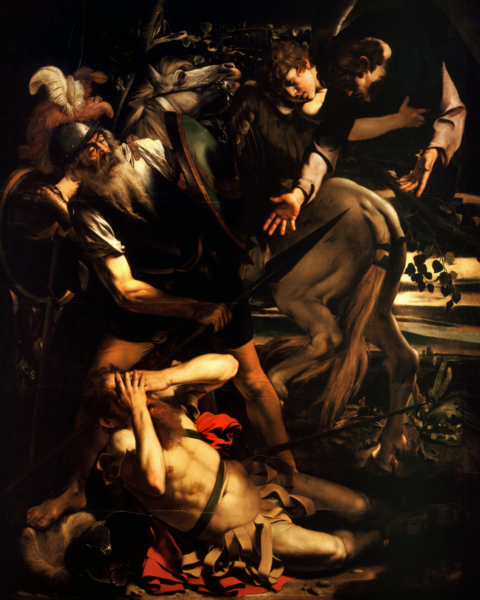
Note on the artwork: This is Caravaggio’s first version of the conversion of St. Paul. A more well-known version, «The Conversion of St. Paul on the Road to Damascus», is in Santa Maria del Popolo, in Rome. The one above is recommended for the resistance and opposition to the Light represented by the foaming steed and the soldier wielding the sword: lust and power on display.
About the author:
Father Robert Imbelli is a priest of the Archdiocese of New York. He is the author of Rekindling the Christic Imagination (Liturgical Press) and Christ Brings All Newness (Word on Fire Academic).