


By Fr. Thomas G. Weinandy
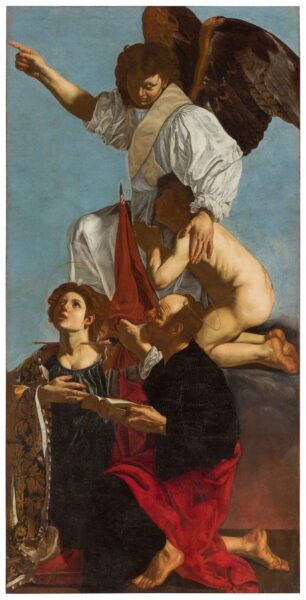
Like many people years ago, when I was a child, my brother and I, along with our father, always prayed in our «nighttime prayers» the traditional prayer to our guardian angels: «Angel of God, my dear guardian to whom God’s love commits me here, stay by my side this day (or night), to light and guard, to rule and guide. Amen».
I still ask my guardian angel at night when I go to bed and, in the morning, when I get up, to watch over and protect me. Additionally, before writing, I always ask my guardian angel to give me clarity of thought and expression and to whisper the right words in my ear. Sometimes, when I struggle to find the right word, he places exactly the precise term in my mind.
Prayers to one’s own guardian angel have a biblical foundation:
-
God instructs Moses, as the Israelites set out for the Promised Land: «Behold, I send an angel before you, to guard you on the way and to bring you to the place that I have prepared. Pay careful attention to him and obey his voice» (Exodus 23:20-21).
-
Psalm 91:11 states that there is no need to fear, «for he (God) will give his angels charge of you to guard you in all your ways».
-
Jesus himself states that we must not despise the little ones, «for I tell you that in heaven their angels always see the face of my Father who is in heaven» (Matthew 18:10).
-
In the Acts of the Apostles, when Peter escapes from prison and knocks on the door where the faithful were gathered, his brothers mistakenly think: «It is his angel!» (Acts 12:13-15).
Although most of us will never see our guardian angels, many saints have. Padre Pio frequently conversed with his guardian angel, who defended him from demonic attacks. Gemma Galgani was in daily contact with her guardian angel, who taught, protected, and corrected her. Sister Faustina Kowalska spoke of her guardian angel accompanying her on her travels. She also saw him when she was immersed in prayer, often asking him to pray for the dying.
The purpose of the previous examples is not to say that one has to be a «saint» to speak with one’s guardian angel or contemplate him. Rather, it is to illustrate that we too can converse with him and have the assurance of the protective and guiding presence of our guardian angel.
Furthermore, we must dispel the romantic and «tender» notion that guardian angels are only relevant for vulnerable children. Adults need their guardian angels just as much—perhaps even more—since their temptations and concerns are often of a more serious nature.
Our guardian angels are therefore present to strengthen, encourage, and guide us in fulfilling our respective vocations, whether in the single, married, religious, or priestly state. Dismissing them as something suitable only for what is childish puts us in danger.
The following question has been raised: after death, do our guardian angels stop being with us once we enter Heaven? Obviously, we no longer need to be protected. Do they then get «recycled» for someone newly conceived?
According to Catholic tradition, our guardian angels remain with us even in Heaven, and together we give praise and glory to the Most Holy Trinity: to the heavenly Father, who is the ultimate source of life; to the risen Jesus, the Father’s incarnate Son, who is our loving Savior and Lord; and to the Holy Spirit, who cleanses us from sin and makes us holy.
With all our brothers and sisters in Christ, along with our respective guardian angels, we will forever sing a glorious hymn of praise and thanksgiving.
Here we perceive the confluence of the earthly and heavenly liturgy. At the conclusion of the Preface in the Mass, the following is said, or something similar: «And so, with the Angels and all the Saints we declare your glory (that of the Father), as with one voice we acclaim: Holy, Holy, Holy is the Lord God of hosts. Heaven and earth are full of your glory».
With one single voice, our earthly human voices, the heavenly voices of the saints, and the host of angelic voices, all together declare that both Heaven and earth are full of God’s triple holiness.
Thus, by participating in the Mass, whether in a humble chapel or in the grandeur of a basilica or cathedral, the earth joins the heavenly angelic liturgy, and the heavenly angelic liturgy joins the earth.
The Mass, then, fulfills Isaiah’s heavenly vision: «I saw the Lord sitting upon a high and lofty throne, and the train of his robe filled the temple. Above him were seraphs… and they cried out to one another, saying: «Holy, holy, holy is the LORD of hosts; all the earth is full of his glory»» (Isaiah 6:1-3).
In the Mass, the earth is filled with the glory of God. Our churches are «crowded» with angels, and therefore, in unison with our guardian angels, we join the seraphim to sing this threefold holy proclamation of the Trinity’s holiness.
At the end of funeral Masses, just before leaving for the cemetery, the priest prays: «To you, Lord, we commend the soul of [name], your servant, in the sight of your saints and in the presence of your angels. May the angels lead you to paradise; may the martyrs come to welcome you and lead you to the holy city, the new and eternal Jerusalem».
Our guardian angel will be among the saints and angels who will lead us (as we hope) to the new and eternal heavenly Jerusalem, rejoicing in knowing that he has fulfilled the task God entrusted to him: to guard and guide us to paradise.
About the author:
Thomas G. Weinandy, OFM, a prolific writer and one of the most prominent living theologians, is a former member of the Vatican’s International Theological Commission. His most recent book is the third volume of Jesus Becoming Jesus: A Theological Interpretation of the Gospel of John: The Book of Glory and the Passion and Resurrection Narratives.