


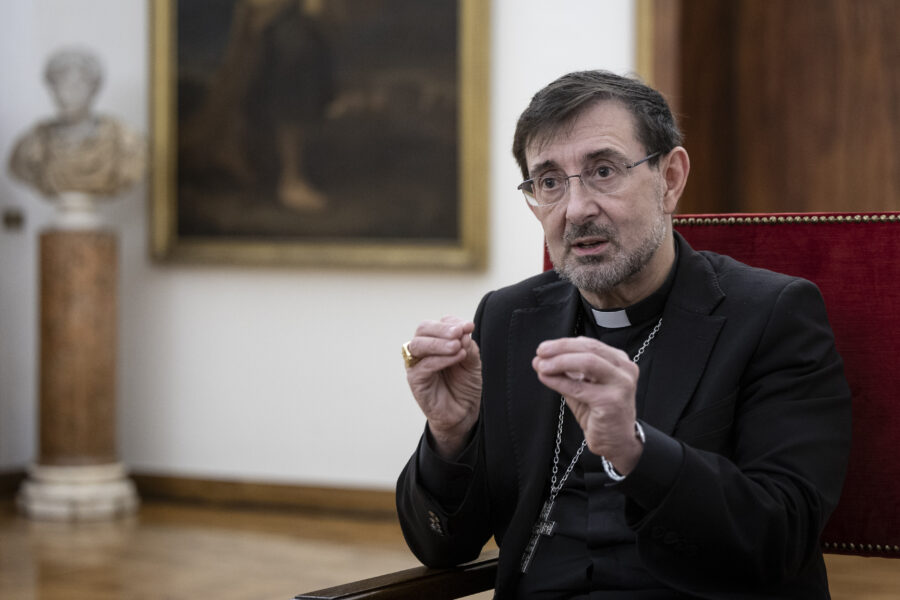
When clarity becomes a pastoral duty in the face of the growing unease of priests and faithful.
In recent days, Cardinal José Cobo has sent to the pastors and rectors of churches and temples in the Archdiocese of Madrid a surprising and unusual informative note titled «Clarification from the Archdiocese Regarding Various Disseminated Information». The document has been sent to the diocesan clergy at a time when unease is growing among numerous faithful regarding the information that has appeared in various media about the role played by the cardinal himself in the process of resignification of the Valley of the Fallen. In that note, it is stated that such information would not be conclusive, would contain partial interpretations, and would include statements that do not faithfully reflect reality or the framework in which the Church would be addressing this issue.
The text further adds that, in the current digital context, personal assessments or incomplete approaches circulate that are disseminated as if they constituted a definitive truth. For this reason, it exhorts the priests of the diocese to welcome and transmit only verified information from the Church’s official channels, in order to avoid confusions or distortions in the understanding of a certainly complex issue.
The concern for truth and pastoral prudence is, without a doubt, legitimate and necessary. But precisely because of that same love for truth, the note from the Archdiocese inevitably raises some very concrete questions that deserve a clear response. Because what various media have published in recent days are not mere opinions or simple speculations. What has been made public is the existence of a document signed on March 4, 2025, between the Minister of the Presidency, Félix Bolaños, and Cardinal Cobo, a document that the Government itself is using to justify its ideological intervention inside the monumental complex of the Valley of Cuelgamuros.
Therefore, it is not a matter of rumors or more or less interested interpretations. It is a matter of facts whose clarification is indispensable to avoid growing confusion among priests and faithful. And when what is at stake is the very nature of a consecrated temple, questions are not a problem: they are part of the duty to seek the truth. In reality, when the Church faces situations that affect the nature of its temples and the conscience of the faithful, clarity is not only convenient: it is a moral exigency.
If the disseminated information does not faithfully reflect reality—as the Archdiocese claims—it would suffice to respond clearly to some very simple questions.
Therefore, respectfully, the following questions could be posed to Cardinal Cobo:
First: Did Cardinal Cobo sign, on March 4, 2025, a document with the Minister of the Presidency of the Spanish Government regarding the ideological resignification of the Valley of the Fallen, published by El Debate?
Second: If so, what was the exact content of that document and what legal or pastoral scope was it intended to have?
Third: With what authority did Cardinal Cobo act when signing that document? Did he do so on behalf of the Archdiocese of Madrid, on behalf of the Spanish Church, or with some express authorization from the Holy See?
Fourth: Was the Holy Father previously informed of the signing of said document? And, if so, was there any type of approval or mandate to proceed with said signing?
Fifth: Is it true that in said document the area of the basilica reserved for worship—the altar and the adjacent pews—is restricted, and the rest of the temple’s interior and its access are opened to museographic, artistic, or exhibition interventions of a political and ideological nature?
Sixth: If so, how is that provision reconciled with the inviolability of temples recognized by the Agreements between the Holy See and the Spanish State, with the Organic Law on Religious Freedom, and with Canon Law itself?
Seventh: Does Cardinal Cobo consider that a pontifical basilica dedicated as “any sacred place” can house within it a project of political and ideological resignification without affecting its nature as a sacred place? Have the words of Leo XIV on sacred places, from the door to the altar, contained in the letter addressed to the priests gathered at the recent Convivium organized by the Archdiocese of Madrid, been taken into account?
Eighth: Was the Benedictine community that inhabits the Valley monastery formally consulted before the signing of that document and regarding the interventions of an ideological nature in the access and interior of the basilica?
Ninth: If the signed document does not have the scope that various media attribute to it, why not make it public in its entirety to avoid any partial or interested interpretation?
Tenth: Some priests privately express that Cardinal Cobo now excuses the signing of that document by alleging that he thus managed to overcome the supposed and unprecedented threat from the Government to expel the monks. Is there any document signed with Minister Bolaños guaranteeing that he would not carry out his threat, if the monks accept the profanation of the pontifical basilica they custody?
These questions are not the fruit of any artificial controversy. They simply respond to the growing unease and scandal that this situation is provoking among the clergy and an ever-increasing number of faithful. Beyond the media debate, the fact is that the lack of clarity about what happened is generating growing bewilderment among numerous Catholics, who cannot understand how a Catholic temple—and moreover a pontifical basilica—can be involved in a process of ideological resignification without there being a transparent explanation from those who have the responsibility to safeguard its sacred character.
In the tradition of the Church, scandal does not arise from questions when they are formulated with respect and right intention. Scandal arises when legitimate questions go unanswered. That is why these issues do not seek to fuel any confrontation, but quite the opposite: to help dispel a situation that is causing perplexity, pain, and scandal among many faithful.
When the sacred nature of a temple, religious freedom, and the relationship between the Church and political power are at stake, what is truly pastoral is not to ask for prudence regarding information, but to offer clarity about the facts. Because, in the end, when priests and faithful are invited to welcome only verified information from the Church’s official channels, the most direct way to do so is precisely that: to put the documents on the table and explain with transparency what happened.
Cardinal Cobo already attempted to offer some explanation in an off-the-record appearance before previously selected media, excluding others. However, that appearance—leaked shortly afterward and published by Infovaticana—not only did not contribute to clarifying the situation, but increased confusion and scandal even more. It suffices to take a look at its transcript.
The Church has never feared the truth. What truly causes confusion is not the light, but the lack of it. And when what is at stake is a consecrated temple, the issue is no longer media or political: it is a matter of truth, pastoral responsibility, and fidelity to what the Church has always considered inviolable. Because when the Church asks for prudence from the faithful, the first thing they expect from their pastors is not silence, but truth; and when the truth is in a document, the simplest—and also the most honest—thing is to show it.
And if, when the time comes, the document signed between Cardinal Cobo and Minister Bolaños turns out to be effectively authentic and it is not possible to offer satisfactory responses to the legitimate questions it raises, the spiritual tradition of the Church has always pointed out what the most fruitful path is: to recognize with humility what may have been done without fully measuring its consequences and to work serenely to correct what has caused bewilderment and scandal among the faithful. To rectify when necessary does not weaken pastoral authority; on the contrary, it strengthens it.
Because when the nature of a consecrated temple and the trust of the faithful are at stake, true pastoral charity does not consist in prolonging the confusion, but in restoring the clarity that the life of the Church always needs. And that clarity—which the faithful undoubtedly desire, the monks who custody the Valley, and the Church as a whole—can only be born from truth spoken with simplicity. Because, in the life of the Church, truth has never been a problem: the problem has always been silence when truth is necessary.