


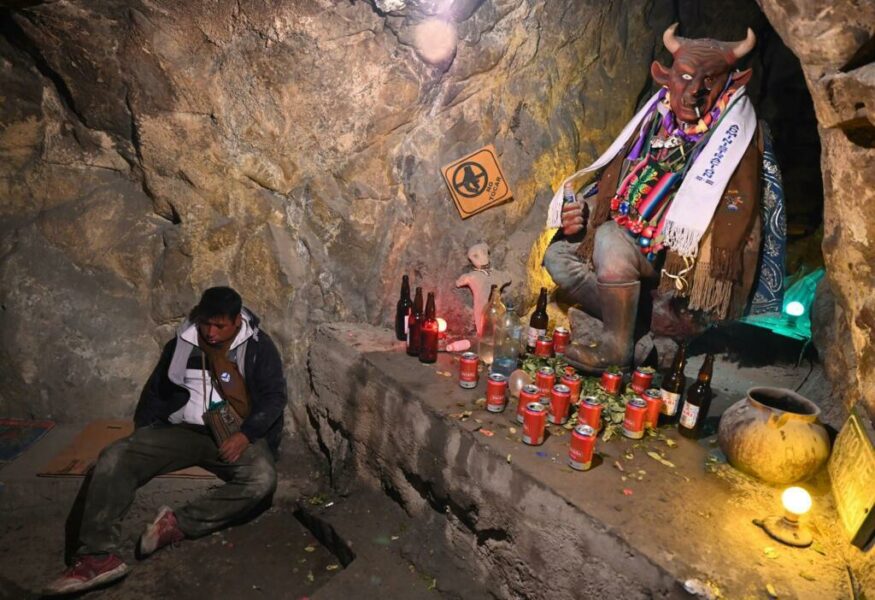
For years, from ideological, media, and even ecclesiastical environments, attempts have been made to present the worship of Pachamama as a mere folkloric expression, a harmless spirituality linked to nature, or a poetic form of indigenous religiosity. But the reality, when examined without propaganda and without moral cowardice, is much more sinister. In the 21st century, cases, testimonies, and journalistic investigations continue to emerge in Bolivia that link this cult to real human sacrifices. These are not colonial legends or apologetic exaggerations. These are facts published by media outlets, gathered by identified journalists, and backed, in some cases, by judicial proceedings.
The most brutal case was reported by journalist Ariel Melgar Cabrera in El Deber. In his report, published on March 15, 2024, he explains how the justice system in La Paz sentenced two men for the disappearance of Shirley H. R. A., a 25-year-old young mother whose disappearance dated back to 2021. According to the Prosecutor’s Office and the police investigation, the woman was deceived, drugged, transported unconscious, and buried in a mine in the Palca municipality as a offering to Pachamama. We are not dealing with a biased interpretation or a symbolic reading of an ancestral rite. The accusatory thesis adopted by the Bolivian justice system was exactly that: the victim was offered as a sacrifice.
The gravity of the case shatters at once all the sentimental rhetoric with which some try to wrap these cults. The victim was a young woman, mother of two children, and was turned into a ritual object to obtain supposed favors from the earth. There is no “ancestral wisdom” to admire here, nor “spirituality of the peoples” to romanticize, nor “intercultural dialogue” with which to whitewash the horror. There is a sacrificial, bloodthirsty, and deeply anti-Christian logic. There is a divinization of the earth that demands blood. And there are men willing to give it to her.
The most disturbing thing is that it is not an isolated case. The newspaper La Prensa, in a report signed by journalist Carmen Challapa, published an article with an unequivocal title: “Human sacrifices, a practice that persists in the country”. The text includes the testimony of a yatiri, that is, an Andean ritual specialist, who openly states that human offerings are still being made, especially in constructions and mines. His explanation leaves no room for ambiguity: the victim is plied with alcohol until losing consciousness, the corresponding ritual is performed, and then she is buried. This is not a denunciation made from outside by cultural enemies of the Andean world. It is an internal description of the procedure.
That same article also includes the words of historian Sayuri Loza, who explains that these sacrifices respond to the belief that the soul of the sacrificed must remain in the place to protect it. It is a religious vision in which the human person ceases to be an image of God and becomes usable material to stabilize a work, guard a mine, or attract prosperity. It is a radical degradation of human dignity. Man ceases to be an end and becomes an instrument. And when innocent blood is incorporated into the rite, the phenomenon ceases to be simply pagan and shows an unequivocally demonic dimension.
Also Telemundo, in a piece broadcast by Al Rojo Vivo on November 8, 2023, reported that the Bolivian prosecutor’s office was investigating alleged human sacrifices in a mine. The network spoke of the discovery of bodies in contexts related to mining operations and the suspicion that the victims had been offered to the so-called Tío of the mine, an infernal figure associated with mining cults in Bolivia. Once again, the same pattern appears: blood, mine, offering, religious superstition, and a dark spiritual background that has nothing innocent about it.
At this point, continuing to say that Pachamama is merely a respectable cultural symbol or a neutral expression of popular religiosity is not ignorance: it is a deliberate falsification of reality. The facts published by El Deber, La Prensa, and Telemundo force us to call things by their name.
And from a Catholic perspective, the judgment cannot be ambiguous. Any cult that demands human blood, any rite that seeks favors through immolations, any spirituality that replaces God with divinized earth and turns man into a propitiatory victim belongs to the realm of the idolatr ous and, in its extreme form, of the demonic. There are no “bridges” to build with a spirituality that degrades man until turning him into offering material.
The question is no longer whether these practices can be reinterpreted symbolically in academic congresses or in well-meaning ecclesiastical discourses. The question is that concrete examples continue to exist, investigations continue to emerge, testimonies continue to arise, and Bolivian media have documented that human sacrifices associated with this religious universe are not mere cultural archaeology.