


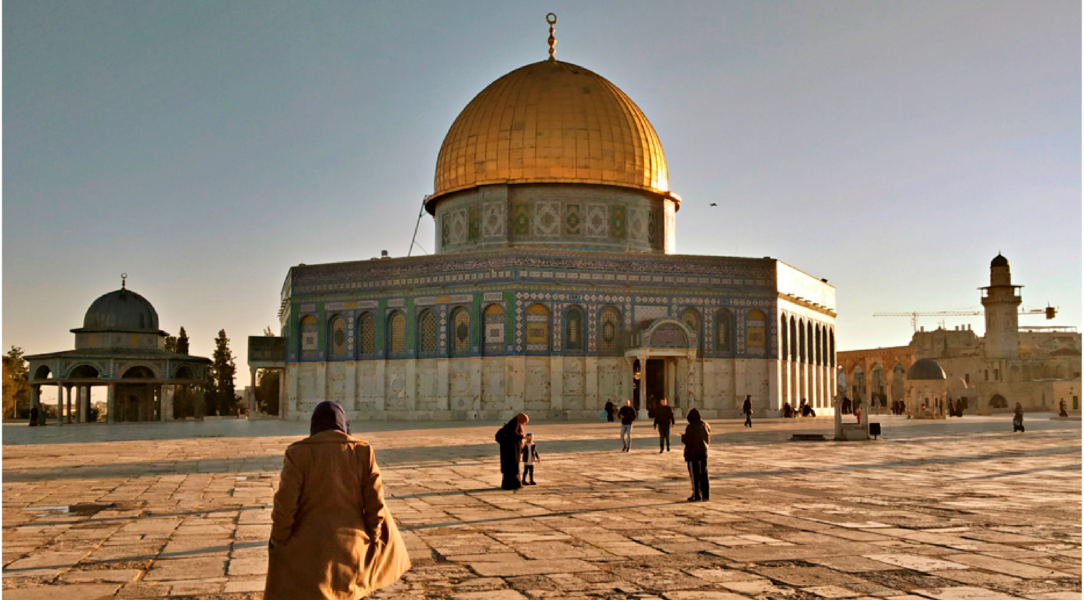
The Vatican has launched a new appeal to the entire Church to support the Collection for the Holy Land on Good Friday, at a particularly dramatic moment for Christians in the region, who are battered by war, economic crisis, emigration, and the collapse of pilgrimages. In a letter from the prefect of the Dicastery for the Eastern Churches, Cardinal Claudio Gugerotti, he asks bishops and faithful not to reduce this aid to a symbolic gesture, but to understand it as concrete support so that Christian communities can continue living in the holy places.
Gugerotti calls for moving from words to real aid
The initiative has been officially presented by the Holy See and is rooted in the Popes’ desire to maintain an effective bond between Christians worldwide and the Holy Places. According to the documentation released by the Vatican, this collection is traditionally held on Good Friday and aims to directly help people and ecclesial life in the Holy Land. Saint Paul VI gave decisive impetus to this work with the apostolic exhortation Nobis in Animo in 1974.
Gugerotti paints a bleak picture. He states that, despite announcements of dialogue and supposed peace agreements, the weapons have not fallen silent, the population continues to die, the lands remain in dispute, and Christians are pushed to emigrate to save their lives. The prefect also emphasizes that in some places even schools cannot function normally because teachers cannot pass checkpoints. His message is clear: prayer remains necessary, but real economic aid is needed to allow communities to survive one more day and preserve a minimum hope of starting over.
The prefect insists that the collection is not an optional alms or a pious gesture without consequences. He presents it as an act of Christian conversion and ecclesial responsibility in the face of a land devastated by violence. In that vein, he exhorts pastors to awaken the consciences of the faithful and remind them that a Holy Land without Christians would be a spiritually disfigured land, because the living memory of the places where the history of salvation unfolded would be lost.
War and the collapse of pilgrimages worsen the crisis
The Vatican’s appeal is also supported by data provided by the Custody of the Holy Land and the Dicastery for the Eastern Churches itself. Both bodies agree that ongoing conflicts, especially in Gaza and other areas of the Middle East, have aggravated the poverty of Christian families and left many of them without sustenance. Added to this is the near-total drop in religious tourism, which for years has been the basic source of income for thousands of families linked to welcoming pilgrims.
The economic report released by the Custody explains that, two years after the start of the war that is once again punishing the region, income from parishes, shrines, pilgrims, and other local activities has been drastically reduced. As a result, numerous projects have had to be scaled back, slowed down, or suspended, giving priority to those that directly affect the most needy people. This situation not only strikes families but also the ecclesial, educational, and welfare fabric that allows Christians to remain in their own land.
What the Good Friday collection is used for
Ordinarily, 65 % of the funds raised go to the Custody of the Holy Land, while the remaining 35 % is managed by the Dicastery for the Eastern Churches, which distributes it according to the needs of the Churches in the region. This distribution finances the conservation of shrines, the maintenance of pastoral, educational, health, and social structures, as well as direct aid to dioceses, eparchies, seminaries, and religious institutions.
The Custody supports schools, housing, shrines, and social works
The Custody of the Holy Land’s report, corresponding to the 2024/2025 cycle, allows for a more detailed view of the concrete destination of the aid. The Franciscan work has sustained the conservation of the holy places for centuries, but it also maintains an extensive network of schools, apartments for needy families, parish centers, university scholarships, dispensaries, cultural initiatives, and emergency projects in various Middle Eastern countries.
Among the interventions described are works in shrines and basilicas of enormous importance to Christianity, such as the Holy Sepulcher, Gethsemane, Bethlehem, Nazareth, Capernaum, Mount Tabor, or Ain Karem. In addition, the Custody finances improvements in educational centers, helps with school tuition payments, maintains housing with symbolic rents for young married couples and poor families, and collaborates with hospitals, centers for the disabled, nursing homes, and psychological support projects for children and adolescents affected by the war.
The report also highlights a revealing fact: the Custody has nearly 1,500 employees, of whom around 1,000 work in works and schools located in Israel and the Palestinian territories. The continuity of this network depends to a large extent on the Good Friday collection and other support campaigns, precisely in a context where the war has reduced income and even made it difficult to obtain work permits for many Palestinian employees.
The Vatican warns of the risk of a Holy Land without Christians
Beyond the economic aspect, the Holy See’s appeal has a marked ecclesial content. Gugerotti insists that it is not just about preserving stones and monuments, but about preventing the “living stones,” that is, the Christian communities that still inhabit the land of Jesus, from disappearing. In that line, he recalls words from Leo XIV in which the Pope thanked the Christians of the Middle East for their perseverance and demanded that they be given the real, not just rhetorical, possibility of remaining in their lands with security and all their rights.
The prefect states that wounding the Church in its most vulnerable members is also a form of sacrilege. For this reason, he asks bishops to make this call resound in their dioceses, adapt the message to the sensitivity of their faithful, and explain to them that collaborating with the collection is a concrete way to sustain the Body of Christ where it suffers most harshly today. His approach is blunt: if a choice must be made, the Christian does not take life from the other, but gives life for the other.