


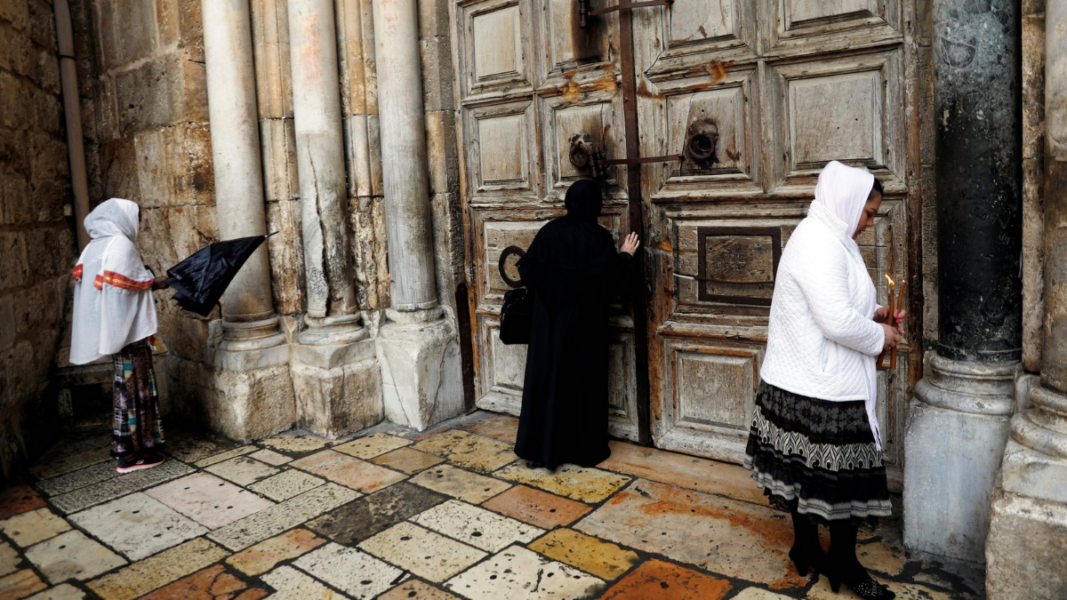
The Holy Sepulchre in Jerusalem has remained closed since February 28 due to the climate of insecurity caused by the conflict in the Middle East, an unprecedented situation due to its duration that prevents the celebration of masses and liturgies in the place where Christian tradition places the crucifixion and resurrection of Christ.
An unusual closure of the holiest place in Christianity
According to Vatican News, the large two-leaf gate that has protected the entrance to the Holy Sepulchre for centuries had never remained closed for such a continuous period of time.
Throughout history, wars, tensions, or even the pandemic limited access to the sanctuary, but they had never prevented liturgical celebrations in this central place of Christian faith for weeks.
The situation also coincides with the Lenten season, a period of spiritual preparation leading to Holy Week, which is traditionally experienced in Jerusalem by walking the Via Dolorosa, the path that recalls the Passion of Jesus Christ up to Golgotha.
However, since the end of February, the doors of the temple have remained closed, and the celebration of rites that are part of a millennial tradition is not permitted.
The celebrations of the Paschal Triduum in doubt
The prolongation of this situation raises fears that the celebrations of the Paschal Triduum, the central moment of the Christian liturgical calendar, may be affected.
Ecclesiastical authorities in the Holy Land have intensified their efforts with Israeli authorities to obtain at least permission to celebrate Holy Week inside the sanctuary that houses Golgotha and the empty tomb of Christ.
The local Church insists on the importance of maintaining the Christian presence in what is considered the Mother Church of all Churches, also recalling the words of St. John Paul II at the beginning of his pontificate: “Do not be afraid. Open wide, even more, open wide the doors to Christ”.
Not even during the pandemic or in other particularly difficult historical moments had the celebration of Sunday Lenten masses in the Holy Sepulchre been prevented, even if with restrictions.
The conflict raises “invisible walls”
The climate of violence in the region has generated, as described in the reflection published by Vatican News, a deep distrust and fear among communities.
The constant pressure of insecurity raises “invisible walls” between people, fueled by fear of the other and by the violence that continues to mark daily life in the Middle East.
The sky of the region continues to be crossed by missiles, drones, and attacks that do not distinguish between peoples or religions and that destroy lives, history, and nature.
A call to open “the doors of the heart”
In the face of this situation, the Church once again insists on the need to work for peace. During the Angelus of the fourth Sunday of Lent, Pope Leo XIV firmly called for a ceasefire, expressing pain for the suffering that continues to strike the region.
The Pontiff also invited Christians to “open their eyes” and to live a faith that does not remain indifferent to the suffering of their neighbor.
From the Holy Land, it is insisted that, although the conflict raises seemingly insurmountable barriers, Christians are called to tear down those walls through truth, hope, and love for their neighbor.