


In a text disseminated on his Substack, he reveals that the meeting was organized by the far-left journalist Pedro Salinas, who was key in the liquidation of the Sodalicio de Vida Cristiana, at the request of León XIV himself.
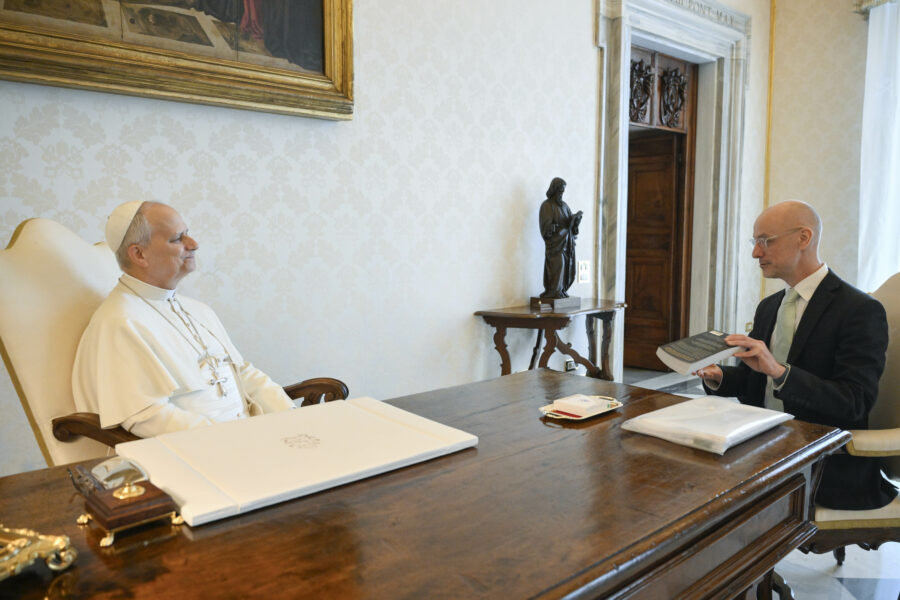
British journalist Gareth Gore has revealed that he was received in a private audience by Pope León XIV on March 16 at the Apostolic Palace, in a meeting where he directly presented the Pontiff with various accusations and testimonies related to alleged abuses within Opus Dei.
Gore recounted the episode in a text published today, where he explains that the meeting was arranged after Peruvian journalist Pedro Salinas—known for his investigations into abuses within the Church in Peru—sent him a message asking him to get in touch. According to Gore, Salinas informed him that the then Cardinal Robert Prevost, now Pope León XIV, was aware of his journalistic work on Opus Dei and was interested in speaking with him in a private audience.
After several exchanges of messages with a Vatican intermediary in charge of organizing the meeting, communication was interrupted for a few days, leading the journalist to think that the meeting might have been blocked within the Holy See. Finally, two weeks later, he received official confirmation through an invitation from the Prefecture of the Papal Household.
Gore explains that he arrived in Rome from London the night before the meeting. On the morning of March 16, he presented himself to the Swiss Guard at the main entrance of the Apostolic Palace, where he showed his invitation and passport. He was then led through several rooms of the palace to the private library, where the Pope posed for some photographs with him and congratulated him on his book, which he described as a “rigorous work.” Subsequently, both sat down for a private conversation.
The journalist acknowledges that in recent years he has been very critical of the way the Church has handled abuse allegations related to Opus Dei. In his text, he maintains that the organization has been accused of various abuses, including child abuse, exploitation of young people, psychological manipulation of its members, and violations of the seal of confession through the misuse of spiritual direction.
Gore states that during the meeting he explained to the Pope how, according to the testimonies he has gathered, Opus Dei would recruit young people from very early ages—in some cases from ten or eleven years old—and lead them toward lifelong commitments within the institution. He points out that he also handed over documents and testimonies that would describe practices of control over members and the misuse of spiritual direction to obtain personal information.
Among the issues he claims to have discussed is also the existence of a psychiatric center in northern Spain, known among Opus Dei members as “the fourth floor,” where—according to his account—some members would have been sent to treat mental health problems. Gore claims to have mentioned testimonies about the use of medications to address these situations and cases of suicide within the organization’s environment.
He also states that he spoke with the Pope about the open case in Argentina in which Opus Dei has been formally accused of human trafficking. As he explains, he handed the Pontiff a copy of the report prepared by the Argentine prosecutor’s office after a two-year investigation into the group’s practices. In his account, he maintains that similar accusations have also arisen in other countries such as Ireland, France, Mexico, and Spain.
Gore also claimed to have informed the Pope of what he describes as attempts by Opus Dei to discredit his journalistic work. According to his version, the organization would have tried to pressure him and his editor to prevent the publication of his book and would have promoted smear campaigns against his work.
The journalist notes that he concluded the meeting by asking Pope León XIV to order an independent investigation into Opus Dei that examines possible spiritual, psychological, physical, and financial abuses. He also claims to have requested that the possibility of dissolving the organization be studied if the evidence warrants it.
Gore adds that during the meeting he also asked for the beatification and canonization process of Saint Josemaría Escrivá, founder of Opus Dei, to be reopened, alleging that new information has emerged about the internal functioning of the institution.
The journalist concludes his account by stating that he left the Vatican after the meeting with the hope that the Pope will listen to the victims who have reported abuses related to the organization and take decisions accordingly. As he writes, he believes that the way in which León XIV addresses this issue could significantly mark his pontificate.