


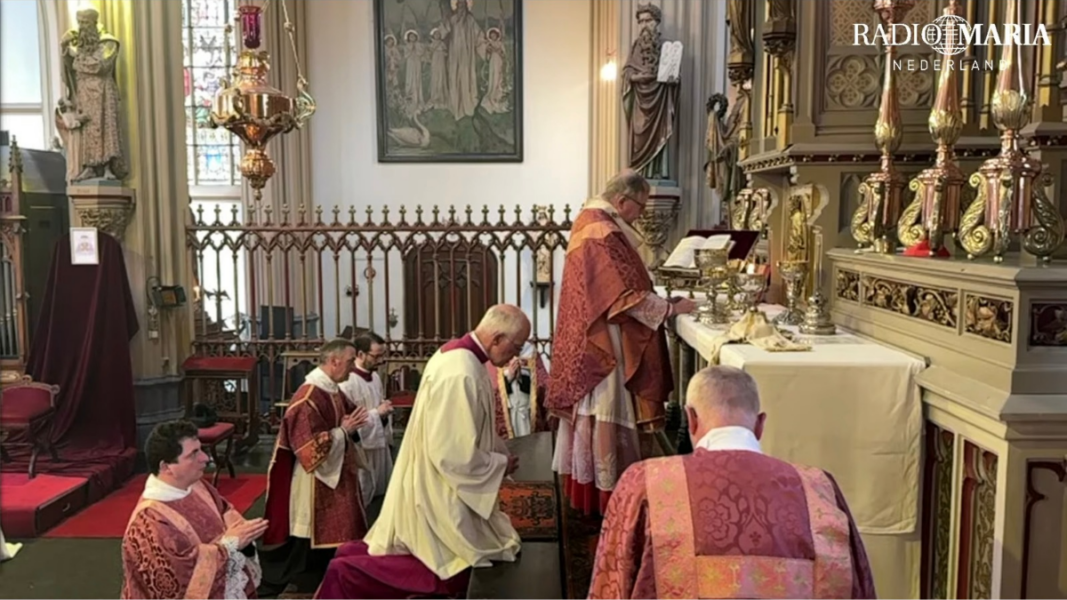
Cardinal Willem Eijk, Archbishop of Utrecht, celebrated this Sunday, March 15, a Pontifical Mass in the traditional Roman rite in the Church of the Immaculate Conception of Oss, in the Netherlands. The celebration, announced weeks earlier, has drawn attention both within and outside the country as it is the first time the cardinal publicly presides over a solemn liturgy according to the vetus ordo in Dutch territory.
The Mass took place on the occasion of Laetare Sunday and was organized by the community that regularly celebrates the traditional liturgy in that parish of the Diocese of Den Bosch.
A Solemn Pontifical Mass on Laetare Sunday
The celebration began at 12:30 in the Grote Kerk of Oss and was presided over by Cardinal Eijk as the principal celebrant. He was assisted by several priests and deacons from the local clergy, including the parish priest Pieter Zimmermann as the assistant priest and Deacon Edwin Veldman.
As is customary in a traditional Pontifical Mass, the liturgy included the rites proper to the episcopate, such as the presence of a liturgical throne for the celebrant, the participation of assisting deacons, and the use of vestments proper to the cardinal’s rank. The celebration was sung and followed the usual scheme of the Roman rite prior to the liturgical reform following the Second Vatican Council.
In addition, the Holy Mass was broadcast by Radio María of the Netherlands.
Debate on the Application of Liturgical Norms
The celebration provoked criticism in some Dutch media. An article published in the Dutch press questioned the legitimacy of the Mass by considering that it could conflict with the provisions of the motu proprio Traditionis custodes and that it could be interpreted as a challenge to Rome.
In response to these criticisms, the Bishop of Den Bosch, Gerard de Korte, has defended the continuity of these celebrations by appealing to what he defined as “pastoral wisdom”.
The prelate explained that in his diocese there is a small group of faithful who regularly participate in the traditional liturgy and that maintaining contact with them is part of the pastoral care of the local Church.
In this context, the presence of Cardinal Eijk as celebrant is a gesture of closeness toward these faithful and a signal within the liturgical debate that continues to be present in the Church.