


“Throughout their wanderings—especially the early ones—they carried on their shoulders the fate of the world in that wooden tabernacle that contained perhaps a faceless symbol and that certainly enclosed an invisible God (…) That God dwelt in a land of monsters. We will have occasion to consider carefully what monsters they were: Moloch, Dagon, and Tanit, the terrible goddess. If the divinity of Israel had ever been embodied in an image, it would have been a phallic image. To give Him a body would have meant falling into the worst elements of mythology, into all the polygamy of polytheism: the vision of the harem in the sky (…). It is often said with contempt that the God of Israel was nothing more than a Warrior God, ‘a mere barbaric Lord of Hosts.’ But the world must be grateful that He was a Warrior God. We must be grateful that He was, to the rest, nothing but a rival and an enemy. Had things followed their natural course, it would have been very easy for them to strike up a disastrous friendship with Him. It would not have been difficult to see Him stretching out His hands in a gesture of love and reconciliation to Baal, or kissing the painted face of Astarte while sitting in pleasant camaraderie with the gods (…). And His worshipers would easily have followed the enlightened slope of syncretism and the amalgamation of all pagan traditions. The followers of this Warrior God, certainly, were always slipping down that comfortable slope, and this obliged certain inspired demagogues to employ almost demonic energy in defense of divine unity, with words that still resound with the force of the wind of inspiration or of ruin. Truly, the more we understand the ancient conditions that contributed to the final culture of the Faith, the greater will be our reverence for the greatness of the prophets of Israel”.
(G. K. Chesterton. “The Everlasting Man” (Ed. Cristiandad, Pp. 128-129).
I
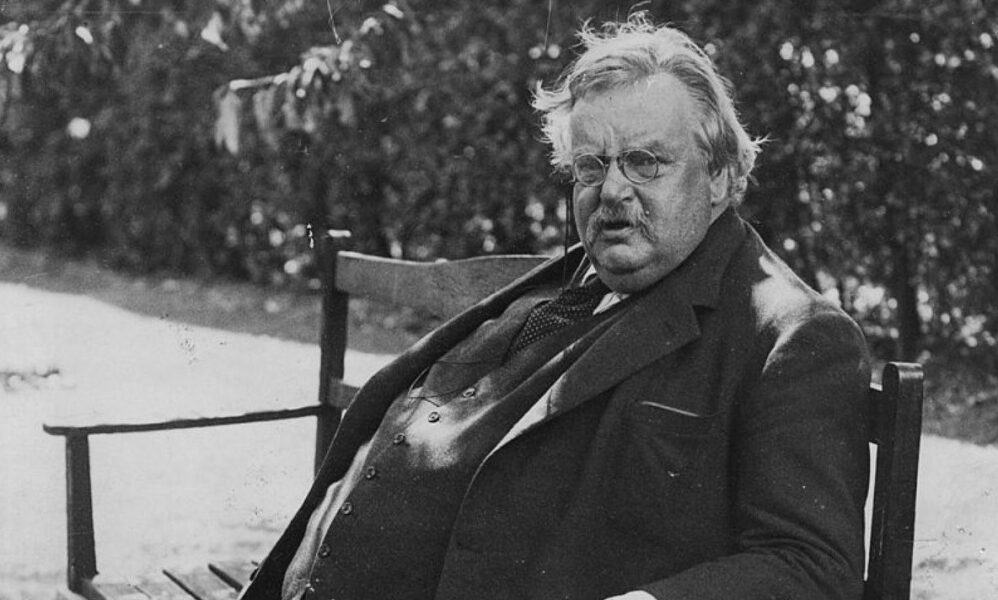
Gilbert K. Chesterton, an outstanding English writer and polemicist, was born in London on May 29, 1874, and died in Buckinghamshire in 1936. From an Anglican family tradition, it was in 1922, after a long process, that he was received into the bosom of the Catholic Church. From then on, he became its most ardent defender and apologist in a country, England, full of prejudices against the Roman Catholic religion. In his book “Why I Am a Catholic” he acknowledged that in Roman Catholicism he found the only place where his sins were truly forgiven, also affirming that there he was freed from the ominous slavery of being a child of his time.
His essay “The Everlasting Man” (originally published in 1925) is, in my opinion, the pinnacle, in beauty and depth, of his writings in defense of the faith. In it, he develops a true philosophy of human history, from the caves to Christ, confronting the materialist theses of authors like George Bernard Shaw and especially H.G. Wells. The latter, in his work “The Outline of History”,” written a few years earlier and a great public success, proposed a conception of man as a casual—rather than causal—fruit of evolution, and presented Christ—as before Buddha and later Muhammad—as a mere mortal. In a memorable phrase, Chesterton will correct these theses, affirming that “man is not the fruit of an evolution but of a revolution”, and regarding Christ, he will remind us that He Himself said: “Heaven and earth will pass away, but my words will not pass away”.
The text presented at the beginning is found in the first part of the book, titled “On the Creature Called Man”. In that section, he brilliantly defends that “the world owes to the Jews the knowledge of God”; for our author, the comparison of the monotheistic God of the Jewish tradition with the polytheistic traditions of gods is as unequal as comparing “a man and the men who walk inside his dreams”. Chesterton, although he expresses his clear sympathy for the imaginative power that the creation of the myths of pagan religion represented, also recognizes that “the world would have been lost if it had not been able to return (from paganism) to that great original simplicity that perceives a single authority in all things”. Because although we may magnanimously qualify the universalization of paganism for encompassing more and more gods (more cultures and, in theory, more tolerance) in its endless pantheon, it ultimately meant an immense tragedy for humanity by “the loss of the highest idea of all: the idea of paternity that makes the world a single reality”.
And that unique paternal authority translated into “the supreme and serene blessing of a jealous God”, a God hardly assimilable because He was unrepresentable for being invisible, and moreover because He had given origin to everything ex nihilo and guided with His Wisdom the forces of nature and history, without being fatally bound to either; a God “who had no distinctive feature”. The Jewish people—Chesterton will explain to us with the brilliance of his paradox—“precisely because of that tribal and narrow character was able to preserve the primary religion of all humanity: it was tribal enough to be universal and as narrow as the universe”.
But that God, as the text we are commenting highlights, by His own unique, transcendent, and omnipotent essence had to be necessarily for the other gods “a Warrior God,” “a rival and an enemy”. That is to say, there should be no compromise whatsoever with them, despite the insidious temptation of friendship or reconciliation that recurrently loomed over the minds of the Jews.
In fact, the historical setbacks suffered by the nation that carried on its shoulders the weight of this Deus absconditus—symbolized in an ark of acacia and gold—forced the Jews on numerous occasions to implore the protection of the false gods of those nations that seemed more successful. The Bible reports numerous examples, such as that of King Ahaz of Judah, who, tormented by the Syro-Ephraimite war (735 B.C.), “offered sacrifices to the gods of Damascus, who had defeated him, saying: ‘Since the gods of the kings of Syria help them, I will offer sacrifices to them so that they will help me’” (2 Chron. 28:23). Of course, without foreseeing that the consequences of such infidelity to YHWH, the one true God, would be his ruin and, in the long run, that of all Israel.
But it was not only the kings and rulers of Israel who yielded to idolatry. The people themselves, led by the bad example of the priests, were unfaithful to God. In Jerusalem, in the times of Ezekiel, just a few years before the catastrophe of the destruction of the city and the Temple by the Babylonian troops (587 B.C.), the prophet beheld in a vision that near one of the city gates stood “the idol that provokes the Lord’s anger” (Ez. 8:3). And inside the Temple “I saw painted all around the wall all kinds of figures of reptiles and other unclean animals, and many idols of the people of Israel” (Ez. 8:10). All of this instigated by the priests who “worshiped those idols, each one having a censer in his hand from which a great cloud of incense rose” (Ez. 8:11).
We observe, then, that the political head of Israel (its kings), its spiritual guides (its priests), and even the people themselves yielded during some periods to the “natural course of things” (the idolatrous and polytheistic temptation). Despite this, they resisted. As Chesterton states in the text we are commenting “it would have been very easy for them (…) to stretch out their hands in a gesture of love and reconciliation to Baal, or to kiss the painted face of Astarte while sitting in pleasant camaraderie with the gods (…). And His worshipers would easily have followed the enlightened slope of syncretism and the amalgamation of all pagan traditions”. Had they submitted to the logic of history, Israel—like Ammon, Moab, or Edom—would have disappeared from the map, dissolved in the hurricane of destiny.
II
But that did not happen; Israel managed to preserve its unique legacy for humanity, a promise of universal salvation, linked to the eternal design of that unknown God, who seemed distant, but whose “innards were moved with love for His people” (Hos. 11:8). And that miracle was due to the intervention—following the magnificent text of Chesterton—of “certain inspired demagogues who employed almost demonic energy in defense of divine unity, with words that still resound with the force of the wind of inspiration or of ruin”. Those were the prophets, men who, following a divine call and with awareness of their mission to save the people, announced to them “the word of God”. Their message formula is unequivocal and performative: “Thus says YHWH”.
Although some prophets were priests or from priestly families—such as Ezekiel or Jeremiah—the majority were laymen. But they spoke with more authority than the priests themselves. Amos, the combative prophet against the injustice of the Northern Kingdom in the times of Jeroboam II, herded flocks before his vocation. Micah was probably a peasant, a victim of the latifundism of the large wealthy landowners whom he lashes with great harshness, not forgetting the priests of Jerusalem who represent a theology of oppression. Indeed, they invoke the fulfillment of ritual laws, forgetting that the Lord desires “mercy and not sacrifice” (Hos. 6:6). In fact, Isaiah will teach that God “detests the blood of bulls, rams, and goats” (Is. 1:11), because His true will is for the people “to stop doing evil, to learn to do good, to strive to do what is just, to help the oppressed, to do justice to the orphan, and to defend the rights of the widow” (Is. 1:17).
Because of this language, Chesterton defines them—in my opinion correctly, including a certain ironic nuance in his expression—as inspired demagogues, for being aware of all of them of God’s call and their vocation, they launched themselves—sometimes with great pain and almost always with serious risk to their lives (see Jer. 38:6)—to denounce idolatries and injustices against their people. And to do so, they used brutal (and even obscene) words and expressions and performed bizarre acts. Only with that bluntness did they reach the wounded heart of the people, and they hoped that the scandal of their comparisons and their extravagant prophetic gestures would move the people to conversion, return to the Lord, and avert the inevitable punishment. As an example, Ezekiel, to criticize Israel’s idolatry, will compare it to a marital infidelity in such a way that “you opened your legs to every passerby and fornicated without ceasing” (Ez. 16:25).
But even when the demands of conversion proclaimed were not met—that dramatic “Return to Me” (Joel 2:12; Zech. 1:3)—when the inevitable punishment occurred (as apocalyptic as it might be, like the destruction of the Northern Kingdom or the demolition of the Jerusalem Temple), the prophets always pointed to an exit, an open door. Ezekiel or Jeremiah himself, despite the drama and pessimism of their words, will announce a “new covenant” as the fruit of the people’s conversion (Ez. 11:20; Jer. 31:31), in such a way that “I will forgive their wickedness and remember their sins no more” (Jer. 31:34), for “I, the Lord, affirm: at that time Israel and Judah will be free of guilt and sin, because I will forgive those I leave alive” (Jer. 50:20). Ezekiel himself will give us the spectacular image of Chap. 37, in which the dry bones of Israel will regain life as a nation and Israel and Judah will be reunited. The Temple will also be renewed, into which the “Glory of God” will re-enter (Ez. 43:1), and from whose eastern gate will flow a “living water” that will regenerate all Israel (Ez. 47:1-12).
In short, denunciation of injustice, religious and cultic deviation; the cry for conversion and the announcement of punishment if what YHWH orders through the prophet’s word is not obeyed are constitutive elements of prophecy. But since “God remains faithful and cannot deny Himself” (2 Tim. 2:13), His promise of salvation—not only to the Jews, but to the whole world (Is. 60:3)—remains safe, despite the harsh setbacks. And that is why the prophets will also be heralds of hope. And more than two millennia after the Word of God was proclaimed by its spokesmen, that hope becomes reality when we see that today the fullness of Israel’s faith, which is Jesus Christ, has spread to all corners of the earth. Hence the admiration that Chesterton shows for those fools for God, those men who risked their integrity to save monotheistic faith against a pagan world that was willing to dissolve it. Thanks to them, that saving Truth embraces all the peoples of the earth in our days, despite the weeds sown by the devil. And truly—as Chesterton concludes—the more we delve into the dramatic circumstances in which they preached, the greater our gratitude and reverence we owe to each and every one of them.