


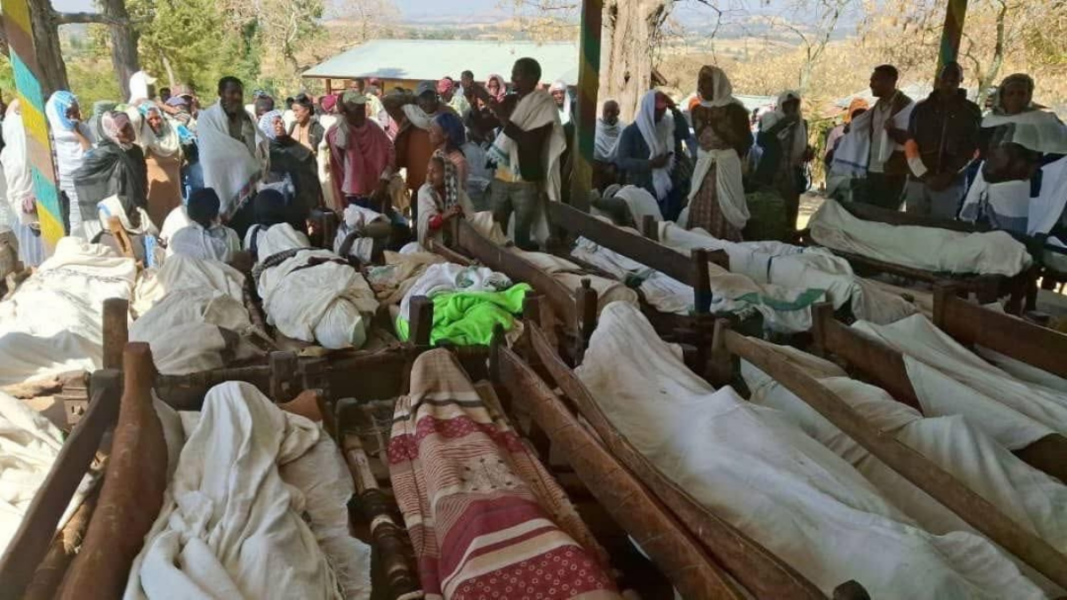
The Catholic Bishops’ Conference of Ethiopia has firmly condemned the recent murders of civilians in various areas of the country, including the attacks carried out in the Arsi region, and has demanded that the government conduct transparent investigations to bring those responsible for these atrocities to justice.
Violence in Arsi Reaches Alarming Levels
According to information disseminated by the Fides Agency and local media, the massacres recorded in the Arsi area (Ethiopia) represent a tragic escalation of violence in which human rights violations have reached alarming levels.
Districts such as Shirka, Merti, Guna, and Holonto have become epicenters of brutality, with civilians subjected to executions, injuries, destruction of property, and forced displacements.
The March 2026 report from the Ethiopian Human Rights Commission (EHRC) documents a series of systematic attacks that demand immediate intervention from federal and regional authorities. In just the recent episodes, 34 Orthodox Christians have been killed—26 in Shirka and 4 in Merti—, bringing the death toll in Shirka to 164 so far this year. Additionally, there are 8 hospitalized injured, 8 missing persons, and 2 kidnapped.
The Bishops Denounce a “Grave Sin Against God”
The Catholic Bishops’ Conference of Ethiopia issued a statement in which the prelates described the massacres as a “grave sin against God,” a direct affront to the sanctity of human life and a violation of moral law.
The bishops recalled that Church doctrine teaches that every person has been created in the image and likeness of God, so the deliberate elimination of innocent lives can never be morally justified. Citing the biblical commandment “thou shalt not kill,” they emphasized that no religious, ethnic, or political motivation can legitimize violence against defenseless civilians.
They also expressed their pastoral closeness to the families of the victims and manifested their solidarity with the Ethiopian Orthodox Tewahedo Church and with all religious communities that defend the dignity of the human person.
Attacks Against Christian Communities
Information gathered from local sources describes a climate of constant terror: families abandoning their homes, thousands displaced, and local economies paralyzed by violence.
The wave of attacks is set in the context of the conflict affecting the Oromia region since 2025, where more than 1,244 civilian victims have already been counted, especially in the Arsi and West Arsi areas.
In this context, the Catholic bishops have expressed special solidarity with the Orthodox Christians, who have been the target of several attacks at the end of February.
On February 26, a group of extremists attacked a market in eastern Arsi—a traditionally peaceful area where Muslims and Orthodox Christians coexisted—opening fire on those present. Twenty Orthodox Christians and one Muslim guard died in the attack, while other people disappeared, presumably kidnapped.
Local sources also indicate that a priest is among the victims. According to witnesses, the attackers burst into a church chanting religious songs before shooting at the faithful present. They then set fire to houses and crops, causing panic and forcing numerous inhabitants to flee to nearby cities.
The attack was not an isolated incident: two days later, on February 28, new attackers struck the community again, killing seven people inside a church.
Call for Justice and Reconciliation
In the face of this situation, the bishops have asked the Ethiopian government to carry out thorough, transparent, and fair investigations, recalling that guaranteeing the security of innocent citizens is an essential responsibility of public authority and a condition for the common good.
They have also reiterated their willingness to collaborate with the Ethiopian Orthodox Tewahedo Church, the Supreme Council for Islamic Affairs of Ethiopia, and all people of goodwill to promote peace.
“We exhort all Ethiopians to resist hatred, not to be swept away by these tragic events, and to reject any attempt to create divisions in our society,” the episcopal statement concludes.