


By Casey Chalk
I wouldn’t describe myself as a «fan» of science fiction. I shrug at Star Wars and Star Trek, and I got so frustrated with Frank Herbert’s Dune that I barely managed to finish it. Nevertheless, I confess a certain guilty fascination with futuristic dystopian works.
The images of the Australian bush and the plot that accompanies them in the revised series Road Warrior haunted my imagination for weeks. The same happened with the new version of Blade Runner. Brave New World, 1984, A Clockwork Orange. I devour those books and wonder: How could human society come to be like that?
Undoubtedly, escapism explains much of this, but there is also a human desire to imagine, and even anticipate, what the future holds for us and our descendants. It is a way to deal with the sharpest moral and political issues of our time, but with a certain personal and emotional distance. It is not us or our children who suffer at the hands of post-apocalyptic Australian biker gangs or humanoid robots with automatic weapons.
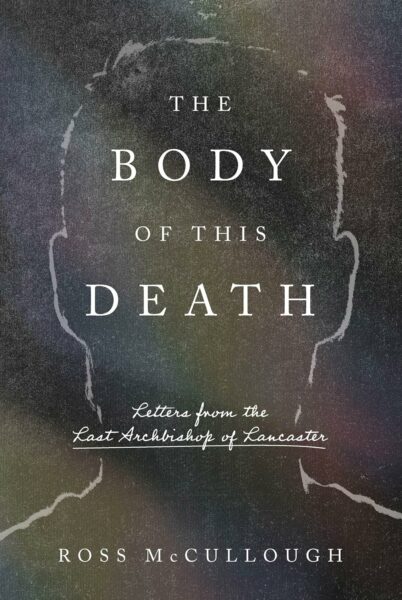
All this, and much more, can be said of The Body of This Death: Letters from the Last Archbishop of Lancaster [The Body of This Death: Letters from the Last Archbishop of Lancaster] by Ross McCullough, a charming book that rides between several genres: epistolary novel, pastoral manual, and theological science fiction.
A sort of science fiction The Screwtape Letters, the reader cannot help but be drawn into McCullough’s dystopian (though terrifyingly imaginable) world, in which the remnants of liberalism accommodate a rising global Islam, while humanity escapes into an absorbing artificial intelligence called «IR.» However, like C.S. Lewis’s classic, it is also a text brimming with spiritual and theological insight.
The letters from the late archbishop certainly paint a bleak picture of a future in which the Church’s influence has waned. Citizens’ behaviors are carefully documented from school onward to exert maximum control over the population. Tech companies promote transhumanism and «transfiguration procedures» to «transfer consciousness from one brain to another.»
The underlying irony is that, in «metamodernity,» the modern Baconian quest to control the natural order is carried out by fleeing from nature.
Priests have adapted to the new reality, leveraging IR to visit more faithful, though the bishop admits that «there is little friendship with someone who is in IR, whether they are in the withdrawn catatonia of passive consumption or in the excited catatonia of erratic and inexplicable movement.»
It is an admirable description of the dehumanizing tendencies of social media. Or how about this:
Let’s just think about how much more control the government has over us on these platforms. Let’s just think about who controls the platforms themselves. This is the problem when reality itself is put up for sale, when we position ourselves in a market of realities. For we are not the hunters in the market, but the prey.
The archbishop’s reflections on sexuality are equally incisive. One letter argues that AI-generated porn—presented as a means to protect human participants from degrading behaviors—only further encourages dehumanizing tendencies, because users of such material are free to do whatever they want within the «safe» world of IR. It is not real, though the effects on the brain and human character certainly are.
Elsewhere, the archbishop describes a «second pill» that was developed to allow sexual partners to feel no mutual attachment. In a twisted way, that makes sense. Obviously, a baby complicates sex, but so does the unitive quality of the sexual act, which binds people in complicated ways, even if both tried to keep things «casual.»
McCullough hints at a panoply of terrifying future possibilities. He describes a procedure ironically titled «transfiguration» that involves extracting the patient’s eyes and penetrating the orbital cavities, something that subjects «generally end up approving.» The result is «lobotomized rebels» similar to those described by (non-practicing Catholic) Anthony Burgess in A Clockwork Orange.
Elsewhere, McCullough prophetically describes «immersive simulations» of the dead that do not ask permission from family or friends, because the data used to construct the deceased person is public domain.
The text presents not only a dystopian future that is all too familiar, but our immediate present. «Your own position is caught in a certain irony,» the bishop writes to an interlocutor, «defending the tradition that exalts the rejection of tradition. And it has not managed to triumph over its opposing irony: a rebellious submission.»
In a later missive to the same individual, the archbishop astutely argues that utopian-inspired regimes attack the family because it perpetuates social classes, and parents protect and promote the well-being of their children above others. «The only way to fit each one into their role in the social order is to destroy the social order,» he warns.
However, McCullough’s work is much more than a cautionary tale about a world that our children and grandchildren might inhabit. It is also filled with beautiful reflections on eternal truths.
For example, the archbishop argues that the sense of St. Augustine’s Confessions «is that there is wisdom in being easily dissatisfied… Our desires do not disappoint us, but their objects: the love of God has no measure… There is no temperance for charity. Only intemperate men are saved.»
In another letter, he preaches: «Only by loving others more deeply will you convince yourself that you too could be loved in that way.»
Rarely have I read a book as captivating as The Body of This Death, which triumphs not only as a work of dystopian fiction, but also for its profound theological vision that reminds us of God’s sovereignty amid suffering. Like this: «You know, Christ is not nailed to the cross; the cross is nailed to Christ.»
McCullough skillfully provokes questions that demand answers. The book, in a sense, is unsatisfactory in all the ways that define a true work of art, leaving the reader in unsettling contemplation.
Perhaps that is what our post-Christian world needs, so incapable of perceiving the person of Christ that many speak of a generic appreciation for «Christian civilization.» As the Archbishop of Lancaster says: «Appreciating Christianity for its contribution to Western civilization is like reading Dostoevsky to increase vocabulary.»
About the author
Casey Chalk is the author of The Obscurity of Scripture and The Persecuted. He is a contributor to Crisis Magazine, The American Conservative, and New Oxford Review. He holds a degree in History and Education from the University of Virginia and a master’s in Theology from Christendom College.