


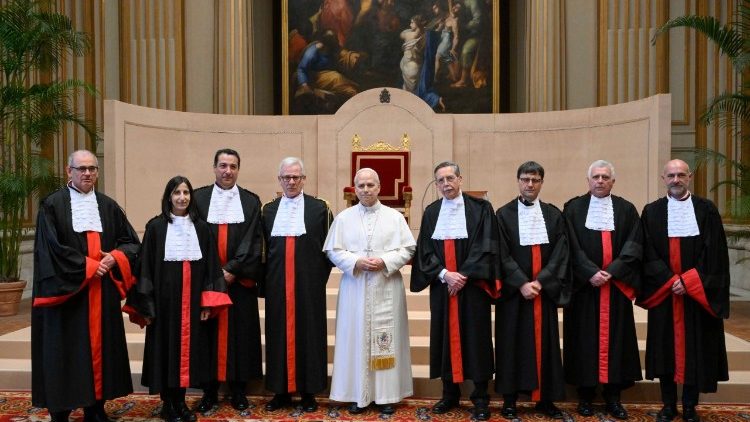
Pope Leo XIV presided over the opening ceremony of the judicial year of the Tribunal of the State of Vatican City this Saturday, where he recalled that justice cannot be reduced to a mere technical application of norms, but must be deeply linked to truth, the common good, and charity.
First speech of the pontificate before Vatican justice
According to the Holy See, the ceremony took place in the Hall of the Blessing and was attended by the president of the Tribunal, magistrates, lawyers, tribunal collaborators, and representatives of judicial bodies of the Italian State.
This is the first speech of Leo XIV’s pontificate addressed to the judicial authorities of the State of Vatican City, a particularly sensitive area in recent years due to the controversies surrounding the functioning of the Vatican judicial system.
In his address, the Pope thanked those who work in the administration of justice, highlighting that it is a task that must be carried out “with discretion and in silence,” but which is essential both for the institutional functioning of the State and for the credibility of the legal order.
Justice, truth, and the order of love
The Pontiff explained that authentic justice cannot be understood solely in technical categories of positive law, for in the context of the Church’s mission it also constitutes an ordered form of charity intended to safeguard communion among persons.
To explain this relationship, Leo XIV quoted St. Augustine, who stated that the order of society arises from the order of love: «ordinata dilectio est iustitia». When God occupies the center and the dignity of the neighbor is recognized, the Pope explained, social life finds its correct orientation.
In the same vein, he recalled the classic definition of St. Thomas Aquinas, based on Roman law, according to which justice is the “constant and perpetual will to give each one what is due to him”. This vision underscores that justice does not depend on momentary interests or balances of power, but is founded on the truth about the person and the pursuit of the common good.
Justice as the foundation of unity
Leo XIV insisted that when justice is exercised with fidelity to the truth, it becomes an authentic factor of unity within the community.
“When justice is applied with balance and fidelity to the truth —he pointed out— it strengthens the bonds between people and generates the trust necessary for an ordered coexistence.”
This perspective takes on particular significance in the case of the State of Vatican City, whose legal structure —the Pontiff recalled, citing the Lateran Treaty— is at the service of the mission of the Successor of Peter and the independence of the Holy See in the international sphere.
For this reason, the Pope added, the administration of justice is not limited to resolving conflicts, but contributes to protecting the legal order and strengthening the credibility of institutions.
Judicial independence and procedural guarantees
In his speech, Leo XIV also emphasized the importance of some essential principles for the functioning of the judicial system: respect for procedural guarantees, the impartiality of the judge, the effectiveness of the right to defense, and the reasonable duration of processes.
These elements —he explained— are not mere technical instruments, but necessary conditions for the judicial function to be recognized as legitimate and to contribute to institutional stability.
The Pope also recalled that justice must be exercised independently of pressures or personal relationships, emphasizing that the magistrate is called to apply the law with fidelity to the truth and not based on conveniences or influences.
A legal and spiritual service to the Church
In the final part of his speech, Leo XIV recalled that justice within the Church also has a spiritual dimension.
The administration of justice, he affirmed, is not a mere technical exercise of the norm, but a service to the People of God, which requires not only legal competence, but also wisdom, balance, and a constant search for truth.
For this reason, he encouraged the members of the tribunal to carry out their task with integrity, prudence, and evangelical spirit, recalling that justice must always be illuminated by truth and accompanied by mercy.
The Pope concluded by entrusting the work of the magistrates to the intercession of the Virgin Mary and imparting his apostolic blessing to them as a sign of communion and peace.