


Regarding the text from this server last week about the origins and main characteristics of the Charismatic Renewal, some comments could be read attacking what was exposed without arguments, simply because Kennedy Hall is a faithful member of the Society of Saint Pius X. The SSPX is not schismatic. The Catholic Church says so. And the Charismatic Renewal is at least very heterodox. And this is stated by Msgr. Athanasius Schneider, who is as much a successor of the Apostles as Munilla, for example. The truth is objective, after all. Whoever does not want to believe it because they dislike the person exposing it is their problem and they should try to solve it, for intellectual and spiritual honesty.
That said, today we will continue with the second table of this triptych on the Charismatic Renewal, which consists of two parts: 1) the Charismatic Renewal as evidence that “modernism is the synthesis of all heresies, as a Pope who is a Saint, Pius X, said, and 2) its “baptism” in the Catholic Church at the hands of Cardinal Suenens, one of the architects of the disaster that was Vatican II and its implementation.
- The Charismatic Renewal and modernism, the synthesis of all heresies
Regarding the Pentecostal origins of the CCR that Pablo Ginés summarizes so well in the article published in Aleteia that we discussed last week, Kennedy Hall has very interesting things to add: «already from 1967, in a report from the National Catholic Reporter, the Charismatic Renewal was known as “the new movement of Catholic Pentecostals» (Mary Papa, «People having a good time praying» (Gente pasándolo bien rezando), National Catholic Reporter, May 17, 1967). The journalist Mary Papa attended a charismatic gathering and, when asking two of its leaders what the movement consisted of, they responded that it was “ecumenical” and that they were “Catholics who had had a Pentecostal experience” . They added that, although the Baptism in the Spirit is not the same as the sacrament of Confirmation, it represents what “should happen in Confirmation”. The interviewees, the Ranaghan couple, are two of the progenitors of the Catholic Charismatic Renewal and, in 1969, were co-authors of a book titled «Catholic Pentecostals» (Pentecostales católicos). The book details the beginnings of the Renewal and offers a surprising view of the heretical theology adopted by the first Catholic charismatics.
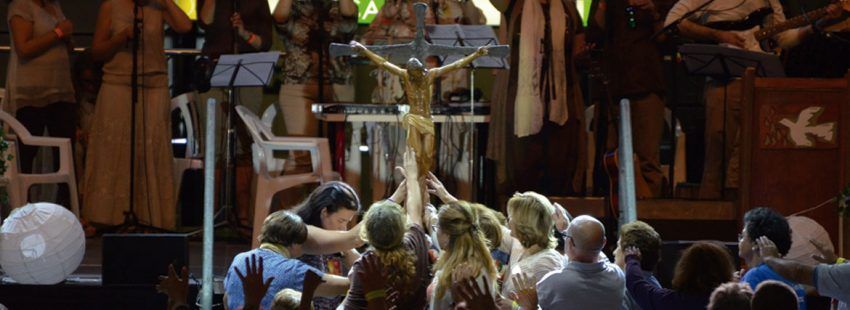
In the early days of the Charismatic Renewal, those who had received the “baptism” prayed for others and the movement began to spread. The new Catholic Pentecostals were delighted with the new feelings and inner emotions they had experienced, not to mention the immediate “gift of tongues”. By then, the gift of tongues had transformed so completely that the new Catholic Pentecostals were less orthodox in their interpretation of the Scriptures than the heretics.
A key event was the one that occurred on February 17, 1967, known as the “Duquesne Weekend” (which Pablo Ginés cites in his aforementioned article): A group of professors and students from Duquesne University went on a weekend retreat to the Ark and the Dove retreat house. Patti Mansfield was one of the students participating in the retreat. A Pentecostal woman preached to the students, and Mansfield recounts how she was moved by the Protestant theology, writing that “the woman had the power of the Holy Spirit like the apostles”. Mansfield states in her book that she had a supposed ecstasy and a Mosaic glow, and that she and the others she invited to pray felt invaded by “a burning sensation that ran through their entire body”. The experiences she recounts in her writings and interviews bear a surprising resemblance to pagan religious practices, but not to what is related in the New Testament or in the lives of the saints. In addition to the burning hands, Mansfield has expressed on multiple occasions—and many charismatics testify to the same—that what accompanied the spiritual event was uncontrollable laughter and crying.
Kennedy Hall mentions how in the 1917 Code of Canon Law (which was in force in the 1960s), canon 2316, it can be read that “whoever in any way helps to propagate heresy or communicates in sacred ceremonies with heretics against the prescriptions of canon 1258 is suspected of heresy. Canon 1258 #1 states: “It is not lawful for Catholics to assist or participate actively in non-Catholic ceremonies”. Writing on the subject of active participation by Catholics in Protestant rites, Pope Pius XI wrote in unequivocal terms that “it is by no means lawful for Catholics to support or collaborate in such endeavors, for if they do, they will give their approval to a false Christianity, totally alien to the one Church of Christ”. Thus, a few decades before its appearance, all those who participated in the initial activities of the Renewal would have been suspected of heresy and of committing an illegal act, for from the 1917 CIC and the words of Pius XI it is clearly evident that the beginnings of the Renewal were contrary to the Law of the Church, unequivocally and without any justification.
We have tried to see so far how the Charismatic Renewal was born from Pentecostalism; but if we pause briefly to observe how Pentecostalism was born and what it consists of, it becomes even clearer why the Charismatic Renewal is so pernicious and heretical.
Let us remember how St. Pius X had defined modernism as “the synthesis of all heresies”. And that is exactly Pentecostalism: a synthesis of heresies that dates back to the early centuries of the Church: in his study, Kennedy Hall begins with the ancient Phrygian heresy: approximately a century after the true Pentecost, a false preacher emerged who chattered about new revelations from the Holy Spirit. A man named Montanus began to preach a false doctrine about the Holy Spirit in the region of Phrygia (Turkey), which gave rise to an error initially known as the Phrygian heresy, later called Montanism. The heresy centered on the idea that the Holy Spirit revealed things to Montanus and his false prophets, and that these revelations and spiritual manifestations were manifested in an extraordinary way. Eusebius, perhaps the greatest historian of the early Church, wrote about the matter as follows: “prophesying contrary to the constant custom of the Church handed down by tradition from the beginning (…); the distinction established by the Lord and his warning to watch carefully against the coming of false prophets”.
It was said that the Montanists experienced intense ecstasies, very different from what we read in the account of Pentecost in the letters of St. Paul. Montanism fostered great emotionalism and sensationalism, with continuous revelations, and the result was chaos. What is interesting is that the Phrygian heresy was not a heresy in the sense that it explicitly denied any of the teachings of the Church, but rather that it was heretical for what it added to the Revelation of Christ. They were, in a certain sense, “reformers” who believed they were living the Gospel more fully. The Phrygian heresy was finally condemned by the Church, but it remained active in the region for several centuries and, like all heresies, came from the devil, who never stops tempting Christians with heresies of all kinds. Seventeen centuries later, Montanism resurfaced under another name, this time outside the Catholic Church.
In the centuries following the Phrygian heresy, there were other heretical movements with some similarities; however, it was not until the emergence of what would be called Pentecostalism that the world witnessed such a complete return of Montanism. And Pentecostalism is recognized as the progenitor of the Catholic Charismatic Renewal.
Kennedy Hall explains how “in the 18th century, the Protestant world saw the rise of what is known as the Holiness Movement, a movement within Protestant Christianity that emphasized personal religious experience as proof of God’s grace. In general terms, these movements followed the example of John Wesley, an Anglican cleric active during the 18th century who sought a “revival” of religious fervor in the stagnant Church of England. His movement became known as Methodism, and inherent to it was a theology of grace that advocated a “second blessing” or a “second work of grace”—the first work of grace being baptism—that, according to its proponents, is the proof of God’s grace in life. The century following Wesley saw the emergence of various sects associated with the Holiness Movement, whose beliefs became increasingly strange and severe. In the 1880s, John Alexander Dowie, an Anglican minister, moved to the United States and gained notoriety as a healer and miracle worker. In 1901 he founded a sectarian community called Zion City in Illinois. He died in 1907 and is remembered as one of the progenitors of Pentecostalism.
Frank Sandford (1862-1948) was one of the first leaders of the Pentecostal movement in the United States. In 1893 he founded his own “church,” in which his theology changed drastically from the Free Will Baptist Church from which he came. He rejected his former belief in free will and came to believe that his only responsibility was to “respond” to the movements of the Holy Spirit in his soul. Essentially, he believed that he could live exclusively under the guidance of the Holy Spirit, as if he had a direct conduit with the Third Person of the Holy Trinity. His influence grew and his community came to have hundreds of residents, including families and young children.
Later, Charles Fox Parham followed the teachings of both Dowie and Sandford, becoming the de facto progenitor of the official Pentecostal movement and considered by Catholic charismatics as the spiritual leader of Pentecostalism. Parham’s influence on the Catholic Charismatic Renewal was enormous.
And all this Pentecostal heresy is the origin of the Catholic Charismatic Renewal. Charles Parham (1873-1929) created in Topeka, Kansas, his own faith healing center called Bethel. In the days leading up to New Year’s Day 1901, Parham instructed his students to study the Acts of the Apostles in great detail in order to discern God’s will for his ministry. His students were convinced that if they truly had the Holy Spirit, they would manifest the same gifts as the apostles and the first disciples, including speaking in foreign languages, miraculous healings, and prophecies. Thus, on New Year’s, Parham’s community prayed for a revival of the Holy Spirit and to receive the charismatic gifts.
The Pentecostal theology on how charismatic graces operate is of course not orthodox. The first notion that the gift of tongues would be the ability to speak a foreign language is perfectly in line with Catholic thinking, but the notions that you would stop speaking your own language and that you can receive the gifts by asking as they did lack foundation when considering the Church’s wisdom on the subject. Parham claimed that he believed his new revival of the Holy Spirit would be “the greatest since the days of Pentecost”. Parham, a Freemason and alchemist, was not only a spiritual fraudster, a sodomite, and an opportunistic manipulator, but he was also an avowed supporter of the Ku Klux Klan, which is not only a racist movement but one of the most virulent anti-Catholic organizations in the United States. Despite all this, Catholic charismatic leaders proclaim Parham as an instrument of Divine Providence and of the Renewal by the Holy Spirit, and link their movement to him.
When studying the words, both written and spoken, of the RC leaders, we have the feeling that they believe that a literal new Pentecost has arrived in the Church through the Renewal: they believe that Pentecost has essentially returned with Charles Parham thanks to the prayer of Pope Leo XIII and that John XXIII and Vatican II opened the floodgates of charismatic graces so that a new Pentecost could flourish in the Catholic Church.
Bishop Athanasius Schneider considers Pentecostalism to be to some extent a new religion (Christus Vincit, pp. 235ff): “The Pentecostal, charismatic, sentimentalist, and irrational religious experience has penetrated many Christian confessions and even non-Christian religions and presents a real spiritual danger. We have two main branches in Christianity: the orthodox Catholic Christianity that is sacramental and has its priests and an episcopal hierarchy and the Protestant one, which does not. And now, we have a new Christian branch, the Pentecostal one, which equates the essence of religion with feeling and irrationalism, although these principles were already anticipated in some way by Martin Luther. The new evangelical Christian religion is dangerous and leads to the destruction of the virtue of religion, the authentic relationship with God. Pentecostalism ends in subjectivism and arbitrariness. Experience and feeling become the measure of all things. There is a lack of reason, truth, and the necessary fear of God. However, divine Revelation is intrinsically united to reason and truth. Jesus Christ, the Incarnate Son of God, is the word, the Logos, the truth, the Second Person of the Holy Trinity.
When my religious feelings disappear, my faith disappears. Pentecostalism, in the long run, damages faith and truth. Unfortunately, the Pentecostal phenomenon has deeply penetrated the Catholic Church through the so-called Charismatic Renewal. Neither the Old nor the New Testament, nor the Apostles, nor the Fathers of the Church approved an irrational religious sentimentalism or a liturgical practice where feelings are central. The religion of the Old Testament came through divine Revelation and is characterized especially by the Law (liturgy and moral commandments) and by the prophets (with the teaching of doctrine), who were represented by Moses and Elijah in our Lord’s transfiguration on Mount Tabor. Our reason is enlightened in the light of faith while always remaining faith and not pure rationalism.
Up to here, the lapidary quote from Msgr. Schneider.
Today, the Charismatic Renewal is one of many modernist movements that have multiplied in the Church in the last sixty years. But, how was this movement “baptized” Catholic?
- Cardinal Suenens and the “baptism” of the Charismatic Renewal
Pablo Ginés explains in his 2017 article in Aleteia that, initially many priests and bishops received the CCR with coldness, disinterest, or even hostility, especially in Europe. For the hierarchy more interested in social issues, the charismatics were too mystical, disembodied, or conservative. For the more conservative hierarchy, the charismatics, with their music, their exuberant and uninhibited ways and “all that commotion”, were too disorderly and unpredictable.
In a 1997 article titled “The Charismatic Cardinal Suenens”, John Vennari, editor of Catholic Family News from 1994 until his death in 2017, wondered how it was possible that, if “Catholic” Pentecostalism is an anomaly, it enjoyed such favor in the modern Church, and even the support of the Vatican. And he concluded that, since “Catholic” Pentecostalism is ecumenical in its roots, stems, flowers, and nectar, it could only grow in the climate of liberal Catholicism that Vatican II unleashed on the world.
Rome’s opposition to liberal Catholicism within the Church had remained firm until Vatican II. In it, liberalism manifested itself evidently in the three outstanding novelties that emanated from it: religious freedom, collegiality, and ecumenism. In this context, it is logical that the key figure in the “legitimization” of the charismatics is one of the same key figures responsible for the triumph of liberal Catholicism at Vatican II, the Belgian cardinal Leo Joseph Suenens.
In the opening speech of the 30th Anniversary Conference of the Charismatics in 1997, the pioneer charismatic Kevin Ranaghan paid special tribute to Suenens, the first “cardinal defender” of the Charismatic Renewal. Ranaghan praised Suenens as a man whose “work in favor of this renewal is legendary” and credited him with making possible the 1975 Charismatic Synod in Rome.
Suenens was firmly committed to ecumenism and, given that the ecumenical-based charismatic renewal is a fruit of liberal Catholicism, it is logical that Cardinal Suenens, rabidly liberal, became a “Catholic Pentecostal” and considered the charismatic movement as the apple of his eye.
In his book The Rhine Flows Into the Tiber (El Rin desemboca en el Tíber), Father Ralph Wiltgen reports that, from the beginning of the Council, Vatican II was hijacked by a clique of liberal theologians and prelates, mainly from the Rhine countries. These progressive ecclesiastics were determined to reform the Church in their own image and likeness. Before the Council, Pope John XXIII had created in Rome the Preparatory Central Committee to prepare the schemas, documents containing the topics that the bishops were to debate at Vatican II. The Committee’s work lasted two years. The prepared schemas were quite orthodox and would have made the debates develop along traditional lines. At the beginning of Vatican II, the liberal conciliar clique, along with Cardinal Suenens, managed to get this magnificent preparatory work thrown in the trash. This left two thousand five hundred bishops in Rome without an agenda. The bishops then turned to the periti liberals to draft the new documents for debate. A full-blown coup d’état, with the connivance of the Supreme Pontiff. Cardinal Suenens himself, in an indiscreet song of triumph, proclaimed: “Vatican II is the French Revolution in the Church…
In 1974, in a scathing critique of the charismatic movement, Archbishop Dwyer of the United States, firmly orthodox, said: “We consider it outright as one of the most dangerous trends in the Church in our time, closely allied in spirit with other disruptive and divisive movements; that threatens to cause serious damage to unity and to countless souls”.