


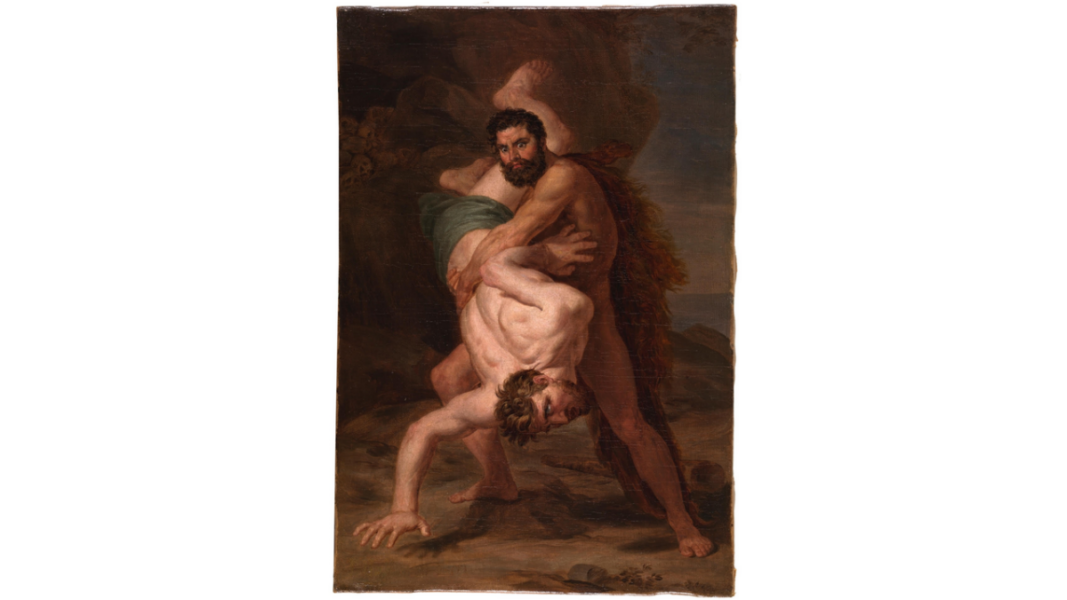
Antaeus is not born solely from mythological imagination, but from a deeper memory, almost geological. Son of the Earth, of Gaia, the primordial mother who in ancient theogony begets all that lives, and of Poseidon, the god of the sea, lord of the mobile and unstable depths, Antaeus possessed a double heritage: the solidity of the earth and the hidden power of the waters. But he did not draw his vigor from the father, but from the mother: not from the element that moves, but from the one that remains.
He lived in Libya, on the southern confines of the known world, and forced travelers to fight, out of an instinctive fidelity to his nature: he was invincible as long as he remained united to his origin. Lucan, in book IV of the Pharsalia, describes him thus:
«Hoc quoque, cum primum terris expulsus fuit,
proderat; in gremium matris nulloque fovente
decidit et viris redeuntibus altior exit»:
“This also benefited him: when for the first time he was expelled from the earth,
he fell into the lap of his mother, without anyone holding him,
and upon the return of his strength, he rose higher.”
The verb is precise: proderat —“it benefited him”—. What seemed like his defeat was, in reality, his advantage. And Lucan continues, delving even deeper into the mystery of that silent restoration:
«Hoc quoque, quod fessus terrae se abiecerat, hostis
credebat vires; sed terrae adiutus ab ortu
excepit fessas refoventi numine membra».
“This also: that if, exhausted, he had thrown himself to the earth,
the enemy believed him without strength; but he, aided by his earthly origin,
received his fatigued members, relieved by the divinity that reanimated them.”
Here the decisive word appears, ortu: origin, birth, principle. The earth as vital principle: not merely the ground on which he stands but, above all, that from which he proceeds.
And finally, Lucan formulates the law:
«Nil opus est artus adplicare laboribus;
stans etiam e terra trahit in sua membra vigorem».
“He does not need to apply his limbs to efforts;
even standing, he draws vigor into his members from the earth.”
The verb is exact: trahit, draws, attracts, absorbs. He does not receive passively: he draws actively. The earth is not only a support, but a continuous source of strength. E terra trahit vigorem: “from the earth he draws vigor”. It is a law of vital dependence.
Antaeus is not strong by himself, but by contact: as long as he touches the earth, he participates in its generative power; separated from it, he is reduced to himself, and in himself he does not have sufficient strength to live. His strength is not his own and autonomous, but relational; he lives from a dependence. As long as he touches the earth, he is invincible; separated from it, he dies. The earth is not a mere point of support: it is a source of regenerating energy.
Antaeus reveals a truth that belongs as much to the spiritual order as to the natural one. There are beings whose life does not consist in affirming themselves in themselves, but in remaining united to that from which they proceed; beings whose strength is not born of independence, but of fidelity. The modern illusion has consisted in identifying strength with autonomy. Man has been taught to suspect all dependence, as if freedom were a rupture, but nature teaches the opposite: the tree lives as long as it remains rooted; the river is a river as long as it remains in its channel without overflowing; the child is gestated within the maternal womb. Antaeus is strong as long as he touches the earth: separated from it, he does not need to be wounded to die; suspension is enough for him.
There is, in the supernatural order, an earth that is more than all the visible ones: it is the stone of sacrifice, the place where heaven touches matter, the point where eternity becomes contemporary. The altar is not a symbol: it is a reality that does not “represent” a sacrifice because it contains it. It does not recall a presence, but realizes and reactualizes it. The altar is the earth in the most radical sense: it is origin, foundation, and irrenunciable point of contact.
The priest, like Antaeus, does not possess in himself the source of his strength: he receives it, not from an idea, a feeling or a memory, but from a real, physical, concrete, everyday contact.
That the ordained in sacris —for that!— lives by touching the altar is not a poetic affirmation, but an ontological one, because priestly identity is not psychological, but sacramental. He is not a priest because he thinks or acts like a priest, but because he has been configured with Christ the Priest, and that interpenetration finds its supreme act in the Sacrifice. The altar is the point of that living attunement: there the priest does not recall Christ: he is his instrument, the other I of Him to whom he lends his voice and his hands. At the altar, the priest touches the source of his being.
E terra trahit vigorem. From that earth he draws his vigor.
Hence the delicacy of the gestures of contact: the kiss to the altar at the beginning of the sacrifice is not mere ritual courtesy but a confession of one who recognizes his origin, knowing that without that contact he cannot live; it is not a sentimental gesture, but vital. The priest kisses the altar as Antaeus touched the earth.
There is a form of weakness that does not come from fatigue, but from separation; it is not the vulnerability of combat, but that of uprooting from one who has been suspended in the air. That is why Hercules’ victory did not consist in wounding Antaeus, but in lifting him; he did not need to destroy him: it was enough to separate him from the earth.
Hercules, son of Zeus, the god of the sky, defeated the son of the earth, not by striking him, but by tearing him from his mother. As long as Antaeus remained united to Gaia, no force could dominate him, but, suspended between heaven and earth, deprived of contact with his origin, he lost what sustained him. His defeat was not a wound, but an interruption of contact.
This is the most silent tragedy that can befall a priestly vocation: not the visible sin, which wounds but does not necessarily destroy the root, but the progressive, indolent and painless separation from the altar. It is not a brusque rupture, but a growing distance, physical and cordial; not an explicit negation, but a practical forgetfulness. A sort of semi-voluntary suspensio a divinis without appearance of ex-communicatio.
The priest does not lose his vigor from one day to the next: he loses it gradually when he stops touching the earth of his origin, when the altar ceases to be the center and becomes an episode, when the sacrifice ceases to be life and becomes a function; when the contact becomes infrequent, or superficial, or distracted, or unloving. And then, even in the midst of a thousand pastoral activities —in reality, undermined by them— the unstoppable weakening begins.
Because if Antaeus’ earth was his mother, the altar is also a maternal womb where the priest not only finds his strength, but his continuous birth, returning every day to being what he is. At the altar the priest is remade. Each Mass is a new regeneration of his priesthood: every time he pronounces the words that are not his own, and holds in his hands what he cannot comprehend, and bows his face before the mystery that surpasses him, he touches the earth of his origin.
And from that earth he draws his vigor; not that of youth, health or psychology, but a robustness infinitely more powerful: that of his invincible configuration with Christ. Such energy does not depend on age, temperament or circumstances, but on contact. The priest is strong not when he affirms himself, but when he remains united to the altar.
Sometimes, in excavations, the archaeologist finds a stone that does not seem different from the others, but which reveals itself to be the foundation of the entire building. Everything else has disappeared: walls, roofs, columns…, but that stone remains and in it everything is understood. The altar is that stone. Let social and ecclesiastical recognition disappear, human companies or securities: as long as the priest maintains contact with the altar, everything remains.
Because… E terra trahit vigorem.
From that earth he draws his vigor: illusioned, tirelessly united to the altar of the Sacrifice, which is the living Heart of Jesus, he will not die.