


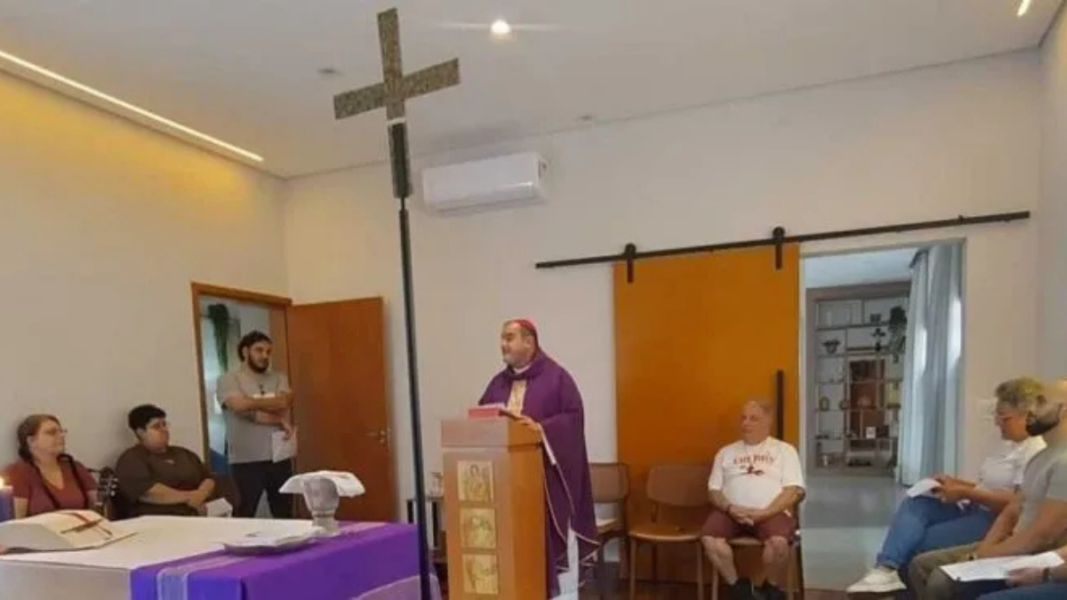
The Bishop of Jundiaí (Brazil), Monsignor Arnaldo Carvalheiro Neto—known for several pastoral controversies in his diocese—hosted a meeting of Catholic LGBT groups from the state of São Paulo at his episcopal residence, an event that included the celebration of Mass and a dialogue on the role of these collectives within the Church.
A meeting at the episcopal residence
According to ACI Digital, the meeting took place on Sunday, March 1, at the episcopal house in Jundiaí. The day began with the celebration of the Eucharist in the small chapel of the residence, where the participants gathered around the altar.
It was followed by a moment of dialogue and testimonies in which the attendees shared the difficulties and challenges faced by LGBT groups within the Church.
Since October of last year, Carvalheiro has also been acting as the reference bishop for the National Conference of Bishops of Brazil (CNBB) for the National Network of Catholic LGBT Groups, a position created to pastorally accompany these collectives throughout the country.
An appointment that generated concern
The appointment of the Bishop of Jundiaí as the national reference for these groups was presented by the CNBB as a pastoral initiative of accompaniment.
However, the assignment caused concern among some faithful and priests due to the profile of the prelate himself and the controversies that have marked his pastoral governance.
Various episodes in the diocese of Jundiaí have generated discomfort in recent years. Among them, liturgical decisions questioned by the faithful and priests, as well as behaviors considered improper for the episcopal ministry.
One of the events that provoked the most controversy was the order to remove the cross from the center of the altars and place it to the side, a decision that many interpreted as a devaluation of the central sign of the Eucharistic sacrifice.
His presence at festive environments with seminarians in the city also generated criticism, in an episode that some considered incompatible with the dignity of priestly formation.
A “theological space” for LGBT groups
During the meeting held at his residence, the bishop defended the identity of Catholic LGBT groups as a “theological space” supported by three pillars: spirituality, charity—expressed in welcome and mutual help—and formation.
The images disseminated by the diocese show the bishop sharing with the participants in an informal setting within his residence.
A network linked to international Catholic LGBT activism
The meeting had the support of the Comunidad Diversidad y Fe, a group from the diocese of Jundiaí formed by Catholic LGBT individuals, as well as family members and people close to them.
The Red Nacional de Grupos Católicos LGBT, to which this community belongs, brings together various collectives that promote pastoral meetings and spaces of accompaniment for people who identify with this reality within the Church.
According to the organization itself, this Brazilian network is part of the Red Global de Católicos Arcoíris (Global Network of Rainbow Catholics), an international platform founded in Rome in 2015 that groups LGBT organizations that present themselves as “Catholic” but openly promote changes in the Church’s moral teaching.
Among the proposals promoted by this network are the recognition of so-called “marriage” between people of the same sex, the normalization of transgenderism, and the revision of Catholic magisterium on matters of sexuality and natural order. Its leaders live publicly in homosexual unions, and the organization also defends claims such as the ordination of women, positions that clash head-on with Catholic doctrine.