


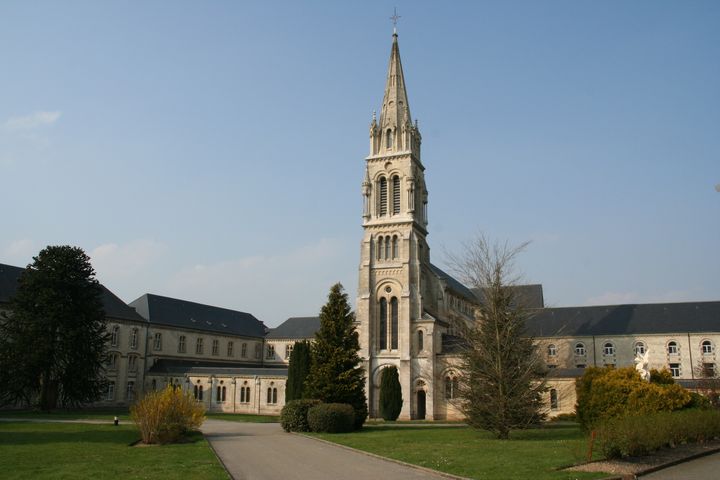
The historic monastery of Our Lady of La Trappe, in Normandy (France), could be left without a monastic community in the coming years. The Trappist monks who inhabit this emblematic abbey—one of the most representative symbols of the Cistercian tradition—are studying the possibility of abandoning the site around 2028 due to a lack of vocations and the economic burden of maintaining the property.
An emblematic monastery of the Trappist tradition
According to EWTN News, the community of approximately twenty monks belonging to the Order of Cistercians of the Strict Observance, commonly known as the Trappist order, has acknowledged that continuing their presence in the abbey has become increasingly difficult.
The religious, established in Soligny-la-Trappe, in northwestern France, explained that the decline in vocations and the growing difficulties in sustaining the facilities force them to consider relocating the community in the coming years.
Even so, the monks have emphasized that the abbey will not close nor is it for sale at the moment. Currently, conversations are underway with other monastic communities to seek solutions that are more viable both economically and spiritually.
“The situation has been difficult for several decades and many other abbeys have already changed hands,” the monks stated in a communiqué released on March 6.
A painful loss for generations of faithful
For the small Trappist community, leaving La Trappe would mean the end of a historic era. The monks recognize that the possibility of departing causes deep pain among those who have been linked to the abbey for generations.
“The departure of the brothers is very hard and painful; it will undoubtedly be a profound loss for all those connected to the community,” they indicated.
Faithful to the tradition of the Rule of Saint Benedict, the Trappists have maintained for centuries a life marked by prayer, silence, and work. The abbey also has a monastic guesthouse, where they receive visitors “as if they were Christ himself,” offering a space for retreat, silence, and spiritual reflection.
The monastery also has a shop where books, religious articles, and regional products handmade at the abbey are sold.
A monastery that survived wars and revolutions
The possibility that La Trappe will be left without monks has sparked reactions in the Catholic world. Bishop Robert Barron, of the Diocese of Winona-Rochester (United States), publicly lamented the situation.
Barron recalled that La Trappe is the mother house of the Trappist order, a reform of the Cistercian tradition characterized by its particularly austere and silent life.
The prelate also noted that the monastery has survived numerous critical moments in European history, including the Black Death, the Hundred Years’ War, the Protestant Reformation, the French Revolution, and the world wars of the 20th century.
“An ideological secularism that corrodes the soul of the West”
For the American bishop, the vocational crisis affecting this historic monastery reflects a deeper reality in Europe.
“In my view, the fact that this venerable monastery cannot find enough vocations to stay alive is a sign of the spiritual disaster that has struck Europe in the last century: an ideological secularism that is rotting the soul of the West,” he stated.
In response to this situation, Barron called for intensifying prayer so that the monks find a solution that allows preserving the historic abbey.
“It is more necessary now than ever,” he concluded.