


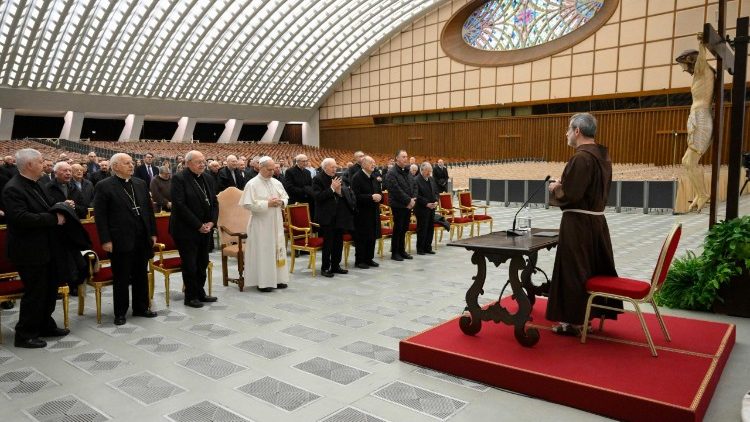
The preacher of the Pontifical Household, Capuchin Father Roberto Pasolini, delivered this Friday, March 13, the second Lenten sermon in the Paul VI Hall, in the presence of Pope Leo XIV. The meditation, titled “Fraternity. The Grace and Responsibility of Fraternal Communion”, is part of this year’s cycle of Lenten reflections centered on the theme: “If anyone is in Christ, he is a new creation” (2 Cor 5:17).
According to the Vatican’s Bulletin, the meditations are inspired by the theme of conversion to the Gospel according to Saint Francis and will continue on March 20 and 27.
Fraternity as a Place of Conversion
As reported by Vatican News, Pasolini emphasized that fraternity should not be understood as an accessory element of spiritual life, but as the concrete space where authentic Christian conversion takes place.
In his reflection, he explained that communion among brothers is at the same time a gift from God and an urgent responsibility, especially in a world marked by divisions and conflicts that make fraternity seem like an ideal that is difficult to achieve.
For the preacher, the relationship with others allows one to confront one’s own limitations and overcome the temptation to believe oneself self-sufficient. In this sense, he pointed out that fraternity “softens the heart” and helps to reconcile with one’s own fragility.
The Example of the Early Franciscan Communities
During the sermon, Pasolini evoked the experience of the early Franciscan communities. Saint Francis of Assisi— he recalled— wanted communities where there were no relations of power or superiority, but a life marked by equality among brothers.
Far from being places of refuge to live in tranquility, those fraternities were conceived as spaces where each person was confronted with their own interiority, with their wounds and with their limits.
In that context, the brothers are not only there to support each other, but to become instruments through which God transforms the life of each one.
“The One Who Comes from the Same Womb”
The preacher also dwelt on the etymological meaning of the Greek word adelphós, which literally means “the one who comes from the same womb.” From this perspective, he explained that the brother is not there to confirm what one already is, but to provoke a transformation.
Diversity, limitations, and even difficulties in fraternal relationships thus become the place where God works on the human heart, helping to overcome rigidities and to learn a more authentic love.
The Story of Cain and Abel
Among the biblical examples mentioned by Pasolini, he highlighted the story of Cain and Abel, which he described as a story that reveals a “problem of gaze.”
More than the material quality of the offering, he noted, what differentiates the two brothers is the personal involvement in the gift offered to God. Abel presents the best of his flock, while Cain simply offers some fruits of the earth.
The rejection of Cain’s offering, he explained, does not seek to humiliate him, but to provoke in him an awareness: God wants to help him discover that his life too can become a true gift.
Fraternity as a Path of Mercy
Pasolini recalled that for Saint Francis, fraternity was not a problem to be endured, but an opportunity to live the evangelical logic of mercy.
In situations of conflict or rupture, the Gospel— he emphasized— does not first invite one to claim rights or defend positions, but to seek the possible good that allows one to recognize the other again as a brother.
A Gift and a Responsibility for Christians
In the conclusion of his meditation, the preacher of the Pontifical Household recalled that the Christian faith does not eliminate the difficulties of human relationships, but it does change the perspective from which they are lived.
The resurrection of Christ— he affirmed— frees the believer not from the fatigue of loving, but from the fear that that effort might be useless.
Therefore, in a world marked by wars, divisions, and conflicts, Christians cannot limit themselves to speaking of fraternity as an abstract ideal. They are called to receive it as a gift and to assume it as a serious and urgent responsibility within the life of the Church.