


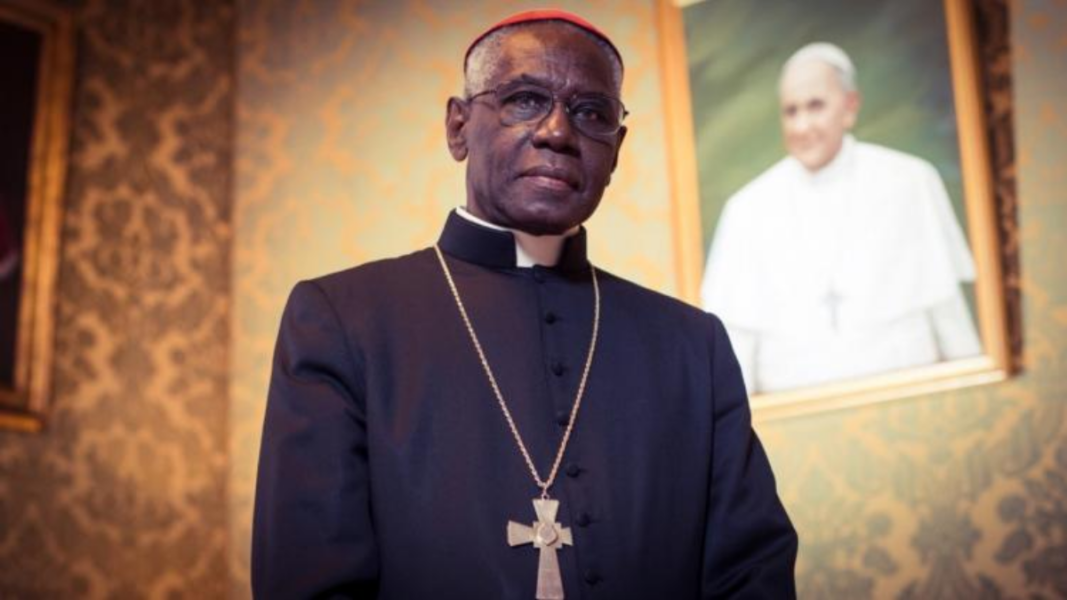
Cardinal Robert Sarah has responded to the criticisms that arose after the publication of his new book 2050, a work in the form of a dialogue with writer Nicolas Diat in which he reflects on the spiritual crisis of the Church and the West. The African cardinal defends that the Church can only fulfill its mission by remaining faithful to the deposit of faith, and warns against the temptation to adapt to the spirit of the world.
Read also: Sarah announces a new book on the future of the Church
According to the French media Le Journal du Dimanche, Sarah reacted to criticisms from some ecclesial sectors—including the newspaper La Croix, which described the book as «controversial»—in a second interview, clarifying that his intention has not been to engage in personal disputes, but to recall the fundamentals of the Christian faith.
A spiritual diagnosis of the Church’s crisis
In his new book, the Guinean cardinal presents an in-depth reflection on the spiritual situation of the Church and the Western world. For Sarah, the root of the current crisis is not primarily organizational or pastoral, but spiritual.
«We live in an era in which much is said about the Church, but often without speaking of God,» states the cardinal. In his view, when God ceases to be the center of ecclesial life, everything ends up in disorder.
The book, he explains, does not intend to be a pamphlet or a situational intervention, but a call to fidelity in a time of uncertainty. «The crisis we are living is not just a crisis of organization; it is a crisis of worship,» he maintains.
Sarah insists that the Church, founded by Christ, does not fear for its survival as a divine institution. However, he warns that entire peoples can abandon the faith if Christians stop living it coherently.
Silence on Francis and hope in Leo XIV
One of the reproaches noted is the absence of references to the late Pope Francis in the book. Sarah has responded to that criticism by emphasizing that the Pope, whoever he may be, deserves love, respect, and prayer.
«The Pope is the Pope,» affirms the cardinal, insisting that the Church is not an arena for political confrontation. As he explains, the book does not aim to assess pontificates, but to focus on what endures in the Church beyond historical changes: the deposit of faith, the liturgy, and the centrality of God.
In contrast, Sarah mentions Benedict XVI, whose theological and liturgical reflection he considers particularly illuminating for understanding the current moment. He also expresses his hope in the pontificate of Leo XIV, which could—according to him—open a stage marked by unity in truth.
«The Church does not save the world by imitating it»
The cardinal also rejects the idea that the Church must adapt to cultural trends to survive. In his view, that temptation constitutes one of the main dangers of the present moment.
«The Church does not save the world by copying it; it saves it by opening it to God,» he states. In his opinion, the current crisis has deep roots: a weakened catechesis, an impoverished liturgy, and the penetration of relativism into Christian life.
Although he recognizes that these difficulties precede any specific pontificate, the cardinal reminds that pastors have the responsibility to examine whether certain decisions have contributed to sowing confusion among the faithful.
Climate, migration, and political agenda
Sarah also refers to another of the reproaches his book has received: not addressing issues such as climate change or migrations. The cardinal responds that these topics are important, but warns against the risk that ecclesial discourse be reduced to a temporal agenda.
As he explains, these matters can only be properly understood when addressed from faith. «If we speak of the climate without speaking of the Creator, or of migrations without speaking of man’s supernatural dignity, then the Church is reduced to a moral agency,» he states.
For the cardinal, the Church’s proper mission is to announce God and lead men toward salvation. When it loses that centrality, it runs the risk of diluting its identity.
The West and the temptation to reinvent the faith
In his analysis, Sarah also contrasts the spiritual situation of the West with that of Africa. In his view, Western culture has been marked by a growing self-sufficiency that has led to questioning the Christian tradition.
«The West wants to reinvent what it has received,» he states. In contrast, the cardinal observes that in many places in Africa, a more humble attitude toward the faith persists: the awareness of having received a treasure that must be guarded and transmitted.
Contemplative life as a prophetic sign
One of the points that, according to the cardinal himself, has elicited the greatest consensus among readers is his reflection on contemplative life. Sarah defends that monasteries remain an essential reminder of man’s ultimate vocation.
«Man was not created only to produce or consume, but to worship,» he states. In that sense, monks and nuns show with their lives that God remains the center of everything.
For the cardinal, the spiritual renewal of the Church necessarily passes through recovering the sense of worship, silence, and liturgy as an encounter with God.