


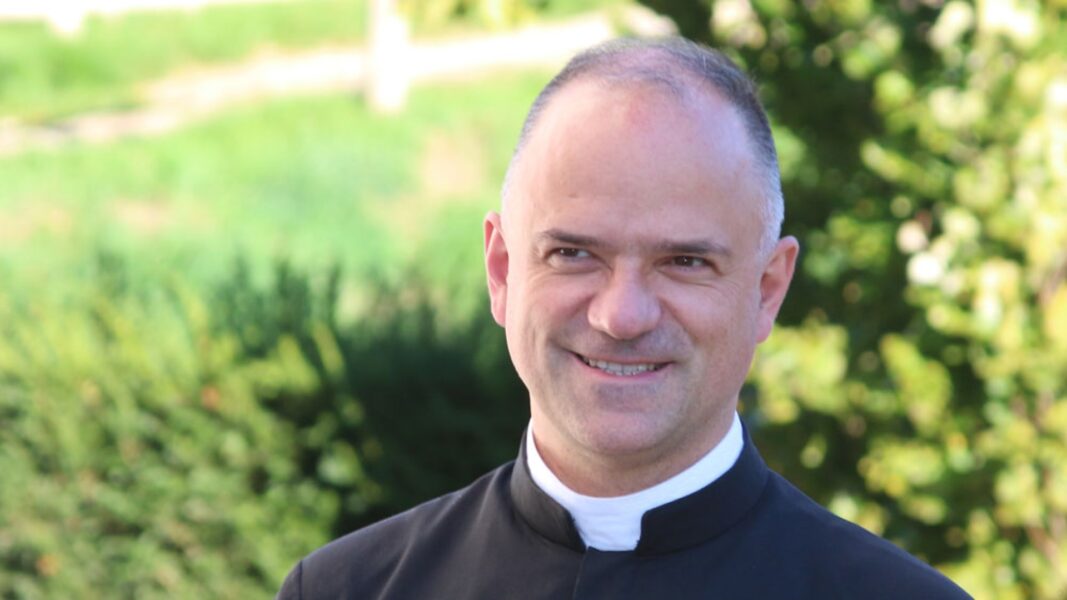
On Saturday, February 7, 2026, Abbot Davide Pagliarani, Superior General of the FSSPX, participated in a roundtable dedicated to the decision to proceed with the consecration of bishops on the upcoming July 1 in Écône. This intervention took place within the framework of the Winter University of the French district of the FSSPX, organized at La Martinerie, near Châteauroux. The event brought together several hundred participants, mostly young people in their twenties.
Roundtable with Abbot Pagliarani
This roundtable, delivered orally, has been slightly modified to facilitate reading. The oral style has been adapted to the written style, without altering the meaning of the words.
First question: Why now?
Question: Rumors about the consecrations have been circulating a lot in recent months, especially following the death of Bishop Tissier de Mallerais. Some wonder why it has waited until now; others might also wonder why it has not waited longer.
Abbot Pagliarani’s response: It is a matter of prudence. Taking such a decision—because it is an extreme decision, a grave decision—is only possible if there is no other alternative. Now, such a choice requires long and difficult discernment, which must be carried out calmly and in prayer. That is what we have done.
The death of Bishop Tissier did not mean that the next day we had to proceed to consecrate someone to replace him. It is true that we were missing a bishop, but the Fraternity could, and still can for a few months, continue with two bishops.
However, on the one hand, we only have two bishops, who are aging; on the other hand, it does not seem likely that the situation in the Church will change course in the coming years. Therefore, we have reached a point where we can, where we must take this decision before God, as we have done, for the good of souls.
It is a matter of prudence. When taking such a decision, there are a thousand elements to consider. That requires time.
I believe the situation is ripe in itself, and not only with regard to the objective need. I would say that what is also ripe is the possibility that all the faithful of good will understand the reasons for this decision. This is also important. It is something we must explain and that the faithful must be able to understand.
And I believe that today, with what is happening in the Church, all the conditions are in place to do so.
The letters sent to the Pope
Question: In your sermon on February 2, Father Abbot, you said that you had written to the Pope, and several times, twice if I am not mistaken. Could you, if possible, give more details and tell us exactly what you wrote to him and what he replied?
Response: I wrote to the Pope for the first time before the Roman jubilee, that is, in early August, to request an audience and, of course, to congratulate him on his election. I never received a response to that letter.
In November I wrote a second letter, in which I put in writing what I would have liked to explain to the Pope orally. In it I set out the reasons why the Fraternity is asking for new bishops and needs new bishops. I asked the Holy Father to understand this, without hiding the doctrinal divergences, without hiding all the problems we know about. But I emphasized that the Fraternity wants to serve the Church; that if we keep the Tradition, it is for the Church, so that one day a Pope may serve it.
Because keeping the Tradition is not simply preserving principles. Keeping the Tradition means keeping the souls that embody this Tradition, that live it. It is your case, it is the case of traditional Catholic families, it is the case of those who choose the religious or priestly vocation. That is the Tradition. They are not just books or principles.
Therefore, I explained to the Pope that this is the service we want to provide to the Church, until the day when he, or one of his successors, wants to make use of it.
I sent this second letter in November and the response arrived a few days ago, a week ago, last Friday, yes, eight days ago. But this response did not take into account what we proposed. It was simply a threat of new sanctions if the Fraternity went ahead with the idea of consecrating bishops.
That’s all. It was quite disappointing. Quite disappointing.
A few days later, we announced the consecrations, as you know.
Why consecrate without the Pope’s authorization?
Question: So, you still have not received the Pope’s approval? Why do you believe you must consecrate bishops?
Response: It is for the good of souls. The only thing to consider is the following: we are here on earth to save our soul. You know that. Everything we do in our profession, in our family, in our projects, everything, without exception, is ordered, directly or indirectly, to the salvation of our soul, to our salvation.
Now, the Church exists to guarantee the necessary means for that salvation. We all agree on that.
But does the current official Church, in a normal parish, provide the necessary means for our salvation? Do we find there everything we need? Do we find there a truly Catholic catechism? Is Catholic morality really taught, that is, how one must behave? Is the truth taught? Are the sacraments necessary for salvation administered, according to what the Church has always done? Is there still a sense of sin, a sense of absolution, a sense of conversion of morals? Is all this taught and practiced in a normal, ordinary parish?
It is evident that no. No. If not, you would not be here. If not, the Priestly Fraternity of St. Pius X would not exist.
Independently of the consecrations, we already justify our apostolate precisely because there is a state of necessity in the Church. Well, it is because of this state of necessity that this decision is imposed; it is imposed, once again, for the good of souls.
And also, I would say, to send a signal to the Church. The Church itself must understand that it is there—the men of the Church, clearly—for serving souls, for leading them to heaven, for snatching them from hell, for snatching them from sin. That is what it is there for.
But that is lacking, and it is lacking more and more. Hence the need to do everything possible to save souls. That is what is called a state of necessity.
It is, therefore, an extreme situation, but one that imposes and demands equally extreme solutions; we recognize that.
Does the Fraternity challenge the Church?
Question: You speak a lot about the concept of service: service rendered to souls, service rendered to the Church. But in practice—and this is an accusation made against the Fraternity; it was the headline in La Croix the day after the sermon you gave on February 2—the Fraternity seems to give the impression of challenging the Church. How do you position yourself with respect to this claim and what can be responded?
Response: Precisely, we do not challenge the Church, we serve it. We serve the Church in souls, once again. And everything we do—let us not forget, as I said earlier—is done to put at the service of the Church itself, as an institution, that is, of the Pope and the hierarchy, the Tradition, because the Tradition belongs to the Church.
We have received an inheritance from which we benefit, and which did not begin in 1970 with the founding of the Priestly Fraternity of St. Pius X. This inheritance is the inheritance of two thousand years of Church history, of two thousand years of magisterium, of two thousand years of Tradition.
We preserve this legacy to live it ourselves, for the souls who turn to us. But I repeat: it is also for the Church itself. It is a torch that we keep lit also for others, even for those who do not share our ideas, even for those who are not Catholic. It does not matter: one day souls will have to be converted. But someone will have to preach the truth. Otherwise, what will those souls convert to?
In this sense we serve the Church, and we do not challenge it. To say that the Fraternity challenges the Church is, in the end, a very superficial reading. No: the Fraternity rejects everything that destroys the Church.
Now, all these new ideas—and several examples could be given—I will cite one very concrete and very recent one. A few days ago the Day of Remembrance was celebrated, January 27, the day dedicated to the memory of the Holocaust, of the Shoah.
On this occasion, the prefect of the dicastery for the doctrine of the faith—that is, the heir to the Holy Office, formerly called the Roman Inquisition; the name has changed, but it is still the doctrinal tribunal of the Holy See, which still exists today and whose function is fundamental—well, the cardinal who heads this institution, this Roman congregation, this dicastery, as it is called today, declared in an official speech addressed to all the members of his dicastery that the Inquisition—that is, that organism of which he himself is the heir—was comparable to the Gestapo.
In other words, the Holy Church, which has striven so much over the centuries to preserve the faith, would have acted like the Gestapo under the Nazi regimes.
So, who loves the Church? Who loves the Tradition of the Church? Who loves the defense of the faith, of the truth, of doctrinal purity as the Church has guaranteed it over the centuries? Who loves that?
We are not ashamed. We are not ashamed of the condemnation of errors. Thanks to these condemnations and dogmatic definitions we have been able to keep the faith.
To compare this doctrinal tribunal, to which popes have devoted so much attention and effort over the centuries, to the Gestapo, is an infamy. And it is not only inadmissible: it is a sign. The sign that, unfortunately, some are ashamed of the Church. They are ashamed of their mother.
We are not ashamed of our mother. No, we are sons of the Church.
In this sense, the Fraternity wants to serve the Church. It is very important to understand that.
We have two thousand years of history behind us. Let us never forget that.
The state of necessity and the canonical mission
Question: Father Abbot, you have spoken of the state of necessity, and we have understood well that this state of necessity consists in the need that souls have to receive the sacraments and the integral faith. We have also understood that this state of necessity is universal: it does not concern only such and such a parish, but, in a certain way, the parishes of the whole world today.
However, an objection often arises with regard to our ministry to souls: the absence of jurisdiction we would have over them, or the absence of a canonical mission in the Church, which would make our ministry a somewhat wild action. In the past, the Écône seminary had already been qualified as a «wild seminary»—not a seminary of savages, mind you, but a wild seminary—to show that things were being done there outside the norms.
What can be responded to this? How to justify, in the current state of the Church, our ministry to souls? Would not simply invoking the state of necessity be a kind of wildcard that allows justifying almost everything?
Response: The fundamental principle is the salvation of our souls; that is why we are on earth. If God gives us sixty, seventy or a hundred years here, it is to save our soul.
Now, if in the ordinary structures the necessary means for that salvation are not found, then I believe that all those who can have the duty to supply them by other means. In the name of what? In the name of charity. In the name of charity.
The Fraternity is often accused of being harsh. That is why I say it right away: we are not exempt from original sin. We need the sacraments, confession; we carry original sin like everyone else. It is a fact.
That said, we have a duty of charity: to do everything in our power, from our place, to save souls.
If we do not have a canonical mission, an official mission, it is precisely because there is a problem in the Church. The Church is increasingly oriented toward other objectives that are not the salvation of souls, objectives much more related to this world. Ecological problems, for example… We could talk for hours about Pope Francis’s «green» theology. Why this fixation on trees, water, rain, climate? Why this fixation?
Because if we lose the eternal perspective, if we lose sight of the fact that this life is ordered to eternity, to the life to come, that we are here to achieve our salvation, then we will concentrate all our efforts not on preparing for heaven, but on ordering this earth, to the point of wanting to turn it into an artificial paradise, because in practice we no longer believe in the true paradise.
Therefore, the real problems are the lawn, street cleaning, waste, drinking water, etc. Perhaps they are interesting issues, but it is not the Church’s task to deal with them.
Therefore, in the name of charity toward souls, even without an official mission, even without a direct mandate from an authority concerned with other things and with other priorities, we must come to the aid of souls.
It is a duty, under another title, but no less important for that.
This does not mean that the Fraternity has no defects. The fact that we invoke charity does not mean that everything we do is exempt from human errors. No, we are men like the others. But we have the determination to serve the Church with the greatest possible freedom, and that is very important.
Nothing must stop you. Nothing must constitute an obstacle to the profession of the truth, to its knowledge, nor to the use of all the necessary means to achieve your salvation.
This is fundamental. We are here for that.
The dilemma: Tradition or communion?
Question: Father Abbot, most of the faithful here present did not experience the 1988 consecrations. They did not have to make any decision. Some converted and had to make that decision. But many of us were born in the Fraternity, so to speak; we grew up in it. We have been in the UDT, in the UDH, we have checked all the boxes.
And then, although we understand everything you are telling us now, the time will come, with the episcopal consecrations, when some run the risk of feeling, despite everything, with the human part that it entails, a kind of Corneillean dilemma. We may have the impression that the time has come for our own choice and that we will have to choose between the integral Tradition of which you speak and full communion with the Church.
This dilemma may present itself before our eyes. Could you complete your response by addressing things from this point of view?
Response: Before speaking of the dilemma, it must be understood that, throughout life, sooner or later, certain decisions must be made, certain choices must be made. That is what marks the difference, so to speak, between a child and an adult.
The child depends on his parents; it is they who decide for him. But when we become adults, we must assume increasingly grave and important responsibilities.
Now, undoubtedly, the sacred consecrations will represent the need for a choice, a choice that may be difficult. Why? Because the consecrations have a divisive character. They will be a sign of contradiction, if you will; we could delve deeper into this concept.
This will place each of us, at his level, before a choice, a choice that may have consequences, including social consequences. There are friends who, perhaps, will not understand it.
Once again, it must be understood that what is at stake in this choice is extremely important: it is the salvation of our souls and the example we can give to others.
Now, as for the dilemma itself: will it be necessary to choose between the integral faith, the integral Tradition and full communion with the Church?
No. In reality, this dilemma is poorly posed. I say it with all possible respect. The question is legitimate, but it is poorly formulated.
Communion in the Church is based first and foremost on the faith. What does it mean to be in communion? To be in communion with the Pope, with the hierarchy of the Church, means sharing the same faith, to put it simply, although perhaps not the most precise.
We are in communion because we believe in the same things. We believe everything that the Church teaches, we adhere to it and, therefore, we are in communion.
This is very important. Communion is that. It is not a feeling, it is not an administrative seal. No. Communion is communion in the faith, in the integral faith.
In other words, no dogma, no truth can be missing from this basis of communion, and no error can be introduced into it. This is fundamental.
Now, it is precisely by preserving the faith and the Tradition of the Church that we preserve the basis of this communion. Therefore, as you see, communion with the hierarchy of the Church as such and the integral Tradition are two realities to which we cannot renounce. It is not a matter of choosing between one or the other. It is not a dilemma. Both must be preserved, without reservation.
Evidently, one cannot be in communion on elements that, by themselves, cannot constitute the basis of ecclesiastical communion. An error cannot be the basis of communion. This is fundamental.
Example of doctrinal error
The example we have taken in recent days, and which is very striking, refers to Pope Francis’s statement that the plurality of religions is willed by divine wisdom, willed by God himself. God would have willed the plurality of religions as such.
Is this statement Catholic? Is it God who has willed as such the true religion, along with errors? No. It is an aberration. It is inconceivable.
God reveals himself, he has made himself known. Why? Because there is only one truth, the truth that comes to us through Our Lord, through the Incarnation.
Why did Our Lord become incarnate? To manifest, through his humanity and his preaching, one God, one truth, one Gospel.
How can a pope say that God willed the plurality of religions? It is inadmissible. It is madness. Yes, it is madness.
So, can one be in communion with such a statement? Can such a statement constitute the basis of Catholic communion? It is science fiction; it is Star Wars; it is inconceivable.
It makes one laugh and, at the same time, it is tragic. Yes, it is tragic.
Poor souls! Think of the souls who hear that. It is normal that, after a while, people drift away from the Church. If God willed the plurality of religions, such a statement can only produce indifference. And if one becomes indifferent, sooner or later one abandons the Church.
They wonder: why do people no longer go to Church? Precisely because such statements, in the long run, only produce indifference toward the truth.
Can we be in communion with that? Of course not. It is impossible. There is only one God. It is the first commandment.
I take advantage, since it is a matter of communion, to add an observation. It is often said that the Fraternity is not in full communion. You have heard that: that we would be on the margins of ecclesial communion, that we would not be in full communion.
But what is partial communion? Variable? It is, once again, a typically modern concept, which has nothing to do with the theology of the Church.
In the Church, either one is a member or one is not; either one is in communion or one is not.
It is like in marriage. In marriage, either one is married or one is not. It is not because one has disagreements with one’s wife, or because there is a problem, that one is married 90%. No. Marriage is valid or null.
The same holds in the Church. Either one has the Catholic faith and then one is in communion with the Church, or one does not have it and one is not in communion.
This modern way of speaking—»they are schismatics,» «they are not,» «they are in communion,» «they are not,» «they are not in full communion»—is nothing but verbiage.
Either one is in communion or one is not. And if one is in communion, why? Because one has the same faith. Faith is the basis of communion.
If there is a hierarchy in the Church, why did God establish it? Why are there a pope and bishops who teach? Precisely for that: to teach the faith; not for something else, not for ecology, not for planting trees. That is not the purpose of the Church.
Internet does not replace the sacraments
Question: Father priest, you mention all these errors of the current Church and make us aware of them. But this awareness is already quite widespread. We see that they have been denounced for a long time, especially on the Internet. Would it not be better to let the Fraternity develop confidently in Providence, instead of intervening with this public gesture, with these consecrations that, as you have said, are going to create a certain division and, possibly, slow down this movement?
Response: One might think that perhaps this movement should be allowed to continue. Thank God, there is some awareness of these errors in the Church. Today reactions are observed that were not seen twenty or thirty years ago. Platforms, the Internet, allow, despite everything, the dissemination of good ideas. This awareness is favored by exchanges, by platforms, even outside the Fraternity. Each advances at his own pace, according to his perspective, but this phenomenon is undeniable.
Therefore, there is a more lively awareness of these errors. So, should this movement not be allowed to develop, without intervening with a strong gesture like the episcopal consecrations that, apparently, could break everything? It is a possible impression.
But care must be taken: a Christian life cannot be exhausted in a simple taking of position. The profession of faith does not consist only in putting a «like» after reading something Catholic on the Internet or after listening to a podcast on YouTube. Christian life, starting from these data of faith, from these professions of faith, must be translated into a life in which grace really acts in the soul.
And this necessarily passes through the sacraments, through the holy sacrifice of the Mass, through the Eucharist, through confession and through the teaching of doctrine.
It is Our Lord himself who built his Church on the sacraments. Souls will be sanctified by the sacraments until the end of time. He willed it so.
Now, to have sacraments, priests are needed. And to have priests, bishops are needed. Therefore, a simple general awareness is not enough if, at the same time, concrete means are not available to sustain and help souls. And those means pass through the priesthood, that is, through bishops.
Why can’t the Fraternity become an Ecclesia Dei institute?
Question: This Christian life of which you speak is therefore not just a theory, nor a simple act of intellectual adhesion: it supposes a putting into practice through Mass and the sacraments.
Now, today, undoubtedly more than in 1988, there are numerous communities around the world—and not only among us—who benefit from the traditional Mass and, probably, also a good part of the traditional catechism, traditional confessions, etc.
Is that not enough today? Should not the Fraternity itself try to obtain a status similar to that of these communities? In what sense do the consecrations bring something more than what these communities can already do?
Response: It is a delicate question. Why? Because, concretely, we have to talk about the Ecclesia Dei institutes. In more colloquial language, in France they are sometimes called «the reunited ones,» but let us speak better of the Ecclesia Dei. It is more accurate. And they are not the only ones: there is also a whole series of diocesan priests who, without belonging to any particular institute, have rediscovered the Tridentine Mass, especially after Pope Benedict’s motu proprio.
Therefore, one might ask: should not the Fraternity also adopt this status? Why not become, concretely, an Ecclesia Dei institute?
It is a very bold question. It awakens…
I want to respond with simplicity and frankness, once again. Let us focus on the principles: here we do not judge persons.
The Ecclesia Dei institutes exist because the Priestly Fraternity of St. Pius X exists. Historically, they began to exist in 1988 after the consecrations. Rome wanted to create an alternative for all those who were sensitive to the Tridentine, traditional liturgy, but who did not want to adhere to the supposed «schism» of Archbishop Lefebvre. That is the history.
So this Ecclesia Dei category was created, within which there are different institutes.
Now, in retrospect, what can be said about the life of these institutes? Has Rome protected them? Has it given them guarantees? Has it kept its promises? Are they really safe thanks to Roman protection? Do they have freedom to say everything they think, or at least everything we hope they think? Do they not, in reality, have a sword of Damocles hanging over their heads?
These are facts, chronicles that you know almost better than I do.
These institutes find themselves in such a situation that, first of all, it is the local bishop who can welcome them or expel them, accept them or exclude them. But if you have a family and the chapel where you go to Mass suddenly closes because the bishop has changed his mind, where do you go with your family? Do you go back to the new Mass?
The very particular situation in which they find themselves, that sword of Damocles hanging over their heads, forces them to remain silent. Now, when the Tridentine Mass is celebrated, it inevitably calls into question the new Mass, simply because it does not correspond to it; and, consequently, it also calls into question the council, the new doctrine, etc.
But if one cannot speak freely, if one cannot preach freely, if one cannot express oneself freely, because otherwise the privilege of celebrating this Tridentine Mass in this chapel will be withdrawn, then one is blocked.
And when things are not said clearly, every time it would be necessary, in the long run one ends up changing the way of thinking.
I say it sincerely, not with bitterness, but with compassion toward these poor priests, toward these poor souls who seek something more serious, more traditional, sincerely. They have a right to it. But they seek it in a context in which they have no guarantee of being able to keep it forever.
Now, can we live without the guarantee of always preserving the Mass, as well as the assurance of a doctrine and preaching in conformity with the ever Tradition? We cannot put our soul in such a fundamentally precarious situation. We cannot.
In 2019, the Ecclesia Dei Commission as such—that is, as the institution that supervised these institutes—was suppressed by Pope Francis. The interesting thing is that the institutes continue to exist, but the structure that supervised them has disappeared. Why? The official explanation given by the Holy See is that the Ecclesia Dei Commission was created in 1988 to allow the reintegration into the Church of those who did not want to adhere to the «schism» of Archbishop Lefebvre, and that today they are considered sufficiently reintegrated into their parishes.
It is not true. But one sees the intention that hides behind it.
For my part, I believe that, since each of us has only one soul, everything possible must be done to give it guarantees. Just as we seek to have a house, to heat it, to fill a plate to live, we must also ensure for our soul guarantees at least equivalent.
That is why I do not believe it is ideal for the Fraternity to become an Ecclesia Dei institute. That is all. I do not believe it is God’s will. That is all. I do not believe it.
The state of necessity today
Question: Father Abbot, let us be a little direct: do you really believe that the need of souls is as grave today as it was in 1988?
Response: I believe it is even more evident today. We have already given this definition of the state of necessity: it is the difficulty of finding, in a parish, the means necessary to ensure our salvation: the truth, the preaching of the truth, Catholic morality and the sacraments.
I believe that today the situation is even worse. Much worse. The decisions taken by Pope Francis are catastrophic. Yes, catastrophic. Traditional morality on marriage has been ruined. It has vanished. Always in the name, of course, of understanding, listening and adaptability. And thus everything ends up being justified.
Allow me to give a very concrete example. There are many young people among you; you are all young… well, actually not all. I see there are one or two. But the majority, yes.
Someday you will have children. Imagine what it would mean if you went to Mass with them and, in a church, a homosexual couple—sorry to address this topic—received the priest’s blessing.
How will you explain to your children that it is not a marriage, that it is something exceptional, but that, even so, it has been desired by Pope Francis, in the name of ecclesiastical inclusion? How do you want them to understand it? And that complicates things even more.
How do you explain this to children? To children, do not forget, who will face an extremely aggressive world. All this LGBT campaign, all this pressure—you know better than I do all these aberrations—will become stronger and stronger. It is diabolical.
But if you have a Church that, instead of warning your children and protecting souls, blesses this, how will you explain it to your children? How will you educate them in such a context, when they themselves have doubts, when they no longer understand what is happening?
They must be preserved. That is what the state of necessity means. Perhaps this example is a bit crude, I recognize, but it is real. It is real.
The Church is entering fully into all the great aspirations of the modern world. The whole LGBT issue affects it. They have gone to Rome on pilgrimage; to Rome, on pilgrimage. But not to ask forgiveness for their scandals and sins: no, to show that finally they can have their own pilgrimage as LGBTQ+, and all that it entails. It is unbelievable. It is unbelievable.
That is the situation of necessity. And I believe that not recognizing that it is very grave, that souls must be preserved from all this, is almost a sin against the Holy Spirit to deny that there is a major problem against which one must defend oneself.
That is what necessity is. In 1988, we were not in that situation. There was still some natural morality, some sense of marriage. Today, everything is collapsing.
Do the consecrations create a parallel hierarchy?
Question: This state of necessity, as you have demonstrated, is universal. It is grave, since it only worsens. It also affects civil society. Therefore, it concerns all human life, both on the religious and civil plane.
This had already led Archbishop Lefebvre to proceed with the 1988 consecrations. The years pass, this exceptional situation drags on longer and longer and some reproach us, through these consecrations, for wanting to constitute a parallel hierarchy in the Church. We understand the argument of the salvation of souls, but what to respond to those who thus accuse us of creating a parallel hierarchy, or even almost a parallel Church?
Response: It is necessary to understand well what a parallel Church is, especially in relation to the episcopate.
A Church in which bishops would replace the bishops of the Catholic hierarchy: that is what would be a true parallel Church. Now, the hierarchy of the Church, of the teaching Church, is constituted by the Pope and all the bishops who have jurisdiction, that is, the bishops who generally have a diocesan title, the ordinary bishops of a diocese, the ordinary pastors who, as such, have the responsibility to teach. It is said that they have jurisdiction.
But not all bishops have jurisdiction in the Church, at least not in the same sense. There are bishops who are truly bishops, but who are not, for example, the bishop of Châteauroux or Paris. Let us take the example of an auxiliary bishop: he helps another bishop in his tasks, but he himself is not the bishop of the diocese.
There are also retired bishops, emeritus bishops. The emeritus bishop of Paris, for example, is no longer the bishop of the diocese; he remains a bishop, but no longer exercises that jurisdiction.
The bishops of the Fraternity will precisely be bishops without jurisdiction. They will be there solely to help souls, to administer the sacraments to them, to serve them, but without the hierarchical authority that belongs to the hierarchical Church proper.
In this sense, our bishops, both those we already have and those we will have, if God wills, on July 1, will not have that quality, that power that only the Pope can grant.
I add that the Fraternity has always maintained these principles. Almost forty years later, it still has very clear that its bishops are there to help, to supply, but not to usurp a jurisdiction that only the Pope could confer.
This is very clear in the Fraternity.
Is the Fraternity the only path to salvation?
Question: Father Abbot, let us be direct: given the role that the Fraternity plays today in the service of souls, can it be said that outside the Fraternity there is no salvation?
Response: I recognize that it is a very direct question.
Well, no: the formula is «outside the Church there is no salvation,» and not «outside the Fraternity there is no salvation.» Theologically, that is not exact.
How then should we conceive the Fraternity, our attachment to it, our love for it? It must be understood that, in this catastrophic situation, the Fraternity represents for us a means to remain faithful to the Church. It is not the same. It is for us the privileged means to remain faithful to the Church.
Are there other means to remain faithful to the Church? Yes. We cannot say that the Fraternity is, in any way, the only means.
But, concretely, is there another means at our disposal that offers us the same freedom and the same guarantees: to receive the preaching of the truth, to be able to profess it, to be able to denounce errors, to denounce those who propagate them, to warn the faithful and to guarantee the sacraments?
From a theoretical point of view, it cannot be said that only the Fraternity exists. There may be other means. But then, what are those other means that would offer the same guarantees?
Well, I return the question to you directly: tell me where you find today, in the parishes, equivalent guarantees. Tell me.
Because here, in my opinion, a clear distinction must be made between theoretical principles and practice hic et nunc, here and now.
And, for my part, I find it very difficult to find, in practice, the same guarantees outside the Fraternity.
I hope this constitutes a fairly direct response.
Can the Fraternity be compared to the Pharisees?
Question: In the time of Christ, the Pharisees were the conservers of tradition. They lost themselves through pride to the point of rejecting the Savior they awaited. What do you respond to those who say that the Fraternity sins through pride? Are we the new Pharisees?
Response: This question is not only direct, but also brutal.
However, I will begin by making a distinction. The word «tradition» is ambiguous here.
The tradition of the Pharisees was an artificial tradition, a human tradition against which Our Lord rebelled. It consisted of a whole set of secondary, banal and insignificant rites, added to the true law of Moses. These human traditions were imposed on others, and the Pharisees used them to judge others.
It was, therefore, a religion that had become extremely external, ritual and, in the end, empty.
For us, Tradition is something completely different. Let us not forget that. Tradition is, along with Sacred Scripture, a source of Revelation. God makes himself known through the Tradition of the Church. God, who continues to assist the Church throughout the centuries, makes the faith known to us through Tradition, with a capital T.
That is why, over the centuries, there has been a development of dogma and, therefore, new definitions. It is the baggage, the treasure of Tradition, that reaches us from the Apostles.
Therefore, we are talking about two completely different realities. The first tradition had to be abolished, and that is what Our Lord did. The second, ours, is indispensable. It is necessary for our salvation.
Now, if we ask ourselves: do we not run the risk, despite everything, of becoming the Pharisees of the 21st century? It is a legitimate question.
Once again, I make a distinction. I have already said it: we carry original sin like the others. We are not Martians exempt from the human condition. We are men like the others.
Now, in all concrete situations in which the human element intervenes, original sin is also present. Therefore, in such and such a case, sometimes we can have incorrect attitudes, but that does not affect the institution as such.
They are human errors that can be made. When one wants to defend the truth, sometimes one can let human zeal enter in.
Yes, that can happen. Sometimes we can say words that are too harsh or have attitudes that do not sufficiently take into account the difficulty the other has in understanding us, in approaching Tradition, in taking the necessary step.
That can happen, and then it must be corrected, as any other defect is corrected.
On the other hand, it is unfair—and even inadmissible—to take such and such a clumsiness, such and such a personal defect, to classify the entire Fraternity in the category of Pharisees or fanatics.
No, no, no. What we represent is the Tradition of the Church. And it is necessary to distinguish, once again, between the institution, between the truth it carries, and the human defects that may exist in one or the other.
What will the Fraternity do if Rome condemns the consecrations?
Question: More concretely, returning to the announcement you have made about the episcopal consecrations planned for the upcoming July 1 for the Priestly Fraternity of St. Pius X—consecrations that will confer the power of order, that is, the ability to confer the sacraments, but not the power of jurisdiction—it is necessary to request a pontifical mandate from the Pope, as provided for by canon law.
Without making prophecies or science fiction, do you believe that Pope Leo XIV might accept this request? Or at least abstain from intervening, tolerating that things be done without explicitly approving them? How do you see the situation?
Response: Everything is possible. Yes, everything is possible.
I would say the following: just as Benedict XVI lifted the excommunication decrees in 2009—what seemed quite improbable—I believe that a pope can understand that the Fraternity acts with a right intention. It seems evident to me. We have a right intention. We are quite direct, as we have said: we say what we think.
Therefore, the Pope can understand it, even appreciate it, without necessarily sharing our position. And, if he really cares about souls, then, for the good of all those souls who, in one way or another, directly or indirectly, turn to the Fraternity, or see in it a point of reference, I believe that a pope can theoretically understand this particular need on the part of the Fraternity.
It is possible. Yes, it is possible. But, once again, everything depends on God, on Providence and on the good will of the Pope.
I believe that announcing the consecrations with five or six months’ notice allows us to prepare for the worst, but it also allows the Pope to reflect and, I hope, to receive more explanations from us to better understand our good will.
All this is possible. On the other hand, I do not believe that the Pope will adhere entirely to Tradition before July 1. Humanly speaking, that is not the prospect. But that he can understand it, yes, that is possible.
Question: What will the Fraternity do if the Holy See decides to condemn it? You have told us that, in the response letter from Cardinal Fernández, there were more threats than anything else. And, as faithful, we naturally think of the excommunication that was imposed on the bishops at that time; we also wonder if we ourselves might be affected in some way. What should we think of all this?
Response: In life one must choose. I have already said it before. The real question is the following: is it better, before God, to guarantee souls what they need for their salvation—for it is not a pastime, nor a preference, nor a privilege, but a necessity—even at the risk of assuming the consequences, or, out of fear of those consequences, to abandon this mission?
If I am asked the question, for my part, the decision is already made. It was announced on February 2. It is a very grave decision, and I can assure you that it has been preceded by prayer, waiting and discernment. We will not go back. We cannot go back.
This is in the hands of God’s Providence. But God asks each of us to do our part. And it seems to me that in 2026, our part, that of all, each in his place, consists precisely in moving forward, in thinking about the future.
I would dare to say: just as those who preceded us thought of us. If we are here today it is because someone allowed each of us to keep the faith: our parents, our families, the Fraternity—let us say it—, Archbishop Lefebvre.
There is nothing to be done: the more time passes, the more the holiness of Archbishop Lefebvre shines.
How could a single man cause all that he caused? How could he resist, transmit the faith, transmit Tradition, love for the Church, love for souls? And how could he, alone, at the right moment, before leaving this world, transmit the episcopate to bishops who could continue his work? How could he take, alone, a decision of such gravity?
For us, today, it is easy, because we have the perspective and we follow in his footsteps. But, in my opinion, the answer is there: it is the most beautiful sign of holiness.
True holiness is that which allows a soul to be moved by the Holy Spirit, by the wisdom of God, by the counsels of God. The proper thing of a pure soul is to be docile to everything that the Holy Spirit may inspire.
And the more time passes, the more perspective we have, the more evident it becomes that this man was truly guided by the Holy Spirit. What holiness! And how encouraging it is to see that there is no crisis, neither in the world nor in the Church, for which God is not willing to raise up the appropriate means and the men capable of knowing what must be done, at the moment when it must be done.
What an example this man gave us! What greatness! What holiness! It is magnificent.
And, with each year that passes, this becomes even more evident. We would not be here without it. You see how a single person, a single man, can change history if he is truly a docile instrument in the hands of the good God and is willing to do everything to fulfill the divine will.
That is the path to happiness. That is what Our Lord rewards, not only in eternity, but already in time, in this same life. Since you meditate on happiness, well, today this example is a very beautiful one.
Final advice
Question: So, precisely, Father Abbot, a few last words, so as not to prolong too much: what advice would you give more broadly to the faithful, to our faithful, to those present here, in this situation? What attitude should be adopted? What practical advice would you give? You have already spoken of prayer, which is obvious, but, concretely, what should be done?
Response: I would like to take up the example that Archbishop Lefebvre leaves us.
I would say: he is a free man, in the Catholic sense of the term. You too must be free. You see how the world accumulates around us all kinds of fears, strange ideas, obstacles that hold us back.
A free man is a man who, in the end, has only one ideal and reduces everything to that single ideal.
This is the advice I give you: meditate on this, on this example, on this legacy that Archbishop Lefebvre leaves us. He was truly a free man in the Christian sense of the term, that is, nothing could stop him. Nothing could constitute in him an obstacle to knowing the will of God nor to fulfilling it.
Now, a truly free man, in that sense, from that perspective, is a happy man on earth and, of course, in eternity.
Therefore, my advice is the following: try to free yourselves from everything that constitutes an obstacle, from everything that weighs on you, from everything that prevents you from seeing where your soul must go, where your life must go, so that you can advance without difficulty, without obstacles.
This is extremely important.
And what can those obstacles be, concretely? Sometimes it is a bit of ambition; sometimes fears; sometimes the thought: «What will they say about me?» And these obstacles can multiply to infinity.
One must discover true freedom, which has nothing to do with the freedom that is spoken of today. True freedom is the freedom to do good, to serve God. That is what I encourage you to do, and that is what I wish for you: that you have it more and more.