


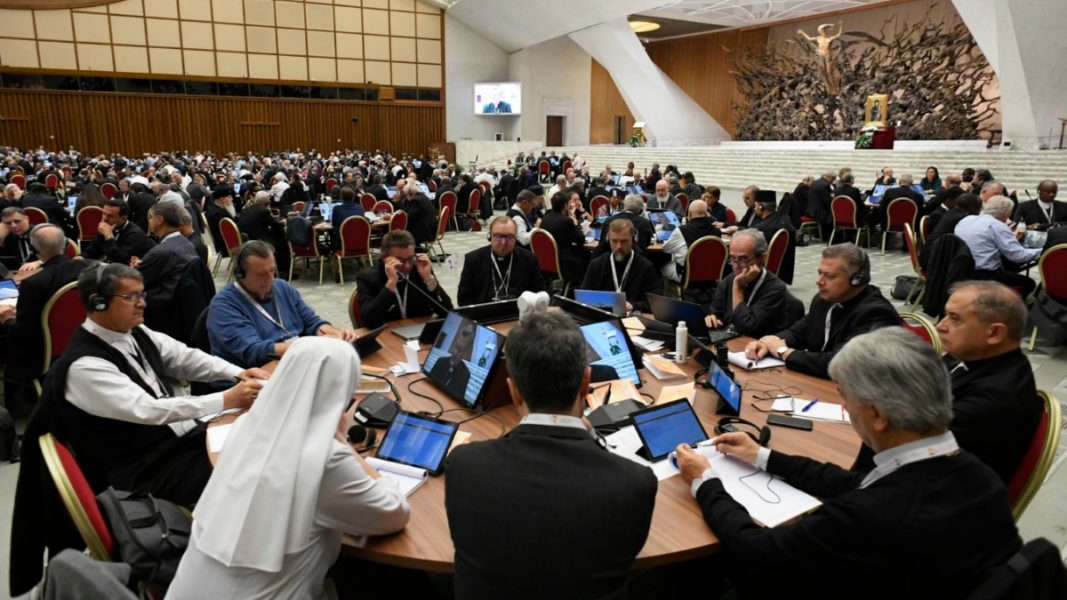
A new report prepared within the framework of the Synod on Synodality proposes opening “new spaces of responsibility” for women in the Church, reviewing the language used in catechesis, and overcoming what it describes as a mentality marked by “clericalism” and “machismo.” The document —currently available only in English and Italian and disseminated by Vatican News— collects the conclusions of Study Group 5, tasked with analyzing women’s participation in ecclesial life and governance.
A report from the Synod’s study group
The text corresponds to the final report of Study Group 5, one of the ten teams created in 2024 to delve deeper into issues arising during the Synod on Synodality process.
According to the information published by Vatican News, the document has been delivered to the Synod’s General Secretariat and made public by decision of Pope Leo XIV, who established that the reports be published progressively “in a spirit of transparency.” This is the third report published to date.
The group, coordinated by the Dicastery for the Doctrine of the Faith, had the mission of studying theological and canonical issues related to forms of ministry in the Church, including women’s participation in tasks of responsibility.
As the General Secretariat itself has pointed out, these texts should be understood as working documents, the fruit of consultations and studies carried out with episcopal conferences, universities, and ecclesial organizations. The report, therefore, does not modify any doctrine, although it does introduce issues that affect long-standing theological and canonical debates.
“Nothing prevents women from assuming leadership roles”
One of the most cited passages in the document states that “there is nothing, in the very fact of being a woman, that prevents assuming leadership roles in the Church.” From this premise, the report proposes opening “new spaces of responsibility for women” and rethinking some areas of participation within ecclesial life.
The text also maintains that women’s participation in leadership tasks should not be considered simply a concession from hierarchical authority. In the words of the report, “the active participation of women in the life and guidance of the Church should not be understood as a concession from hierarchical authority,” but rather should be linked to the recognition of charisms and the dignity of baptism.
The debate on authority in the Church
The report also addresses one of the classic debates in canon law: the relationship between the sacrament of Holy Orders and the power of governance in the Church.
The Code of Canon Law establishes that those who have received holy orders are capable of exercising the power of governance, while lay faithful can cooperate in its exercise. The document recalls, however, that the apostolic constitution Praedicate Evangelium, which reformed the Roman Curia, allows non-ordained faithful to preside over some Vatican dicasteries.
From this precedent, the report raises the possibility of expanding the participation of the laity—and particularly women—in governance functions exercised by delegation from ecclesiastical authority.
Women from Church history cited in the report
To support its reflection, the document reviews the role of various women who, throughout history, exercised significant influence in the life of the Church without having received the sacrament of Holy Orders.
Among the figures mentioned are women from the Old and New Testaments, such as Mary Magdalene, as well as historical figures like Joan of Arc, Hildegard of Bingen, or Saint Francesca Cabrini.
The report also mentions more recent examples, such as Dorothy Day, Maria Montessori, or Wanda Półtawska, presented as women who exercised relevant moral or intellectual authority in the Church’s mission.
Recent appointments in the Vatican
The report also points out some recent appointments that it considers significant in the reflection on women’s participation in governance responsibilities.
Among them, it mentions the case of Sister Simona Brambilla, appointed in 2025 as prefect of the Dicastery for Institutes of Consecrated Life and Societies of Apostolic Life, becoming the first woman to preside over a Vatican dicastery.
It also recalls the appointment of Sister Raffaella Petrini as president of the Governorship of Vatican City State, one of the most relevant administrative positions in the Holy See.
According to the report, these precedents show that spaces already exist in which women exercise governance responsibilities in the Church, particularly in areas where authority is exercised by delegation and not directly linked to the sacrament of Holy Orders.
The proposals that appear in the debate
The document also collects various issues raised during the synodal consultation process. Among them are proposals such as the creation of new ministries, greater female participation in pastoral or administrative responsibilities, or the possibility of assuming coordination tasks in local communities.
The report even includes references to broader debates, such as the opportunity to deliver the homily in community celebrations or the eventual creation of new stable ministries.
However, it does not directly address the issue of the female diaconate, considered by the group as an issue that is not yet mature and that has been previously studied by specific commissions.
The document does not present these proposals as conclusions, but rather collects them as part of the theological debate open in the synodal context.
Criticism of clericalism and machismo
Another aspect addressed in the document is the critique of what it describes as an ecclesial mentality marked by clericalism and machismo.
The report states that these attitudes can generate distrust and distance in some women regarding ecclesial life. In this context, it proposes paying greater attention to the language used in preaching, catechesis, and official Church documents.
According to the text, in some contexts, ecclesial discourse has associated the feminine almost exclusively with traits such as sweetness, docility, or motherhood, leaving other capacities such as leadership, teaching, or discernment in the background.
Re-reading the figure of Mary
The report also proposes reconsidering the way the figure of the Virgin Mary is presented in relation to the role of women in the Church.
The authors suggest avoiding an interpretation centered exclusively on motherhood and highlighting other aspects present in the Gospels, such as her role as a believer, witness, and reference figure in the first Christian community gathered in prayer.
The report’s method: starting from experience
The document also notes that its working method started “from below,” that is, from the direct listening to women who hold responsibilities in the Church, including workers in the Roman Curia.
This approach is supported by a principle cited in the text itself:
“reality is superior to the idea.”
However, some theologians have pointed out that this method raises methodological questions, since traditional Catholic theology interprets historical realities in the light of the deposit of faith and the magisterium, and not vice versa.
A process still open
The conclusions of the report are not binding and do not constitute a doctrinal decision. It will now be up to the competent dicasteries to study the proposals arising from these working groups and present concrete orientations to the Pope if applicable.
Rather than closing the debate, the document confirms that the issue of women’s participation in ecclesial leadership has become one of the most sensitive topics in the current synodal process. The final decisions, in any case, will correspond to Pope Leo XIV.