


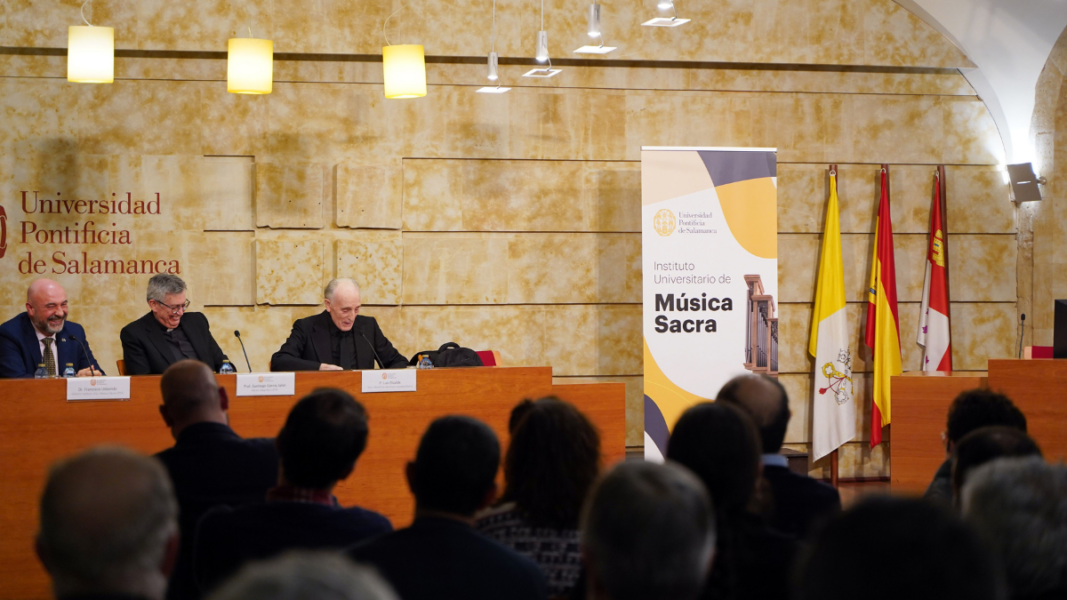
The Pontifical University of Salamanca (UPSA) has presented the University Institute of Sacred Music, a new academic institution dedicated to the teaching, research, and promotion of liturgical music. The objective is to offer specialized training and foster a musical practice linked to the liturgical tradition of the Church.
An institute for training in liturgical music
According to Alfa & Omega, the new institute is born with the intention of offering a stable academic framework for the study of sacred music in Spain. Its director, Francisco José Udaondo, emphasizes that music should not be understood as a mere accompaniment to the liturgy, but as an integral part of it.
The project aims to integrate academic research, historical study, and interpretive practice within a university structure linked to the Spanish episcopate.
Udaondo points out that currently in the Iberian Peninsula, there are hardly any regulated academic programs specifically oriented toward musicians who work in service of the liturgy or pastoral agents linked to sacred music.
A specialized master’s in sacred music
Among the institute’s main initiatives is the launch of a master’s program that will address different aspects of liturgical music.
The curriculum includes subjects related to liturgy and the history of sacred music, singing and choral direction—with special attention to Gregorian chant and polyphony—as well as training in harmony, composition, organ, and improvisation.
In addition, the institute plans to hold an international composition contest in the coming months with the aim of promoting the creation of new sacred music works in continuity with the tradition.
A meeting place for Church musicians
The University Institute of Sacred Music also aspires to become a meeting point for musicians linked to liturgical life, such as organists, choir directors, and those responsible for music in parishes and cathedrals.
The initiative seeks to foster the exchange of experiences and promote training that allows for improving the quality of liturgical music in Christian communities.
Sacred music and spiritual experience
Udaondo highlights that sacred music continues to arouse interest both from an artistic and spiritual point of view. In his opinion, when performed with quality, it remains capable of eliciting a profound experience even among people distant from the faith.
The institute’s director recalls that many of the great works in the sacred repertoire were born as part of the Church’s prayer and not as pieces destined exclusively for concert.
In this sense, he emphasizes that liturgical music is called to accompany the celebration of faith and to contribute to opening paths toward transcendence.