


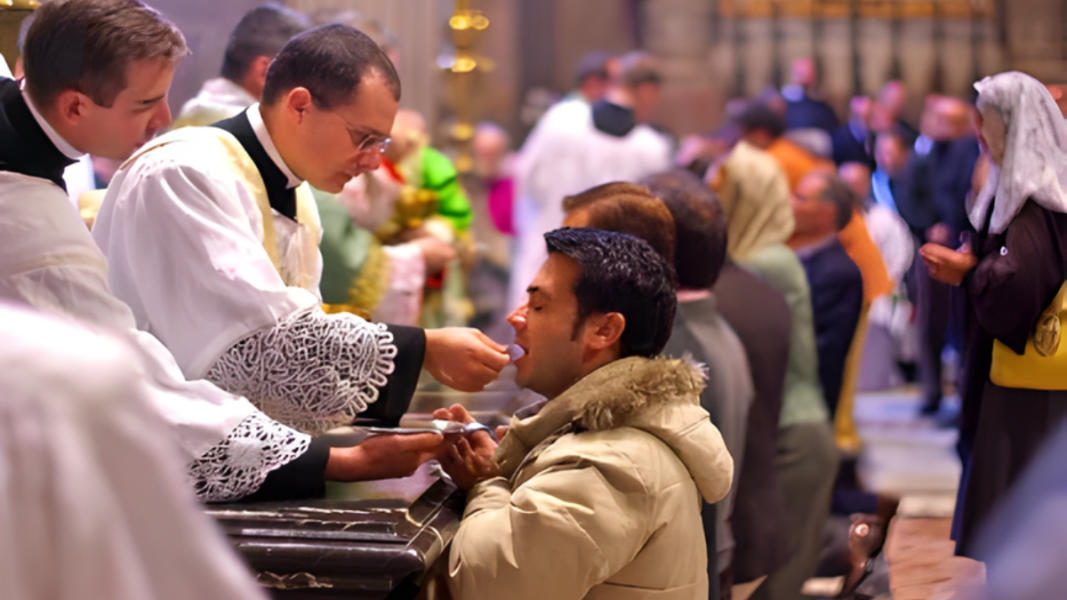
There is an accusation that repeats with surprising lightness every time someone defends the traditional Mass or decides to kneel to receive Communion: pride. No theological arguments are offered. No documents from the Magisterium are cited. It is not demonstrated that this gesture contradicts the faith of the Church. Simply, the disqualification is thrown: «they think they are better,» «they want to appear to have more faith,» «they feel superior.»
It is a poor resource, but effective. When the gesture itself cannot be attacked, the heart of the one performing it is attacked. Debate disappears and is replaced by a moral suspicion. It is not discussed whether kneeling is legitimate—something that the tradition of the Church has considered natural for centuries—but rather an attempt is made to judge the interior intention of the faithful.
And there lies the abuse. Because no one can know what is in the heart of another. No one can claim that a young person kneels out of pride, just as no one can claim that someone who receives Communion standing does so out of irreverence. The interior of people belongs to God, not to the observers of the moment who arrogate to themselves the right to dispense spiritual diagnoses.
The accusation, moreover, is profoundly absurd. Kneeling has always been the classic gesture of Christian humility. The believer kneels because he recognizes that he is not before something ordinary, but before Christ Himself. Bending the knee is admitting one’s own smallness. Turning that gesture into proof of pride requires completely inverting its meaning.
In fact, the most likely thing is exactly the opposite of what is insinuated. Many faithful—and especially many young people—kneel not because they think they are better, but because they need that gesture to remember before whom they stand. Because form, tradition, and the body help sustain a faith they know to be fragile. It is not a spiritual exhibition. It is a need of the heart.
That is why it is so unjust to point at someone who kneels as if they were making a declaration of moral superiority. In reality, the only thing they are doing is adoring. And doing so in the same way that entire generations of Catholics before them did.
It is worth saying it clearly: accusing someone of pride for kneeling before the Eucharist is a rash judgment about another person’s soul. And that type of judgment reveals more about the one who pronounces it than about the one who receives it.
Therefore, if you ever feel the pressure of those looks or insinuations, do not accept that moral blackmail. Do not let them make you believe that your gesture of adoration is an act of pride. If your conscience leads you to kneel before Christ, do so with serenity and humility.
Because before the Eucharist, it is not about appearing better than anyone else. It is simply about recognizing who He is. And before God, the bent knee has never been pride: it has always been adoration.