


The priest of the Archdiocese of Toledo, Luis Gil Borrallo, has published a critical reflection on the recent doctrinal note from the Spanish Episcopal Conference (CEE) on the role of emotions in the act of faith.
In a post on the social network X, the presbyter raises various theological and pastoral doubts about the episcopal document and about some methods of new evangelization to which it refers.
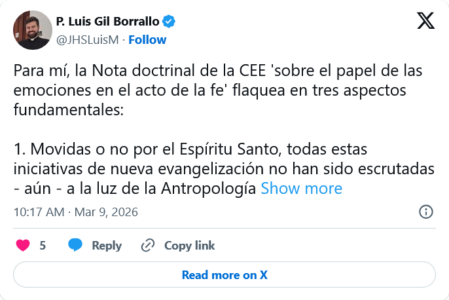
For me, the CEE’s Doctrinal Note ‘on the role of emotions in the act of faith’ falters in three fundamental aspects:
1. Whether moved or not by the Holy Spirit, all these new evangelization initiatives have not yet been scrutinized in the light of Theological Anthropology and the Church’s doctrine on justification. Many saints, moved by God, bequeathed to the Church concrete ways of living Christianly under a rule, a mode of personal consecration… And it is possible that at the moment they received the divine motion for the dissemination of these concrete ways of living the faith, they themselves did not know how to explain or understand in what way these concrete practices supposed a help for the life of faith. However, the Church, subsequently, when giving a ‘placet’ or a ‘nihil obstat’ (I don’t know if they are the most appropriate terms), has had to carefully examine the content of the proposal. And, under the approval, rests the Church’s endorsement, which commits its word supported by God’s Revelation and its own capacity to discern. Now, the purpose of the CEE’s doctrinal note is to «help in discernment and accompany in the maturation of these apostolic experiences so that they can grow and provide better service to so many people who approach the Church.» I hold the following position: although the intention of the note is truly the one mentioned above (‘de internis…’), the note does not clarify the consonance or not of these apostolic experiences with that set of acts that we can qualify as «good» because they are ordered to the proper end of the subject who performs them. Therefore, what should our discernment rest on? It could be objected to me that, except for people who have complete training in Philosophy and Theology, the rest of the faithful also cannot give an account of the consonance or not of the acts of piety they perform in the light of Theological Anthropology (praying the rosary, venerating an image of the Lord, the Virgin or the saints…) and, however, they continue to do so with spiritual benefit without asking for much explanation. To this objection, I respond: Nicea II (787) and the bull ‘Consueverunt Romani Pontifices’ (1569) resolve the question of the veneration of images and the prayer of the rosary in the Church. The discernment of these issues is resolved in the light of the authority of the Church that produced these declarations. Now, in the case of these new proposals and, continuing with the previous example, we are talking about the fact that – for whatever reason (and this is the most important nuance of the whole issue) – the veneration of images and the Holy Rosary do not seem to be the means chosen at first by these new evangelization proposals because they estimate that there are others more suitable – which are not, for example, those of the ‘classic’ Catechumenate or NeoCatecumenal – to introduce into Christian life those who approach the faith. I do not know in what consideration the promoters of these proposals hold their own proposals: whether alternatives, complementary, substitutive, introductory… (that would be another nuance). In any case, here comes the question: if there are means more suitable than those that the Church has proposed in its perennial teaching for a specific moment and time, and knowing that the Church has in Jesus Christ and the sacraments the most eminent means of salvation, and that the rest of religious practices are articulated in historical moments to offer a channel toward Christ and sacramental life, what man do these means portray (which are in accord with the times)? If these proposals are directed toward Christ, from where do they begin to walk? Where have they gone to seek man and how are they lifting him up? Are they telling this man who he is, besides how he is? Is it being clearly affirmed that if the path has more steps than before it is, simply, because the starting point was farther away? Expressed in colloquial language: this helps because it «reaches.» The question is: reaches where? And, above all, it is true that one can «reach» to the depths of the abysses because today’s man ‘is very lost.’ But, reaching there is not enough! You reach, yes, but what do you do with him? Do you tickle him or help him climb up? And here is where a merely phenomenological explanation – like those that abound in the magisterial documents of the Bishops – is quite insufficient. Saying that «man is like this…» or «man is like that…» and «we can reach him like this» or «we can reach him like that…» and then inviting discernment is stopping halfway.
2. Here I link with the question of the chosen means. It is on them that discernment operates. According to Saint Thomas Aquinas, the spiritual powers (especially the will and, to a lesser extent, the intellect) can become vitiated or corrupted by continuous exposure to entities (objects, apparent goods or evils) that move them in a direction opposite to their proper ends. This occurs mainly through the formation of vicious habits (vices), which are stable dispositions toward moral evil, acquired by repetition of disordered acts. The intellect (cognitive power) is ordered primarily to truth (proper end: to know what is). It does not «vitiate» easily in a strict moral sense, because its act is speculative or practical, and error is not sin if it is not voluntary. However, it can become dulled, blind, or obscured by vicious habits (such as culpable ignorance or imprudence), especially when the will disorders the search for truth (through immoderate curiosity, pride, or negligence). Continuous exposure to falsehoods or apparent goods can generate stable erroneous opinions (habits of error), but vice properly speaking resides more in the will that allows or chooses such objects. The will (intellective appetite) is ordered to rational good (proper end: true good, ultimate end: God). It is more susceptible to vitiation because it is free and can choose apparent goods (disordered pleasures, power, wealth, etc.) as if they were true goods. Continuous exposure to such entities (for example, excessive sensible pleasures, repeated injustices, or worldly goods) generates vicious habits that incline the will toward evil in a connatural and almost automatic way. Now (quid of the question): the means chosen by all these new evangelization systems, what qualification do they deserve in the light of this distinction of Saint Thomas? Do they orient the intellect and the will to their proper ends? The answer is – again – worrying: I DON’T KNOW. I don’t know because it is hidden from me and I don’t know because it is not discerned. And the CEE’s note, in this regard, says nothing at all. They do not even commit their own authority and word (it would be necessary to specify exactly in whose name they would do it if they did) as a criterion of reliability that the means are adequate. They limit themselves to warning and preventing (which is the same as what I am doing) and to saying how they should be (which I am also doing). Now, to the question of how they are, no answer is given.
3. And the fact of not answering this last question I raise is symptomatic and significant. And it makes me wonder what intention it harbors. Do they know that, from studying these issues in depth, they would be forced to break the secrecy of some retreats in order to publish their conclusions and that would go to the detriment of the same? Do they suspect that perhaps not all the means are well ordered and we would be supporting that the end justifies the means? Do they fear that this «pastoral success» will dilute when put in the spotlight?
There are other questions and doubts that I do not raise here but that worry me greatly because I cannot clear them up satisfactorily.