


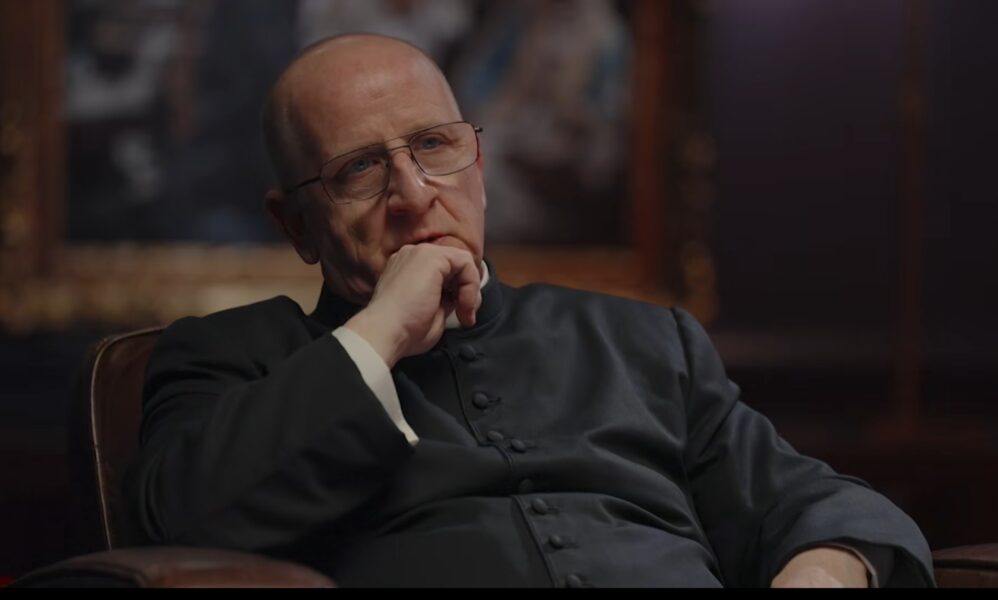
The well-known American priest assures in an interview on one of the most watched channels in the United States that during exorcisms, names, rituals, and crimes related to members of the hierarchy have come to light. His words once again focus attention on the moral crisis in the Church.
A very lengthy interview granted by the American priest Chad Ripperger, one of the most well-known exorcists in the world, has unleashed a strong commotion in Catholic circles and on social media. The conversation, broadcast on the popular Shawn Ryan podcast, exceeds four hours and delves fully into issues that rarely appear exposed with such rawness in a format of great audience reach: demonology, spiritual warfare, occultism, satanic rituals, and, above all, the possibility that part of the ecclesiastical structure has been morally and spiritually corrupted.
The interview has gained particular interest not so much for its references to spiritual combat—usual for an exorcist—as for the statements Ripperger makes about the Vatican and members of the hierarchy. He assures that in various exorcisms, demons have mentioned names, specific rituals, and serious crimes linked to people in positions of authority within the Church. According to him, these are not isolated episodes or personal intuitions, but a pattern that, he claims, other exorcists have also found in different cases.
Who is Chad Ripperger
Ripperger is not an unknown priest or a peripheral figure in the traditional Catholic world. Ordained in 1997, he holds a doctorate in philosophy and theology, and is the founder of the Society of the Most Sorrowful Mother, a religious community based in Denver known for its dedication to the ministry of deliverance and exorcism. For years, he has become a reference for many priests interested in practical demonology, spiritual theology, and the pastoral application of Thomistic tradition.
His intellectual profile has decisively contributed to that notoriety. He is the author of several books on psychology, interior life, spiritual combat, and demonic action, and much of his lectures are supported by a conceptual framework heavily influenced by Saint Thomas Aquinas. That mix of philosophical training, casuistry of exorcisms, and direct language has given him a singular authority among Catholic sectors that believe the current Church has relegated preaching about the devil, sin, and judgment.
Precisely for that reason, what Ripperger says is not usually received as mere eccentricity. His figure carries weight in a realm where exorcists are listened to attentively and where spiritual warfare is not considered a metaphor, but a concrete reality. The interview with Shawn Ryan, in that sense, is not just another eye-catching chat: it is the entry of a very specific discourse from traditional Catholicism into a massive showcase.
The claims pointing to the Vatican
The most explosive part of the interview comes when Ripperger asserts that the Church’s «authority structure» has been «spiritually compromised» by some of the people who form part of it. He is not talking solely about moral weakness, mediocrity, or pastoral cowardice. His language is more severe. He claims that part of the ecclesial leadership would be «morally compromised» and involved in «very dark things.»
The priest explains that, in the context of some exorcisms, demons would have revealed information related to crimes, rituals, and occult practices committed by people in the hierarchy. He does not present documents or public evidence, nor does he identify specific individuals in the interview. But he does insist that it is not an isolated impression of his and that other exorcists would have received similar partial information. In his account, the coincidence of those fragments would draw a gravely serious panorama: a moral and spiritual infiltration in high sectors of the Church.
Ripperger goes so far as to assert that some environments in the Vatican do not look favorably on the work of exorcists who speak clearly about these issues. The reason, according to his interpretation, would be obvious: those implicated in particularly grave sins do not wish for explanations about how the devil acts, how certain spiritual dynamics consolidate, and how certain vices end up opening the door to increasingly profound forms of corruption.
A charge of enormous scope, but based on exorcism testimonies
It is worth pausing here. What Ripperger proposes is of immense gravity, but the support for his claims is not judicial investigations or leaked files, but what he would have heard during exorcism sessions. That nuance is decisive. The very field of exorcism teaches that demons lie, mix truth and deception, and use confusion as a weapon. However, the priest asserts that, at certain moments and under divine mandate, they can be forced to tell concrete truths.
From that principle stems his entire argumentation. What he offers is not a journalistic denunciation in the strict sense, but a spiritual reading of the ecclesial crisis supported by years of ministry, comparison of cases, and coincidence of data that, he claims, have appeared again and again. That does not automatically turn his words into proven facts, but it does explain why they have caused such a stir: because they come from the mouth of a priest with wide reputation in a particularly sensitive field and because they fit, at least partially, with a climate of distrust toward ecclesial power structures that has not stopped growing after decades of scandals.
The moral crisis of the Church, according to Ripperger
Beyond the most eye-catching aspect of the interview, Ripperger articulates a underlying thesis that deserves attention. In his view, the current crisis of the Church cannot be understood solely in sociological or political terms. What exists, he says, is a prior spiritual decomposition that then manifests in abuses, cover-ups, doctrinal cowardice, loss of the sense of the sacred, and generalized moral decay.
In his analysis, when Catholics abandon confession, the life of grace, moral discipline, and prayer, the Church weakens from within. And when that happens, positions of government end up being occupied or influenced by spiritually vulnerable men, ambitious or directly corrupted. That is why he arrives at a devastating phrase: «we have the leaders we deserve.» He does not pose it as an excuse to absolve unworthy pastors, but as a warning: without real conversion of the Christian people, the purification of the Church will never be complete.
From abuse to occultism: the thread traced by the exorcist
Ripperger also links this issue with another central idea in his discourse: the relationship between certain forms of sexual immorality, the loss of moral restraints, and the opening to increasingly dark practices. According to his scheme, many degradations do not remain static. They start with tolerated sins, continue with the normalization of vice, and end up generating a ritualized, deformed mentality that is radically hostile to God.
It is there that he introduces his references to networks of occultism, ritual abuses, and satanic pacts. Again, he does not provide public demonstrations in the interview, but he does insist that these processes exist and that they affect both low levels and very high strata of society. In his vision, part of contemporary elites would not simply be corrupt or immoral, but spiritually subjected to a demonic logic that rewards power, secrecy, manipulation, and the destruction of innocence.
Why his words find echo
The interest awakened by this interview is not explained solely by morbidity. It also responds to a very precise ecclesial and social context. For years, too many Catholics heard that certain denunciations were exaggerations, fantasies, or attacks on the Church, until the reality of abuses and cover-ups finally came to light with devastating force. That precedent makes many faithful today not react with automatic incredulity when a priest speaks of rot in the hierarchy.
What the interview leaves behind
The conversation with Shawn Ryan leaves an unequivocal impression: Chad Ripperger does not see the Church’s situation as a mere administrative, doctrinal, or disciplinary crisis. He sees it as a spiritual battle of dramatic proportions. And in that battle, according to his reading, part of the ecclesial power would have yielded ground in an alarming way. His words are harsh, uncomfortable, and, in some points, extremely delicate. But they touch a fiber that today beats strongly in many Catholics: the conviction that the Church faces not only human errors, but a profoundly spiritual offensive that has reached even places where holiness should be guarded with greater zeal.
It remains to be seen how far the impact of this interview will go. But one thing seems clear: when an exorcist with Ripperger’s visibility speaks of compromised hierarchies, darkness in the top echelons, and internal resistance to those who want to bring these issues to light, silence is no longer as easy as before.