


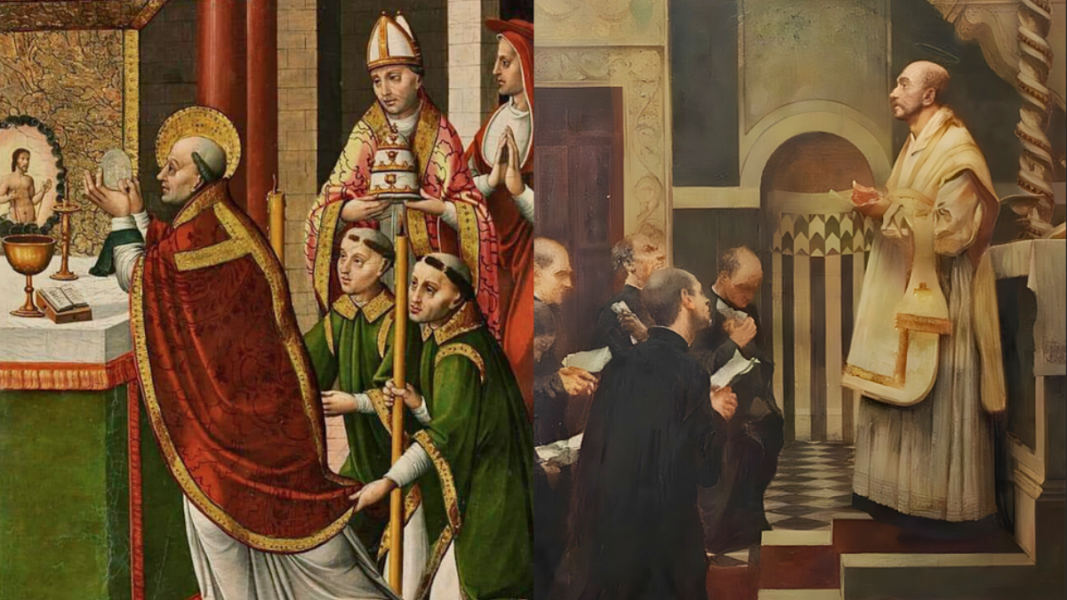
“Blessed Fernando, Archbishop of Granada and minister of the kingdom at the same time, was always extremely busy, and yet he celebrated Holy Mass every day. On one occasion, informed by Cardinal Toledo that the Court was murmuring because, despite being overwhelmed with so many affairs, he did not want to deprive himself of celebrating even one day, the Servant of God replied: «Since Their Highnesses placed such a heavy burden on my weak shoulders, I need a powerful support to not succumb. And where will I find it better than in the holy sacrifice of the Mass? There I acquire all the strength and vigor necessary to carry my burden.” This story and a hundred more of other virtuous examples are testimony to the truth about the incomprehensible value of the Holy Sacrifice of the Mass. In the face of this kind of events, those who are true devotees of the Cross ask the question that arises from love, which is usually in these words: how can I make the most of this treasure in which my soul delights?
This very question has been a contentious matter in recent decades, particularly since the beginning of the 20th century. The issue of participation in Holy Mass has become a false dichotomy consisting of two branches divided between the annulment of being (just going to Mass and doing absolutely nothing) or feeling compelled to get involved in a series of ministries coming from the most insidious corners of human nature in order to achieve a goal of feeling part of Holy Mass.
The pious Christian, through the centuries, has been perfecting this art of participation in Holy Mass to the point of being able to cultivate spiritual life with exemplary delicacy in obedience to what has been professed by the most learned saints. It is impressive the number of forms, methods, and styles of participation in Holy Mass that have been formed with the help of the Holy Spirit, that without a doubt there exists some suitable form for each person. When one explores with diligence the ways to mystically intertwine with the Holy Sacrifice of the Mass, one becomes aware of a variety of hidden treasures that dramatically differ from what is received in modern ecclesial environments. If one compares the vast and wide menu of the spiritual buffet offered by the Church in its tradition forged by the Most Holy Trinity with the scant options of parish everyday life, it is easy work to notice the precariousness and malnutrition that the faithful receive with the normalized deception that they are indeed obtaining what is necessary to join with the Eucharistic Sacrifice. No wonder -one would say- that the parishioners are so lost in the faith if they are not offered even a quarter of the incalculable heritage for the salvation of souls.
With the goal of elucidating this topic in the easiest way possible, below are brought to the table some excerpts taken from the magnificent book called “The Hidden Treasure” written by St. Leonard of Port Maurice. In this brief treatise written by this humble spiritual son of St. Francis of Assisi, there is a section dedicated to proposing some common and profitable ways to assist at the sacrifice of the Mass. With an eloquent simplicity of words, our dear saint will summarize for us what the Church has professed in a variety of manuals, treatises, writings, and letters through the centuries on this matter. Only the most striking excerpts will be cited for didactic purposes; as always, we invite the pious reader to read the complete book for greater growth in the Christian life. Let us read the following with attention:
***
“The Hidden Treasure” by St. Leonard of Port Maurice. (Method to Hear Holy Mass Fruitfully, Section 2: Different Methods to Hear Holy Mass.)
“The first consists in following with the greatest attention and with the book [Missal for the Laity] in hand, all the actions of the priest, praying to each of them the corresponding vocal prayer contained in the book, so that the entire time of the Mass is spent reading. If meditation on the holy mysteries being celebrated on the altar is joined to the reading, it is undeniable that one assists at the adorable Sacrifice in an excellent and very profitable way. But since this requires excessive subjection, as it is necessary to attend to the ceremonies performed on the altar and alternately direct the gaze to the priest and to the book, to read in it the prayer corresponding to that part of the Mass, it follows that it is very laborious in practice; and I even tend to believe that there will be few faithful who persevere for a long time using this method, however useful it may be. Such is the weakness of our understanding, that it distracts easily when it has to attend to the multitude of actions that the priest performs on the altar. Despite this, the one who finds himself comfortable with this method, and obtains his spiritual profit from it, can continue using it with the hope that such a laborious work will earn him a magnificent reward from God.
The second method to assist fruitfully at Holy Mass is practiced not by means of reading, not even during the time of the Sacrifice, but by contemplating with the eyes of faith Jesus Christ nailed to the cross, in order to gather in a sweetest contemplation the precious fruits that fall from that tree of life. The entire time of Holy Mass is employed, therefore, in a profound interior recollection, engaging in spiritually considering the divine mysteries of the Passion and death of the Savior, which are not only represented but also mystically reproduced on the altar. Those who follow this method undoubtedly, if they take care to keep the powers of their soul united to God, will succeed in exercising acts of faith, hope, charity, and all the virtues. This way of hearing Mass is more perfect than the first, and at the same time sweeter and more gentle … I would wish that all learn in its school a science so profound.
The third method to assist fruitfully at the holy sacrifice of the Mass has preference over the previous ones. It does not require reading a large number of vocal prayers like the first, nor does it require a contemplative spirit as needed to follow the second. However, if well considered, it is the most in accordance with the spirit of the Church, whose desires are that the faithful be united to the sentiments of the priest. This one must offer the Sacrifice for the four ends indicated in the previous instruction [Note: “The first, to praise and honor the infinite majesty of God, which is worthy of infinite honors and praises. The second, to atone for the innumerable sins we have committed. The third, to give thanks for the benefits received. The fourth, finally, to direct supplications to Him, as author and dispenser of all graces.”], since this is the most effective means to fulfill the four obligations we have contracted with God. Consequently, and since when you assist at Mass you perform in a certain way the functions of a priest, you must dedicate yourself in the best possible way to the consideration of the four indicated ends, which will be very easy for you by means of the four offerings that I am going to present to you. Here is the method reduced to practice … As soon as the Mass begins and when the priest, humbling himself on the steps of the altar, prays the Confiteor, make a brief examination of your sins, excite yourself to an act of true contrition, humbly asking the Lord to forgive you, and implore the aids of the Holy Spirit and the protection of the Most Holy Virgin to hear the Mass with all possible respect and devotion. Immediately afterward, and to successively fulfill the four most important obligations of which I have spoken to you, divide the Mass into four parts, which you can do in the following way:
In the first part, from the beginning until the Gospel, you will satisfy the first debt, which consists in adoring and praising the majesty of God, which is infinitely worthy of honors and praises. For this, humble yourself profoundly with Jesus Christ, immerse yourself in the consideration of your nothingness, sincerely confess that you are nothing before that immense Majesty, and humbled in soul and body (for in Mass the most respectful and modest posture must be observed)…Above all, strive to remain in profound recollection and very united to God. Ah! how well you will satisfy God in this way your first debt!
You will satisfy the second from the Gospel until the elevation of the Sacred Host, and directing a look at your sins, and considering the immense debt you have contracted with divine Justice … repeat these acts with a lively and profound contrition. Give free rein to the affections of your soul, and without articulating a word, you will say to Jesus from the depths of your heart: «My most beloved Jesus! Give me the tears of St. Peter, the contrition of Mary Magdalene, and the sorrow of all the Saints, who from sinners became fervent penitents, so that, by the merits of the Holy Sacrifice, I may obtain complete forgiveness of all my sins». Repeat these same acts in perfect recollection, and rest assured that in this way you will fully satisfy all the debts you have contracted with God because of your sins.
In the third part, that is, from the elevation of the chalice until Communion, consider the innumerable benefits with which you have been filled. In return, offer to the Lord a victim of infinite price, namely: the Body and Blood of Jesus Christ. Also invite the Angels and Saints to give thanks to God for you … With what sweet complacency this God of goodness will receive the testimony of such affectionate gratitude! How satisfied He will be with this offering which, being of infinite price, is worth more than the whole world! Therefore, to excite more and more in your heart these pious sentiments, invite the entire heavenly court to give thanks to God in your name … To this end, you will do very well to pray every day some act of offering, to offer to God in thanksgiving, not only all your actions, but also the Masses celebrated throughout the world.
In the fourth part, from Communion until the end, while the priest receives sacramental Communion, you will make spiritual Communion in the way I will explain to you at the end of this chapter. Immediately direct your gaze to God Our Lord who is within you, and encourage yourself to ask for many graces. From the moment Jesus unites Himself to you, He is the one who prays and supplicates for you. Therefore, enlarge your heart, and do not limit yourself to asking only for some favors: ask for many, very many graces, because the offering of His Divine Son, which you have just made to Him, is of infinite price … Ask without fear, ask for yourself, for your friends, relatives, and other dear persons. Implore God’s assistance in all your spiritual and temporal needs. Pray also for those of the Holy Church, and ask the Lord to deign to free it from the evils that afflict it and grant it the fullness of all goods. Above all, do not pray with lukewarmness, but with the greatest confidence; and be assured that your supplications, united to those of Jesus, will be heard.
Mass concluded practice the following act of thanksgiving, saying: «We give You thanks for all Your benefits, O Almighty God, who live and reign forever and ever. Amen». You will leave the church with your heart so moved as if you were coming down from Calvary. Tell me now: if you had assisted in this way at all the Masses you have heard until today, with what treasures of graces you would have enriched your soul!