


Part I: origins and characteristics
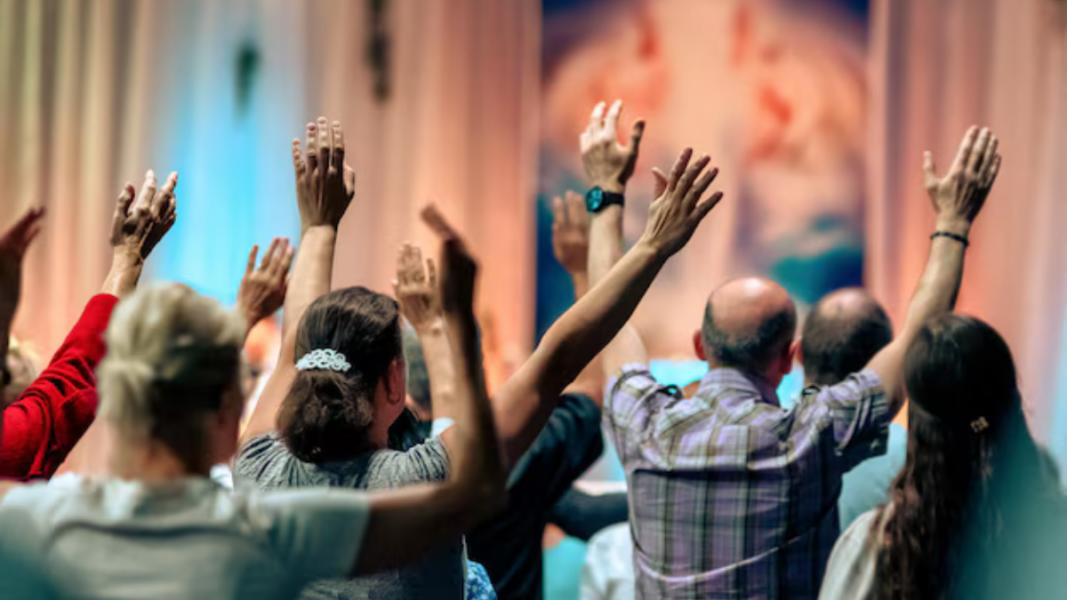
Now that the Spanish bishops have spoken – albeit confusingly – about the danger of emotivism in faith, it seems interesting to me to recover the comment from a few weeks ago on the multitudinous Llamados 2033 event to focus on the Catholic Charismatic Renewal, not only because of its false ecumenism, but also because of that viscous style of charismatic praise that is being imposed in the Catholic Church.
Many may wonder why we include the Charismatic Renewal in the false ecumenism that is being imposed when it is a Catholic movement. Well, let’s take a closer look at this movement to understand how it is actually Pentecostal, Protestant, and not only in its origin but in all its characteristics, in addition to being heterodox and even heretical, in the words of the Canadian scholar Kennedy Hall, who belonged to this movement and has studied it in depth in his essential work Charismania.
To understand the Charismatic Renewal movement, we begin today a triptych in which we will investigate its origins and characteristics, its “baptism” in the post-conciliar Church and its stealthy but constant current expansion in parishes.
An extensive article by Pablo Ginés in 2017 on the Aleteia portal (https://es.aleteia.org/2017/02/16/que-es-la-renovacion-carismatica-catolica/) already exposed the heterodoxy in the origins and practices of the movement, although it did not conduct any critical analysis on the matter.
Ginés explained the origins of the Charismatic Renewal as follows: “50 years ago, the weekend of February 17-19, 1967, a couple dozen North American Catholic students, at Duquesne University, went on a retreat to the retreat house The Ark and the Dove, near Pittsburgh (USA). There they prayed to ask for baptism in the Spirit, a powerful action of the Holy Spirit that would transform their lives. At first, nothing seemed to happen. They took a break, started preparing a birthday party… but soon after they found themselves each going to the chapel on their own and there they couldn’t stop praying. Many praised God out loud, with enthusiasm. Others felt a joy that led them to dance. Others cried with joy. Some fell as if struck down before the Tabernacle in the chapel, in an overwhelming feeling of adoration. When they returned to their Duquesne University campus, they told their classmates, friends, relatives, siblings. Although the university was Catholic, no one from the local clergy supported it in any way, the disinterest was complete. It was the young people and some professors who spread it from campus to campus, from city to city. Every week they needed to gather and pray, out loud and with a lot of music. Through people active in Cursillos de Cristiandad and other Catholic networks, it spread throughout the United States and the world. They were called “Catholic Pentecostals” or “charismatic Catholics.” Thus the Catholic Charismatic Renewal was born.” In 1969, a meeting was held with 500 representatives of Catholic charismatic prayer groups, which sprang up spontaneously, like mushrooms, without planning or centralized organization. In 1970 there were 200 groups in the US; in 1972 there were 12,000 Catholic charismatics in the country. In 1973, there were talks of 1,200 groups and 200,000 charismatics. The spark jumped from the US to France, to Latin America. From Mexico and Colombia, through a lay missionary couple, it arrived in Barcelona in 1973, and soon to Madrid, where there was a group “infected” by Americans from the Torrejón de Ardoz base”.
Up to here, the historical review that Pablo Ginés makes of the emergence of the Catholic Charismatic Renewal (hereinafter, CCR).
Only later, when he breaks down the main spiritual characteristics of the CCR, does Ginés mention two aspects that are very important and disturbing: 1) what he calls the “Protestant connection,” and he says: “The Duquesne students 50 years ago had studied something about the experience of Protestant Pentecostals and charismatic Baptists, Methodists, or Episcopalians, and had read their classic testimony books The Cross and the Switchblade and They Speak in Other Tongues; and 2) a Protestant charismatic woman attended their retreat to share her experience of the Spirit, and prayed with them. From the beginning, the charismatics, in the US and the rest of the world, felt a call to work for the unity of Christians (that is, the false ecumenism emanating from the Second Vatican Council) and to trust that the Holy Spirit would find the ways to foster that unity”.
In 2006, the centenary of the birth of Pentecostalism, Protestant, was celebrated, which began in a rundown church on Azusa Street in Los Angeles in 1906, with dozens of Pentecostal and Catholic charismatic congregations. That is, the Catholic CR celebrated as its own the origin of a Protestant, Pentecostal movement.
Kennedy Hall provides many more revealing details in his book published in 2024 and not yet available in Spanish, Charismania: the truth about the Charismatic Renewal (“Charismania: the truth about the Charismatic Renewal”). In the foreword, Fr. Marcel Stannus, FSSPX, says of the book: “Kennedy Hall offers a stark analysis of how the so-called Charismatic Renewal proposes a shortcut to the coveted power of miracles and signs. With a truly surgical ability to examine the tentacles, the hidden roots, the purulent symptoms, the deceptive charm, and the nauseating effects of this modern religious charlatanism, the author offers a compelling analysis that confirms the doubts of skeptics and warns the credulous and mistaken”.
With the author’s permission, we will reproduce and comment on fragments of his work.
The advantage of Kennedy Hall’s work, besides the wealth of details, is its critical perspective on the Charismatic Renewal, analyzing it from the tradition of the Church. That is why it is an essential work for anyone who wishes to understand this movement.
Regarding his time in the movement between 2015 and 2017, Kennedy Hall comments on a very important aspect that can lead us to empathize with so many people who seek God but are disoriented: “I had no idea what I was doing. So I appreciated the opportunity to be surrounded by Catholics who took it seriously. At first, I didn’t find anything objectionable in the practices: some music, some prayers, and happy moments of fellowship. However, soon I realized that the Renewal is a kind of club with inner circles: after they “initiate” you and you show some potential or fervor, they ask you to try new things. First, it’s praying with someone, then praying over someone or laying hands on them, and maybe praying with a deliverance team; meanwhile, people keep praying for you to “speak in tongues” (…) On one occasion, I attended an event and saw and heard something very strange. There was a woman standing next to me who was considered a kind of guru and who was known in the area for her “gifts.” People approached her to pray, and I saw something very worrying. The music was very loud — the Renewal is very noisy — and the lights were low, and I heard the woman speaking in what seemed like an ancient guttural language. Suddenly, the woman murmured something and passed her hands over the back of a young woman, who fell to the ground and began writhing as if electrocuted. The young woman remained there writhing for a long time, and the event continued with people doing similar things everywhere. When I reflect on that occasion, I almost feel ashamed to admit that I didn’t leave immediately. However, when you are in a state of spiritual ignorance, and the mentors and people you respect accept the events happening around you, you find yourself trapped in an environment that you cannot adequately evaluate. My instinct told me something was wrong, but I was a neophyte and believed that maybe there was a level of spiritual intelligence that I had not yet reached. Looking back now, I realize that what happened was demonic or perhaps some kind of hypnosis”.
Hall also states that “regarding the outpouring of the Spirit, in Pentecostal-style Protestantism, there are many groups that claim that only those who “pray in tongues” have the Holy Spirit. For Catholic doctrine (and that includes Catholic charismatics), everyone who has been validly baptized in the name of the Father, the Son, and the Holy Spirit has the Holy Spirit. Another thing altogether, say Catholic charismatics, is that the gifts of the Spirit may be dormant due to lack of faith, desire, and practice, and need an “outpouring or effusion” to manifest themselves. That is why, when Protestants speak of “baptism in the Spirit,” Catholics prefer to say “outpouring of the Spirit.” In other words, the CCR openly acknowledges that its origins and spirituality are based on the Protestant Pentecostal movement.
The text by Pablo Ginés we mentioned at the beginning overlooks issues that would need to be deepened, while omitting others equally important. First and foremost, the connection with Protestant Pentecostals of Catholic charismatics, which is the foundation of their spirituality. Isn’t that a problem? Aren’t Protestants, in their various variants, heretical sects? It doesn’t seem so for post-conciliar liberal Catholicism, which is why Ginés can so calmly state that the CCR originates in Pentecostalism and that they feel “a call to work for the unity of Christians” according to the false ecumenism that arose after the Second Vatican Council. However, seen from the traditional Catholic perspective, this origin of the CCR in a heretical sect and its spiritual borrowings are its very problem. And that is how Kennedy Hall explains it: “It wasn’t just the few strange things I saw that led me away from the Renewal – Hall continues. In late 2017, I discovered the Catholic Tradition through sermons I found on the Internet. Listening to these sermons by traditional priests, my heart was set on fire. I couldn’t believe the depth and greatness of the Catholic faith that I had been missing all this time. I fell in love with the faith of our ancestors because I fell in love with Christ. And I began to see the atrocious novelty and the erroneous mentality that permeates the entire paradigm of the Charismatic Renewal. In the Renewal, everyone is encouraged to become a direct channel with the Holy Spirit, and in practice this means that individual believers are like Catholics acting under a kind of “divine inspiration.”
The Tradition of the Church opened Kennedy Hall’s eyes to fully understand the great horror of the CCR. Hall says: “I had known for a long time that something “didn’t fit” in the Renewal (Charismatic), but I had never taken the time to study in depth the countless issues related to charismatic theology or the history of the movement. As if by Providence, in recent months I did what I always do: I found a rabbit hole and dove into it without thinking twice. I discovered that the Renewal was not only “wrong,” but that its theology is based on flagrant heresies, and that many of those heresies have been adopted, at least in part, by many Catholics. To put it bluntly, the Renewal is an absolute chaos of theology and strange practices, and the history of the movement is full of unbridled chaos. The theological foundations are modernist, Protestant, and even Gnostic in some cases.” And he concludes: “The Renewal is not God’s will, and it is not Catholic: its emotionalism and dangerous spiritual practices have harmed many people”.