



The recent Supreme Court ruling confirming prison sentences for seven people for comments published on Facebook against unaccompanied foreign minors in Melilla has placed the Jesuit Migrant Service at the center of the debate. The organization was not a secondary actor in the proceedings: it acted as a popular prosecution in the judicial process that ended with prison sentences for hate crimes and has rejoiced in them.
While the entity has publicly celebrated the high court’s ruling, which imposes sentences of between eight months and one year and ten months in prison, data has come to light on the public funding received by this organization linked to the Society of Jesus.
According to data from the National System for the Publication of Grants and Public Aid, compiled and disseminated on X by Israel Cabrera @absolutexe, the Jesuit Migrant Service has received a total of 1,365,337.44 euros in public grants between May 26, 2022 and October 27, 2025.
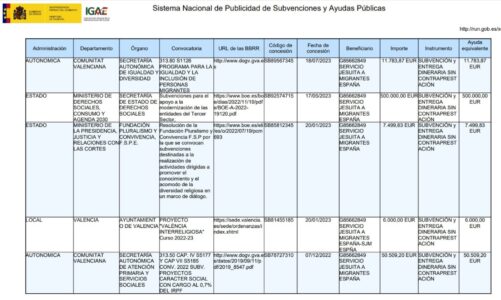
More than 1.3 million euros in public aid
The official records reflect multiple grants awarded by various public administrations for programs related to immigration, social inclusion, and intercultural coexistence projects.
Among the registered grants, the following stand out:
• 500,000 euros granted by the Ministry of Social Rights, Consumption and Agenda 2030 for the support and modernization of third-sector entities.
• 50,509.20 euros awarded by the Autonomous Secretariat of Primary Care and Social Services of the Valencian Community for social projects funded from the 0.7% of the IRPF.
• 11,783.87 euros granted by the Valencian Government under the program for the equality and inclusion of migrants.
• 7,499.83 euros from the Pluralism and Coexistence Foundation, dependent on the Ministry of the Presidency, for projects linked to dialogue and religious diversity.
• 6,000 euros awarded by the Valencia City Council for the “Valencia Interreligious” project.
These amounts are part of the set of registered grants that exceed 1.36 million euros received by the Jesuit Migrant Service in recent years.
The role of the SJM in the judicial process
The prominence of the Jesuit Migrant Service in the Melilla case has been relevant from the start of the proceedings. The organization exercised the popular prosecution in the process opened by the comments published in 2017 in the Facebook group “Opinión Popular de Melilla”.
Initially, the Criminal Court number 2 of Melilla acquitted the defendants, considering that the expressions made were protected by freedom of expression. Subsequently, the Provincial Court of Málaga partially revoked that decision after upholding appeals filed by the Public Prosecutor’s Office and by the popular prosecution exercised by the Jesuit Migrant Service itself.
The Supreme Court has now confirmed the conviction for hate crimes for seven of the defendants. The ruling imposes prison sentences of between eight months and one year and ten months, although reduced due to the highly qualified mitigating circumstance of undue delays because the judicial process lasted nearly nine years.
Public funding and judicial activism
The coincidence between the high volume of public grants received by the Jesuit Migrant Service and its direct involvement in judicial processes related to the migration debate has sparked criticism in various spheres.
It is highly problematic that entities widely funded with public money play an active role in criminal proceedings that end with prison sentences for citizens for comments made on social media.
The case has once again focused attention on the role that certain third-sector organizations are playing in the migration debate and their growing prominence in the judicial and political spheres. In this context, a question that has been pending for months and generating questions remains unresolved. Infovaticana has been trying for some time to learn the composition of the ACCEM Assembly, one of the major organizations operating in the immigration field and which handles around 250 million euros annually in public resources. So far, despite repeated requests for information, it has not been possible to obtain a clear response. This silence contributes to fueling the discomfort of those who observe with growing weariness how some of these entities constantly dispense moral lessons in the public debate while managing millions of euros from public administrations.