


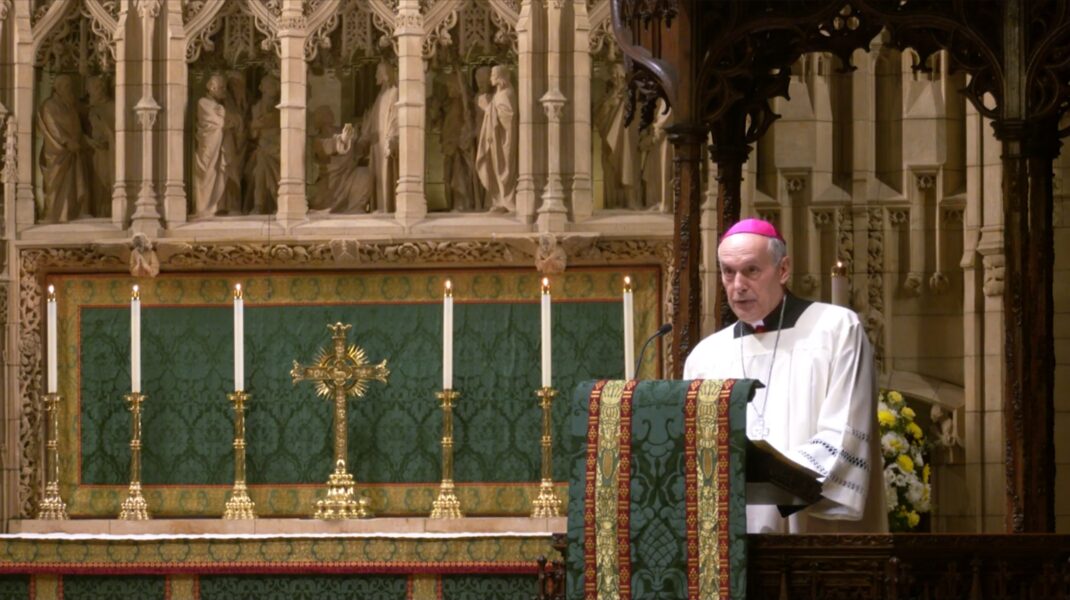
The Holy See announced on March 7 the appointment of Monsignor Gabriele Giordano Caccia as the new apostolic nuncio to the United States, replacing Cardinal Christophe Pierre, whose resignation has been accepted due to reaching the age limit. This is a move of great significance within Vatican diplomacy, not only because of the importance of the Washington nunciature, but also for what it seems to reveal about the internal balances of the new pontificate.
Caccia arrives in the United States with the classic profile of a career diplomat. Born in Milan in 1958, ordained a priest in 1983 and incorporated into the Holy See’s diplomatic service in 1997, he has developed his career within the Vatican diplomatic corps in various pontifical representations and in the Secretariat of State. In 2009, he was appointed apostolic nuncio to Lebanon, a particularly delicate mission due to the country’s political and religious complexity.
Subsequently, he was assigned as apostolic nuncio to the Philippines, one of the largest and most influential local Churches in Asia, where he remained until being transferred to New York. In 2019, he was appointed permanent observer of the Holy See to the United Nations, a position from which he has represented the Vatican in international debates on development, migrations, nuclear disarmament, or religious freedom.
However, his trajectory cannot be read solely in technical terms. In Rome, he has been placed for years in the sphere of influence of the so-called Silvestrini school, linked to Villa Nazareth and a certain curial and diplomatic culture that has continued to have weight in recent decades. In that same vein, his promotion to Washington is being read in various circles as an appointment aligned above all with the circle of Cardinal Pietro Parolin, rather than as a very personal bet by Leo XIV.
This does not turn the appointment into a gesture of weakness by the Pope, but rather into a signal of method. Leo XIV would not have wanted to step on Parolin precisely in the designation of the nuncio in his country of origin, leaving intact a particularly sensitive space within the Vatican diplomatic apparatus. The fact is not minor, because it suggests a form of government based on respect for areas of competence and influence, something that was not always customary in the previous pontificate, much more inclined to direct decisions, on-the-fly corrections, and sudden shifts in internal balances.
The choice of Caccia thus seems to respond to a logic of institutional continuity. He is not a man identified with the traditional world, nor a media or ideological figure. His public profile has always been sober, prudent, and strictly diplomatic. At the UN, he has moved in predictable registers for the contemporary Holy See: defense of multilateralism, references to peace, migration, sustainable development, disarmament, and religious freedom, without stridency and without personal protagonism. In short, he is a man of the apparatus, trained to represent, negotiate, and execute, not to mark his own line.
Precisely for that reason, his landing in Washington will be followed with attention. The nunciature in the United States is not just any destination. From there, relations with the world’s leading power are managed, but the life of one of the planet’s most complex, influential, and tense local Churches is also closely monitored. The nuncio in Washington does not only engage in diplomacy with the U.S. administration: he also intervenes in the preparation of episcopal trios and, therefore, in the future configuration of the U.S. episcopate.
The outgoing nuncio, Cardinal Christophe Pierre, leaves the post after a long and decisive stage. Born in Rennes in 1946, with an extensive diplomatic career behind him, he was nuncio in Haiti, Uganda, and Mexico before being sent to the United States in 2016. His tenure in Washington coincided with particularly turbulent years in American ecclesial life, marked by internal divisions, doctrinal and pastoral conflicts, the credibility crisis stemming from abuses, and an increasingly visible confrontation between different sectors of the episcopate.
Pierre was widely seen as a man very close to the style and priorities of the previous pontificate. During his time at the head of the U.S. nunciature, his influence on the map of episcopal appointments was considerable, favoring in numerous cases profiles considered more pastoral, less combative on the doctrinal plane, and closer to the sensitivity dominant in Rome during those years. His creation as a cardinal in 2023 confirmed the weight he had acquired within the Vatican machinery.
With Pierre’s departure and Caccia’s arrival, no phase of rupture seems to open, at least for now. Rather, it gives the impression of a carefully managed transition, in which the man changes but not necessarily the underlying logic. What is significant, in any case, is that the new Pope has opted in such a delicate position not to disauthorize Parolin’s sphere of influence, allowing Vatican diplomacy to maintain its own balances in a particularly exposed terrain. In a Rome accustomed to reading every appointment as a signal of power, the message this time seems clear: Leo XIV has not wanted to occupy all the spaces at once.