


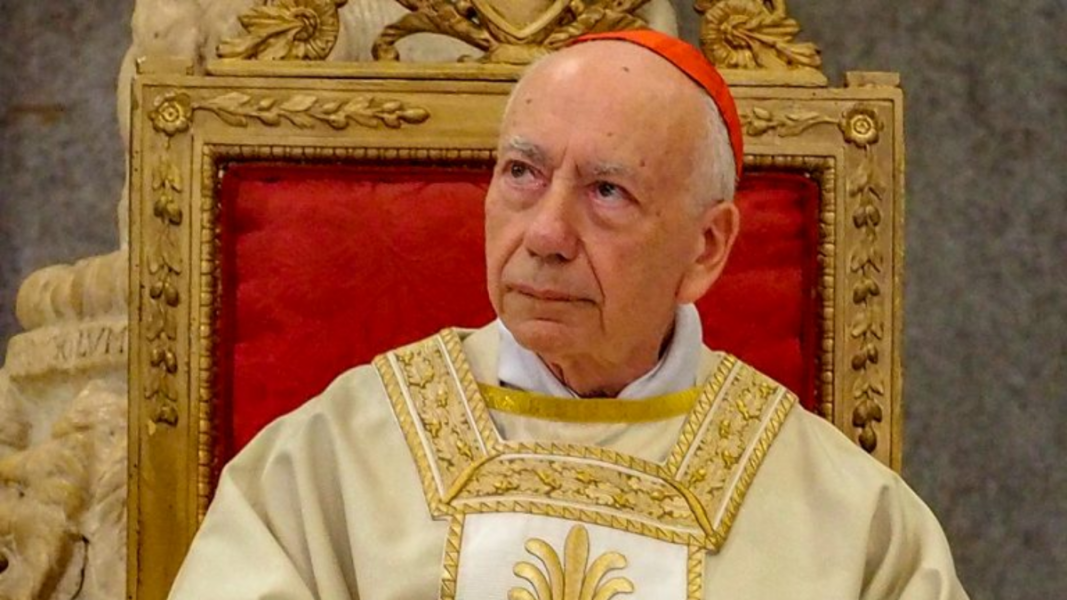
Italian Cardinal Francesco Coccopalmerio, former president of the Pontifical Council for Legislative Texts, has presented a new book on the Synod on Synodality in which he defends expanding the role of the laity in the Church’s governance structures. Among his proposals is to modify canon 212 of the Code of Canon Law to emphasize the “relative duty and right” of the lay faithful to cooperate even in ecclesial governance.
As reported by journalist Michael Haynes, the volume—titled Synodal Church on the Move: A Pastoral Reinterpretation of the Final Document of the Synod of Bishops 2023-2024—offers a pastoral reinterpretation of the synod’s final document and raises new reflections on the participation of the People of God in the life of the Church.
The proposal: expanding the role of the laity
In his work, Coccopalmerio argues that all the faithful have the capacity to hear the voice of the Holy Spirit and discern the good of the Church, so he believes that their participation should not be limited solely to a consultative role.
The cardinal states that, by virtue of the knowledge, competence, or prestige they possess, the faithful have a “relative duty and right” to cooperate in the good of the Church even in its governance.
Canon 212 of the Code of Canon Law establishes that:
Canon 212 §1. Christ’s faithful, conscious of their own responsibility, are obliged to follow with Christian obedience those things which the sacred pastors, inasmuch as they represent Christ, declare as teachers of the faith or establish as rulers of the Church.
§2. Christ’s faithful are free to make known to the pastors of the Church their needs, especially spiritual ones, and their desires.
§3. According to the knowledge, competence, and prestige which they possess, they have the right, and at times the duty, in varying circumstances, to manifest to the sacred pastors their opinion on matters which pertain to the good of the Church and to make their opinion known to the rest of the Christian faithful, without prejudice to the integrity of faith and morals, with reverence toward their pastors, and attentive to common advantage and the dignity of persons.
An influential canonist in the Vatican
Coccopalmerio is one of the most well-known canonists in the Vatican in recent decades. He was president of the Pontifical Council for Legislative Texts from 2007 to 2018, the body responsible for interpreting the Church’s canon law.
Created a cardinal by Benedict XVI in 2012, his career has been marked by his work on legal and disciplinary issues within the Church, especially in the interpretation of canon law norms.
Controversies surrounding his figure
The figure of the Italian cardinal has not been free from controversies in recent years.
In 2017, one of his closest collaborators, Monsignor Luigi Capozzi—then secretary in the dicastery presided over by Coccopalmerio—was arrested by the Vatican gendarmerie after a «gay orgy» involving drug use was discovered in a Vatican apartment. The episode generated significant media scandal and criticism for the cardinal’s closeness to the priest.
This controversy was later added to by his participation in meetings with representatives of Freemasonry, where he went so far as to propose the creation of a permanent dialogue table between the Church and the lodges.
Synodality and the role of the laity
Coccopalmerio’s proposals are framed within the broader debate on the scope of synodality, a process promoted in recent years that seeks to expand the participation of the People of God in the life and mission of the Church.
In some places, these discussions have led to concrete proposals. In Germany, for example, the bishops have recently announced that they will ask the Vatican for authorization to allow qualified laity to preach during Mass, an initiative awaiting evaluation by the Holy See.
These proposals reflect the already evident trend in some ecclesial sectors to redefine the role of the laity —and everyone— in the Church in ways that raise questions about their compatibility with the tradition and sacramental structure of Catholicism.