


In the 1960s, there was a disagreement between two French intellectuals that perfectly explains the antagonistic attitudes that continue to permeate the emergence of every educational and cultural project today. I am referring to the affair between the Schmittian Julien Freund and the Hegelian Jean Hyppolite.
It turns out that, initially, Hyppolite had agreed to supervise Freund’s doctoral thesis on the essence of the political (a work that intimately dialogues with the work of Carl Schmitt) at the Sorbonne. The surprise comes when, after reading the first hundred pages of the thesis, Hyppolite is scandalized to find such a phrase: “There is only politics where there is an enemy.” How is it possible that a Hegelian, translator of the Phänomenologie des Geistes (Phenomenology of Spirit), would be disturbed by such evidence? To put it in context, Hyppolite (who died in October 1968) had been a teacher to illustrious sixty-eighters like Michel Foucault or Gilles Deleuze… It is strange that a cultivator of Hegel’s dialectic would turn up his nose at a distinction—the friend-enemy one—that refers to the very heart of the Hegelian method: the dialectic of master and slave. The reason the professor put forward was: “I am a socialist and a pacifist. I cannot supervise a thesis at the Sorbonne that says ‘There is only politics where there is an enemy.’” I imagine a Freund, between disappointed and relieved, going to Raymond Aron’s office to try his luck and ask him to supervise his thesis instead… This one did accept.
However, despite declining to be the director, Hyppolite agreed to be part of the jury. Time later, on June 26, 1965, Freund had to defend his research, titled L’Essence du politique, before eminent professors such as Paul Ricoeur, Raymond Polin, Pierre Pinza, Pierre Grappin, in addition to Raymond Aron and, of course, the good Jean Hyppolite. Freund, who had been a member of the French Resistance, with the floor, takes the word and opens his presentation by saying: “The work that I have the honor of submitting for your approval is born from an overcome disappointment. A disappointment for which I hold no one else responsible, but only my own capacity for illusion. My disappointment is fed by my experiences in the resistance, that is, those of the time of occupation and liberation, but also those lived in the modest political and union activity in which I have been involved for some years.” Who knows if this disappointment extended to his disagreement with Hyppolite… Be that as it may, the Hegelian professor intervenes: “If you are really right [about the strong thesis of the necessity of the enemy’s existence as a precondition for politics], all that is left for me is to tend to my garden.” To which a shrewd Freund replied: “Your reasoning is that if we do not want enemies, we will not have them. But it is the enemy who designates you. And if he wants you to be his enemy, the most beautiful profession of friendship will be of no use. If he decides that you are his enemy, you will be when he wants. And certainly he will not allow you to tend to your garden.” Crestfallen, Hyppolite could only respond: “In short, all that is left for me is suicide.” How things are that sixty years later another French intellectual, namely Fabrice Hadjadj, has had to intervene again to give new life to Hyppolite’s antipolitical position.
On the occasion of the presentation of his project, of a certain monastic inspiration, Incarnatus Est, a “Hispanic institute of humanistic formation inspired by Catholicism,” Hadjadj asserted, somewhat unfortunately: “Incarnatus Est wants to move away from the mentality of a besieged fortress. Catholic faith will be tested as a source of hope and inspiration. There is much talk of the cultural battle. They place soldiers in front of the garden to protect it. But meanwhile, the plants wither. What we want above all is to form gardeners of culture.” We are not unaware of the danger of the potential “vulgarization” hidden in the “cultural battle”… In any case, it is true that the French philosopher clarified in another interview: “We do not oppose soldiers to gardeners (…). When God charged man with tending the Garden, he uses two verbs: to cultivate and to guard. But the soldier usually acts with urgency (…). Yes, I said that before forming soldiers we must form gardeners, that we must first cultivate. But we do not exclude the soldier’s task.” I do not know if Hadjadj was winking at the affair of his compatriots or not, but it is not too much to emphatically reiterate Freund’s words: “it is the enemy who designates you (…). If he decides that you are his enemy, you will be when he wants. And certainly he will not allow you to tend to your garden.”
It is commendable that someone is concerned about the garden, it is likewise commendable that someone, in the full 21st century, manages to create spaces where one can make a “almost monastic” retreat, but Hadjadj must be told that no craftsman is worth it, no juggler is worth it, nor is any Gregorian chant worth it if there are no guardians on the walls. It is unnecessary to recall that St. Benedict invited monks to militate under the banner of Jesus Christ: “Militare sub Christo Domino, vero regi.” For his part, St. Bernard of Clairvaux, monk and abbot who promoted the expansion of the Cistercian Order, would say: “He is not worthy of Christ who refuses to fight for Christ.” Because the things of faith, which are part of an eschatological combat, which has historically materialized between battlements and watchtowers against barbarians, Saracens, Normans or Cathars, are not separated from the things of life. Faith and life require the Christian to be vigilant. As the prophet Ezekiel warns us: “If the watchman sees the sword coming and does not blow the trumpet, so that the people are not warned, and the sword comes and takes any one of them, that one shall perish for his iniquity, but I will require his blood at the watchman’s hand” (Ezek 33, 6).
Hadjadj also claims, as a struggle against materialist Gnosticism, this project in which: “We want to recover the body, the hands, with an artistic part, with theater, with singing, and also manual craftsmanship, gardening, working with wood. The Word of God became a carpenter. Thus we show that matter is good in itself. Ours is anti-Gnosticism.” And although, with good judgment, he criticizes the fact that “the ancient Gnostic heresies, in the early Christian centuries, were spiritualist” or that “modernity has lost the flesh” or that the profile of the Incarnatus students cannot “separate the office, the Church, the family with a fragmented and schizophrenic gaze,” his project seems to us rather spiritualist with some materializing notes.
The one who curiously knew how to see the limits and dangers of this antipolitical attitude was St. Josemaría Escrivá de Balaguer. In his 1967 homily at the University of Navarra Campus, he warned us: “This truth so consoling and profound, this eschatological significance of the Eucharist, as theologians usually call it, could be misunderstood: it has been whenever one has wanted to present Christian existence as something only spiritual—spiritualist, I mean—, proper to pure, extraordinary people, who do not mix with the despicable things of this world, or, at most, tolerate them as something necessarily juxtaposed to the spirit, while we live here.” The mere fact of cloistering the Incarnatus Institute in Boadilla del Monte or that it is a select group of students (capable of freeing themselves from the servitude of work to which the human race was thrown since Adam and Eve) does not seem very “anti-Gnostic.” What kind of gardener can alienate himself from the system of needs (System der Bedürfnisse, in Hegelian terminology) for an entire course and pay that fortune? Where does that from the Book of Genesis go: “By the sweat of your face you shall eat bread until you return to the ground” (Gen 3, 19)? “When things are seen in this way, St. Josemaría continues, the temple becomes the place par excellence of Christian life; and being a Christian is, then, going to the temple, participating in sacred ceremonies, embedding oneself in an ecclesiastical sociology, in a kind of world segregated, which presents itself as the antechamber of heaven, while the common world goes its own way (…). We simply respond no to that deformed vision of Christianity.” This not only beautiful but necessary initiative runs the risk of becoming the sabbatical year of the children of the wealthy classes, who, instead of going to India to do social action, prefer to clean their consciences in kilometer 0 version. This is an expression of a bourgeois Christianity that, revisiting the utopian commonplace of phalansteries, seeks to build that segregated world—or New Icaria—of which St. Josemaría lamented. It is practically impossible to encourage young people to be “committed lay Christians on the issues of our time” if class monoculture prevents those same young people from even understanding what the issues of our time really are. Thus, Hadjadj, not in vain director of the Institut Philanthropos in Fribourg for more than a decade, may incur the same error as the German reformers of the 18th and 19th centuries of Philanthropinismus, that is, a movement preferably oriented toward the promotion of the children of the upper layers of the emerging bourgeois class, against popular education.
On the other hand, the formula chosen by Hadjadj and his team is at least problematic: “Hispanic institute of humanistic formation inspired by Catholicism,” since, as the Hegelian philosopher Félix Duque acutely explains in his essay Contra el humanismo (2003): “some institutions have raised the banner of ‘Christian humanism’: a strange combination, since it does not seem that the Christian religion (in any of its confessions) can accept the basic point of humanism: self-referentiality (that is, that man recognizes no other unit of measure than himself) (…). Another thing would be, of course, to point out that humanistic secularization (in strong terms: the de-divinization of the world) has been the necessary result of the evolution of Christianity itself.”
Allow me to end with a long excerpt taken from the cited homily “To Love the World Passionately” (1967), by the founder of Opus Dei, for the relevance, timeliness, and truth that his plea in favor of a well-understood “Christian materialism” still holds: “My children, wherever your brothers men are, wherever your aspirations, your work, your loves are, there is the place of your daily encounter with Christ. It is, in the midst of the most material things of the earth, that we must sanctify ourselves, serving God and all men (…). I have constantly taught it with words from Holy Scripture: the world is not bad, because it came from the hands of God (…). I used to say to those university students and those workers who came to me in the thirties that they had to know how to materialize spiritual life. I wanted to keep them away from the temptation, so frequent then and now, of leading a double life (…). No, my children! There cannot be a double life, we cannot be like schizophrenics if we want to be Christians: there is only one life, made of flesh and spirit (…). That is why I can tell you that our time needs to restore—to matter and to situations that seem most vulgar—their noble and original meaning, to put them at the service of the Kingdom of God, to spiritualize them, making them means and occasion of our continuous encounter with Jesus Christ (…). The authentic Christian meaning—which professes the resurrection of all flesh—has always faced, logically, the disincarnation without fear of being judged as materialism. It is therefore legitimate to speak of a Christian materialism that boldly opposes materialisms closed to the spirit (…). Do you not see that every sacrament is the love of God, with all its creating and redeeming force, which is given to us using material means? What is this Eucharist—already imminent—but the adorable Body and Blood of our Redeemer, which is offered to us through the humble matter of this world—wine and bread—, through the elements of nature, cultivated by man?” In this last part, one does see a real effort by Hadjadj to reconcile “flesh and spirit”: “The carpenter, explains the director of the Incarnatus Institute, is the hinge between work with the earth and trees and craftsmanship with objects, with a matter that comes from a living being, the tree. The carpenter prolongs the gesture of the tree, makes it bear fruit even further. And let us remember that the first commandment in Eden is ‘be fruitful and multiply.’ Jesus also says: ‘The glory of my Father is that you bear fruit.’” But, beware!, because there is only one téktōn.
The key to Christianity having survived any political regime, invasions, persecutions, and even martyrdom is what the theologian Nicholas of Cusa defined as coincidentia oppositorum—and which Carl Schmitt expanded in Catolicismo romano y forma política (1923)—, that is, the metaphysical principle that defines the coexistence, union, or synthesis of opposed, contradictory, or polar elements within the same structure, being, or concept. In synthesis: a post-dialectical “this and that.” Gardeners and soldiers… That is why St. Josemaría concludes: “Interpret, then, my words as what they are: a call to exercise—daily!, not only in emergency situations—your rights; and to nobly fulfill your obligations as citizens—in political life, in economic life, in university life, in professional life—(…). Let us take up the shield of faith, the helmet of salvation, and the sword of the spirit which is the Word of God. Thus the Apostle St. Paul encourages us in the letter to the Ephesians.”
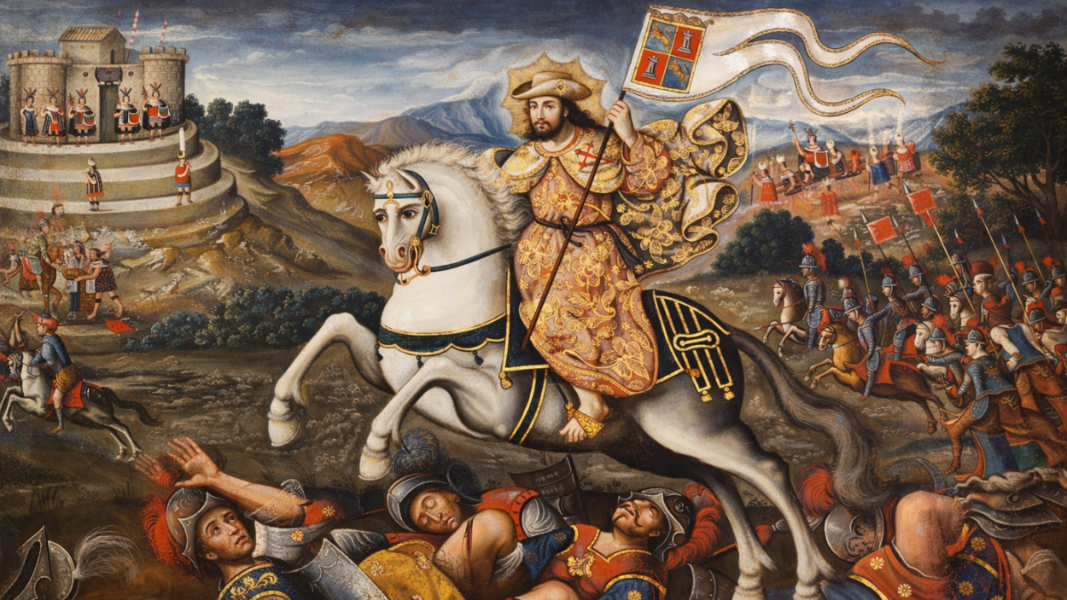
With the sacrament of baptism, all Catholics are invested with a triple dignity: that of priests, prophets, and kings. It is true that nothing is said about soldiers, but there have been in history examples of Christian kings who were great military men: Alfonso I of Aragon (1073–1134), “the Battler”; Richard I of England (1157–1199), “Lionheart”; Jaume I (1208–1276), “the Conqueror”; Louis IX of France (1214–1270), “St. Louis,” or Ferdinand II of Aragon, “the Catholic” (1452–1516). Because they were, we are! After all, what would the Spanish nation be without the spirit of (re)conquest, that is, without the ethos that its patron St. James imprinted on it… I cannot think of many examples of “gardeners of Christendom.”
With all this, of course, I do not want to question the importance, novelty, and transcendence of the Incarnatus Est project, although, yes, from ex-Marxist convert to ex-Marxist convert, I feel obliged to wield that maxim of Marx which says: “Our task is ruthless criticism and much more against apparent friends than against open enemies.” The hyppolitian/hadjadjian contempt for the political leads, in the best case, to gardening (a Christianity antipolitical or castle devoid of watchtowers and battlements), and, in the worst, to civilizational suicide. With profound respect, utmost admiration, and my best wishes.