


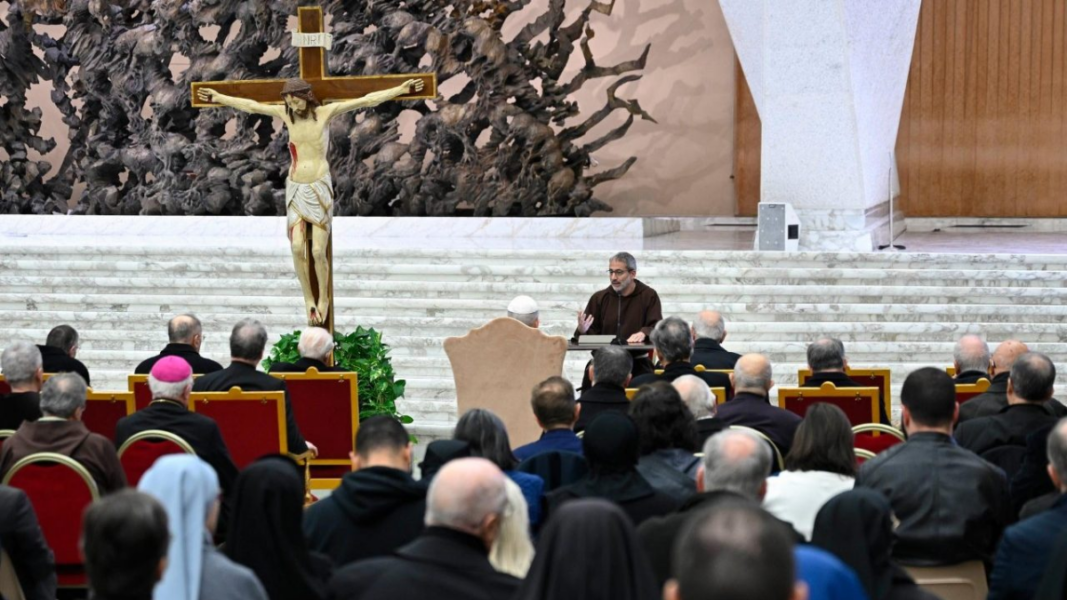
The preacher of the Pontifical Household, Capuchin friar Roberto Pasolini, offered this Friday, March 6, in the Paul VI Hall the first Lenten meditation before Pope Leo XIV and the members of the Roman Curia, centered on the theme «Conversion. Following the Lord Jesus on the path of humility».
According to Vatican News, the reflection inaugurated the cycle of Lenten meditations that will be held every Friday until March 27 and which have as their guiding thread the phrase from Saint Paul: «If anyone is in Christ, he is a new creation» (2 Cor 5:17), in the light of the spiritual testimony of Saint Francis of Assisi.
Peace is born from humility
In his intervention, Pasolini linked the evangelical message of conversion with the situation of violence and war that the world is going through. In his view, peace does not depend solely on political agreements or diplomatic strategies, but on a deeper transformation of the human heart.
«Peace is born not only from political agreements or diplomatic or military strategies, but from men and women who find the courage to make themselves small,» affirmed the preacher.
As he explained, this attitude implies renouncing violence, resisting the temptation of revenge, and opting for dialogue even in difficult circumstances.
Conversion as a response to grace
Throughout the meditation, Pasolini emphasized that Christian conversion is not primarily a human effort to correct one’s own life, but a response to God’s grace.
Inspired by the spiritual experience of Saint Francis of Assisi, he explained that conversion is born when the image of God inscribed in the human heart «awakens» and begins to reorient the believer’s life.
In this sense, he recalled that the Franciscan call to «do penance» should not be understood simply as an ascetic practice, but as a profound change in sensitivity that allows one to look at others with mercy and rediscover the authentic meaning of life.
Rediscovering the reality of sin
The preacher of the Pontifical Household also warned that in contemporary culture the concept of sin tends to dissolve, being replaced by psychological or sociological explanations.
According to Pasolini, when sin disappears from the moral horizon, the greatness of human freedom and the very possibility of holiness are also obscured.
«If the possibility of true evil no longer exists, neither can we believe in the possibility of true good,» he pointed out.
Recognizing sin— he explained— does not mean falling into pessimism, but becoming aware of human responsibility and the need for a deep healing that restores the relationship with God.
The path of humility
In the final part of his reflection, Pasolini highlighted the close relationship between poverty and humility in the spirituality of Saint Francis.
Humility, he affirmed, does not consist in despising oneself, but in recovering the truth of what we are before God.
«Humility does not impoverish man: it restores him to himself. It does not diminish him: it returns him to his true greatness,» he explained.
The preacher recalled that original sin arises precisely from the rejection of humility, that is, from the human being’s refusal to recognize himself as a creature dependent on God.
A conversion that never ends
Finally, Pasolini emphasized that Christian conversion is not a one-time event, but a continuous path that accompanies the believer’s entire life.
«Conversion means continually initiating this movement of the heart through which our poverty opens to God’s grace,» he affirmed.
The meditation concluded with a prayer from Saint Francis of Assisi and with the invitation to follow in the footsteps of Christ, rediscovering in humility the path to a life renewed by grace.