


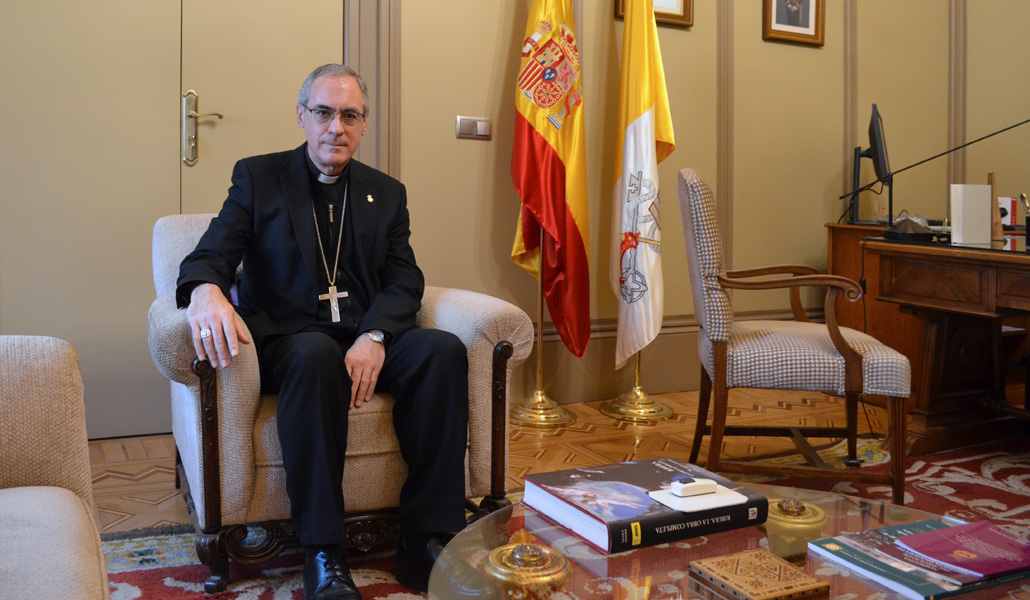
The Military Ordinary Archbishop, Juan Antonio Aznárez Cobo, linked to the Neocatechumenal Way, has decided to deny the celebration of the funeral rites for the soul of Antonio Tejero Molina in the Cathedral Church of the Armed Forces, scheduled for March 25, 2026. The family has disseminated a statement, signed by their legal representative, in which they express “sorrow and perplexity” and denounce that no “ecclesiastical reason” has been conveyed to them to support the prohibition.
The relevant fact is not the historical or political assessment of the character, but the ecclesiastical gesture: a bishop who, in his own see and in the symbolic heart of the military jurisdiction, decides to close the door to funeral rites. This is not an administrative nuance. It is an act of pastoral governance with scandalous public consequences. An extreme decision without canonical explanation that smells more of fear than prudence. Fear of headlines, pressures, discomfort. And when a pastor governs out of human fear, he does not protect the Church: he degrades it.
The Church does not celebrate funerals to canonize biographies, nor to grant public respectability to anyone. It prays for the souls of the deceased and consoles the living. Precisely for that reason, denying funeral rites to a family is something extreme and very exceptional, not an image resource. If what is intended is to avoid “scandal,” the uncomfortable question is inevitable: scandal for whom and why? What “scandal” is being avoided: the spiritual, the moral, or the media? Because if what is being avoided is political noise, then the criterion is no longer ecclesiastical; it is communicational. And if the criterion is communicational, the Military Archbishop is saying, in practice, that the liturgy can be subordinated to external pressure.
In the military diocese, the damage is double. Not only is a grieving family wounded, as the text underscores. A message is projected to military personnel and security forces: ecclesiastical belonging within the jurisdiction can become conditional, selective, dependent on the public profile of the faithful. That is, a Church that measures access to consolation based on reputational cost. That is not Catholic; it is calculation. And a bishop who acts this way is not “avoiding problems”: he is creating a dangerous precedent, because he turns the funeral into a social plebiscite and the bishop into a risk manager, not a shepherd of souls.
The family, moreover, introduces an especially grave element: that the Military Archbishop, “dependent on the Undersecretary of Defense,” would have adopted the decision denying “this spiritual consolation” to a family “with a long and proven link of service” to the Armed Forces and to the State Security Forces.
For an archbishop to deny a funeral in a cathedral is not a neutral or “prudent” gesture. It is a conscious blow to the principle that the Church prays for the dead and consoles the living without submitting to the pressure of the world. Turning the liturgy into an instrument of reputational hygiene, degrading Christian charity to crisis management, and sending an unequivocal message of submission to the political correctness of the moment is a desertion that we must not forget.
The full statement disseminated by the family is as follows:
STATEMENT ON BEHALF OF THE FAMILY OF MR. ANTONIO TEJERO MOLINA
As the lawyer for the family of the siblings Carmen, Dolores, Antonio, Elvira, Ramón, and Juan Tejero Díez, through this statement, they wish to share with the community of the faithful and the public opinion the deep sorrow and perplexity that overwhelms said family at this time and to that end DECLARE:
“Yesterday, the Most Excellent and Most Reverend Lord Military Ordinary Archbishop, Mr. Juan Antonio Aznárez Cobo, personally communicated to us his decision to deny the celebration of the funeral rites for the soul of our father Mr. Antonio Tejero Molina, in the Cathedral Church of the Armed Forces, scheduled for March 25, 2026.
The funeral rites constitute an act of piety and consolation for the living, not a judgment on the life of the deceased. The decision of Monsignor Juan Antonio Aznárez Cobo, dependent on the Undersecretary of Defense, has been received with great pain, by denying this spiritual consolation to a family with a long and proven link of service to the Armed Forces and State Security Forces.
As active members and parishioners of the Military Diocese, we receive this news with a wounded heart.
We understand that said prohibition lacks any foundation, as no ecclesiastical reason has been conveyed to us to justify depriving a faithful person of the suffrage of the Church in his own diocesan see.
Said decision affects Christian charity, as the farewell to a loved one is an act of mercy and a spiritual right, which appears to have been subordinated to considerations of a temporal or political nature. Moreover, it contradicts the evangelical spirit, and it pains us to observe how, at times, human fear seems to prevail over the principles of justice and truth that should govern this institution.
Despite the pain that this decision causes us, our faith remains unshakable. As practicing Christians, we continue to trust and pray for a militant Church that is a faithful reflection of evangelical freedom, brave in the face of external pressures, and always welcoming to its children, without distinction.
We ask those who accompany us in affection to offer a prayer for the eternal rest of our father, trusting that Divine Justice transcends any human limitation.
Signed: The Tejero Díez family”
On their behalf and representation: Ángeles Cañizares. Lawyer
In Madrid, March 5, 2026.