


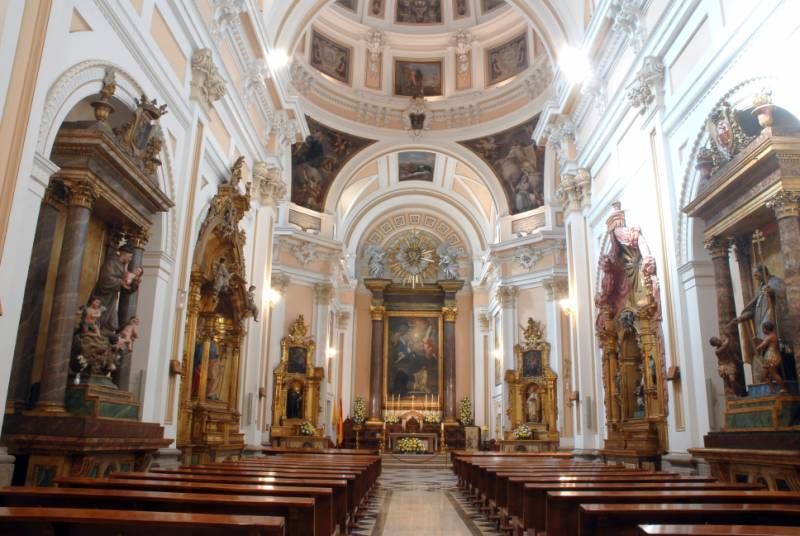
The decision of the Military Archbishop of Spain, Juan Antonio Aznárez Cobo, to deny the funeral rites for the soul of Antonio Tejero Molina in the Cathedral of the Armed Forces is not simply debatable. It is scandalous. And it is even more so when one observes the contrast with what happened just a few months earlier in that same temple.
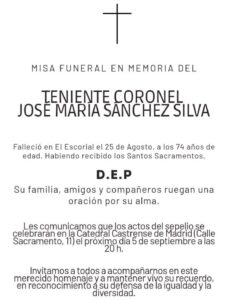
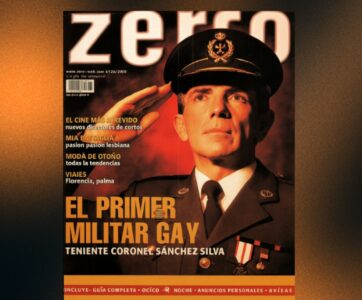
In August 2025, a funeral mass was held in the Military Cathedral of Madrid for Lieutenant Colonel José María Sánchez Silva, who was publicly presented for years as the first high-ranking Spanish military officer to declare his homosexuality. His figure was turned into a symbol of LGBT activism within the Army, and his death was accompanied by numerous media and political tributes.
The religious ceremony in the military cathedral was not a simple discreet mass for a deceased person. It became an act loaded with ideological significance, in which people linked to LGBT activism participated, and where the figure of the deceased himself was reclaimed as a reference for that movement within the Armed Forces. No one in the military hierarchy then considered that it could cause public scandal, nor that it was inconvenient to hold the funeral rites in the main temple of the military jurisdiction.
However, when the family of Antonio Tejero Molina—practicing Catholics to the point that his son is a priest and linked for decades to the military world—requested to hold the funeral rites for their father in that same cathedral, the military archbishop decided to deny them. Slam of the door. There is no mercy for everyone, everyone, everyone. It seems that some Catholics are left out.
The family has made public a statement in which they denounce that no ecclesial reason has been offered to justify the decision. No canonical explanation. No pastoral argument. Just a denial.
The comparison is inevitable. For a military man turned into a symbol of LGBT activism within the Army, there was a mass in the Military Cathedral. For Antonio Tejero, no. For one case, total opening of the temple. For the other, the door closed. For some, public welcome. For others, absolute exclusion.
When a bishop decides to deny a funeral in a case like this, he in fact introduces a political criterion into the liturgical life of the Church. Because then the question is inevitable: what kind of lives deserve the public prayer of the Church and which do not? Who establishes that filter? The Gospel or the woke ideological climate of the moment?
What happened sends a devastating message to many faithful. If the deceased fits with the dominant sensitivity, the doors of the cathedral open. If the deceased is uncomfortable for the current political narrative, the Church withdraws and leaves the family alone.
The problem is not Antonio Tejero. The problem is the precedent that is created when a bishop allows fear of the world’s judgment to determine such serious pastoral decisions. Because if the Church starts deciding who can be prayed for based on their public reputation, then mercy ceases to be universal and becomes selective.
That is not the Gospel. That is simple human calculation.
The reaction of many faithful to this decision cannot be one of indifference. It is not about defending a specific biography, but about defending an elementary principle of the Catholic faith: the Church prays for all its children, especially when they die.
Denying that spiritual consolation to a family that requests it, without clear canonical reasons and after having allowed ceremonies loaded with ideological significance in the same temple, is not only a pastoral inconsistency. It is an ecclesial scandal that demands explanation.