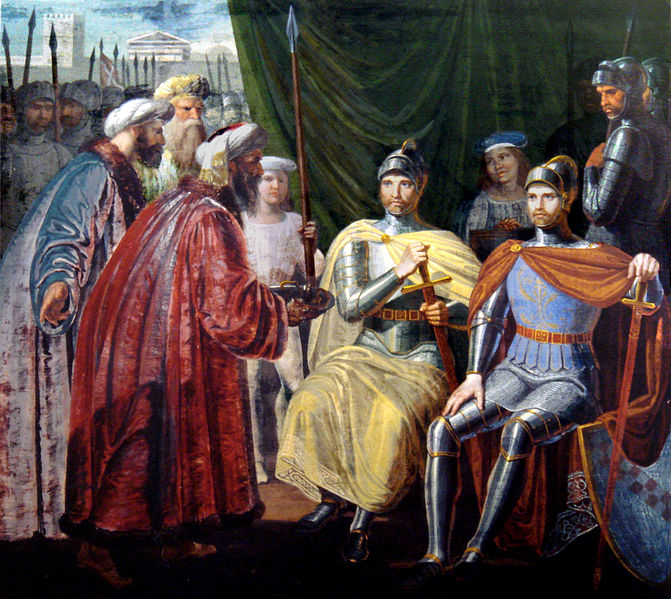
Roger I & Robert Guiscard Receive the Keys to Palermo [from Arab Muslims] by Guiseppe Patania,1830 [Palazzo dei Normanni, Palermo, Sicily]
by The Catholic Thing |
By Robert Royal
Nuclear weapons, like other modern technological developments, have exerted great pressure on traditional moral principles. Just as modern medicine has changed our understanding of the beginning and end of human life, the enormous destructive power of modern weapons, nuclear and non-nuclear, has made a careful reflection on war not only urgent, but—to use the trendy term—existential.
That is probably the main reason why the Vatican has seemed quasi-pacifist in recent decades. But the Church possesses a well-developed set of criteria on the just and unjust uses of force. In fact, in the past it even—rightly—called for crusades. (I will explain that on another occasion.) But those criteria—still valid in themselves—need further elaboration to address the conditions in which we find ourselves today.
I have direct relatives who fought in Iraq and Afghanistan, I have actively participated in U.S. diplomacy in the Middle East, and I have worked at the Pentagon managing defense readiness. Some of my grandchildren have been forced to take shelter in air raid shelters in Jerusalem; the others may one day have to face terrorism in their own country or even participate in wars abroad. Millions of Americans—and not just Americans—have similar stories. And, unless we keep the human costs of war at the center of our consciousness, we might be tempted to consider just war theory as a mere political or intellectual exercise.
That said, there are, of course, things worth dying for—and, regrettably, things worth killing for. Precisely for that reason, just war theory was developed, a tradition of moral reflection that began in the ancient world—especially with St. Augustine and St. Thomas Aquinas—and that constitutes the common heritage of most modern armies. Some of the best-informed students I have had on just war over the years learned that tradition during their military training in the United States. Academic environments often mock this, but it is true.
A good summary of the principles of just war can be found here. (Our friend Phil Lawler has been reexamining them in strict fidelity to the Catholic tradition online here). But I want to pause here on some of them to highlight certain particular circumstances that we face today.
I am not sure if the U.S. attack on Iran in recent days is justified. Many people already claim to know, one way or another. But I have seen enough similar situations to be willing to suspend judgment until we know more. (In the past I have been wrong.) However, I am sure that the way to decide must be based on Catholic principles of just war, and not simply on the exhausting and totally predictable back-and-forth for or against Trump.
The first criterion is last resort. Resorting to arms is a matter of life or death. It should only be done when other means to address a threat have failed. But who decides when all reasonable alternatives have been exhausted? It can always be claimed that something else could still be tried. Meanwhile, great evils can spread:
Nature is contaminated,
There are men in every secret corner of it
Committing condemnable and perverse acts.
The answer is that a legitimate authority has the responsibility to decide. But it must also explain how everything reasonable has been tried, what the threat is, and why it is necessary to address it now.
The president has not said nearly enough about this. Rumors are circulating that Iran was planning an attack on U.S. forces. If so, we need an authorized statement about it—and more details.
Hamas, Hezbollah, or the Houthis (and perhaps some sympathizers on university campuses) may lose sleep over the fall of the Islamic Republic. No one else will. They have all agreed that “Iran must not develop a nuclear weapon” (an existential threat), but they have done little more than talk for half a century. That is why it is positive that the president has presented the attack in terms of defense, both immediate and long-term. But we still need to know much more.
A second criterion is just cause: wars of conquest, in our tradition, are never just. Our intention must be to achieve some good by correcting a real or imminent injustice. We cannot invoke the mere possibility of a threat in the distant future, or otherwise all nations would become possible targets.
Another criterion is a reasonable probability of success. War is uncertain by nature, but unless there is a reasonable chance of achieving the objective, the use of military force—which means killing people and destroying things—would lack justification.
There is no doubt that our forces can degrade Iran’s military capabilities and nuclear programs. But is that, by itself, sufficient success? At this moment there is hope—quite vague, to be honest—that the Iranian people will rise up. But can they? And what will come after?
These are, in general terms, what theorists call principles of ius ad bellum, the criteria for going to war. And they apply to every armed conflict, even to complex contemporary cases.
But the next steps are more complicated in our time. The criteria of ius in bello refer to how the war is conducted. A fundamental principle is the distinction between combatants and non-combatants. Attacking civilians—as Russia routinely does in Ukraine—is simply a war crime.
But the enormous destructive power of modern weapons makes that distinction uncertain. The need to accept some collateral damage has always been recognized. No war can be as precise as surgery. To demand it would make almost any just use of force impossible. That is not a responsible stance in a world with multiple malicious actors.
Collateral damage, like war itself, must be proportional to the cause. As we have seen in Gaza, eliminating a homicidal threat can lead to massive civilian destruction, even when the target is, quite rightly, an evident evil like Hamas.
The world tried “dialogue” with Iran for decades. The U.S. attack has just cause, is directed at combatants, and remains relatively proportional—considering that Iran has been obstinately developing long-range missiles, enriching uranium, and sponsoring terrorism—for half a century.
And it is a good sign that other countries—the United Kingdom and states in the region—are helping.
Debates about all this will continue for years. What comes next, however, will show less whether the U.S. action was just than whether it was prudent.