


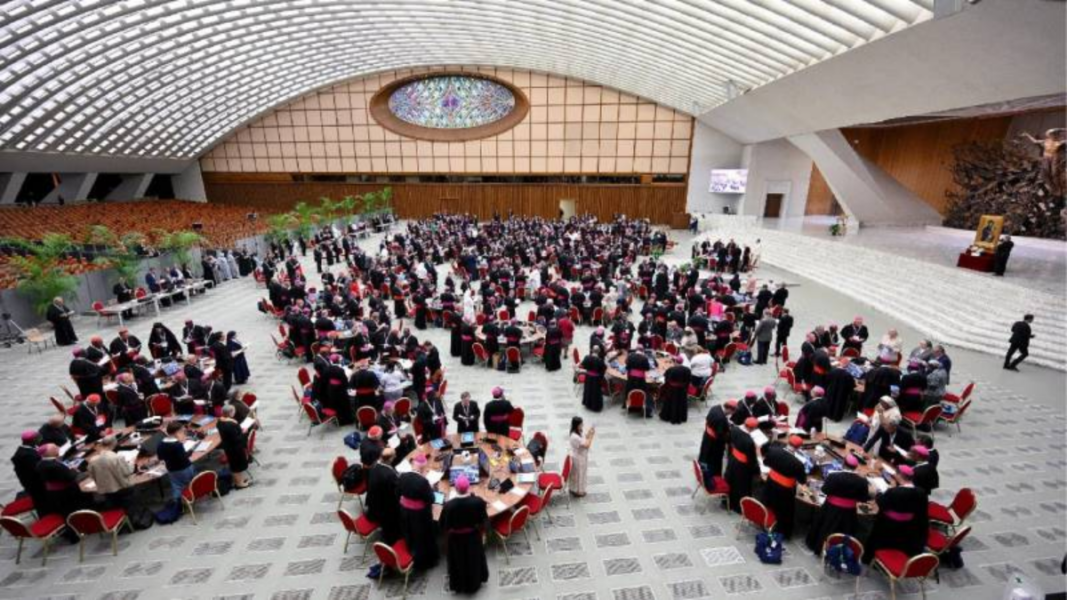
The General Secretariat of the Synod has published the first final reports from the study groups created following the XVI Assembly of the Synod of Bishops on synodality. The documents, made public by decision of Pope Leo XIV, address two specific areas: the formation of future priests and the Church’s mission in the digital environment.
The report dedicated to priestly formation introduces several guidelines that point to a reinterpretation of the presbyteral ministry and the formative processes in seminaries. Although presented as working documents, the texts gather the fundamental lines of the synodal process and point to their concrete application in the life of the Church.
A new reading of the priesthood within the People of God
One of the central elements of the report is the new way of understanding priestly identity as more «linked to the People of God.» The document states that the priest’s identity is formed «in and from» the People of God and not as a reality separate from it.
The Ratio Fundamentalis (2016) —the document that, up to now, establishes the guidelines for the formation of future priests— starts from a strong ontological centrality: the priest is sacramentally configured with Christ Head and Shepherd, and from that configuration derives his mission and authority. The new document does not deny this basis, but shifts the axis toward a relational and communal understanding.
From this new perspective, the priest appears first and foremost as part of a concrete ecclesial community, whose mission develops in constant relation with the faithful and with the diverse vocations present in the Church.
Changes in the formation of future priests
The document also proposes practical modifications in the way candidates for the priesthood are formed.
Among the suggested measures is the alternation between life in the seminary and periods of residence in parish communities or other ecclesial contexts. The objective is for priestly formation to develop in more direct contact with the real life of Christian communities.
Likewise, the text proposes that from the earliest formative stages, shared experiences be developed between seminarians, lay faithful, consecrated persons, and ordained ministers.
This approach seeks to shape a more communal and pastoral formation, in line with the vision of a Church defined by the synodal process as «communion, participation, and mission.»
Synodality and communal discernment in clerical formation
Another of the relevant changes is the explicit incorporation of the synodal method into the formative processes.
The report states that future priests must acquire competencies related to communal discernment and co-responsibility in ecclesial life. In practice, this would imply that pastoral decision-making and ecclesial governance processes develop with greater participation from various members of the community.
According to Cardinal Mario Grech, Secretary General of the Synod, these reports reflect a concrete exercise of synodality based on listening, common reflection, and shared discernment within the Church.
Structural participation of the laity—including women—in formation
Among the most significant proposals is also the stable incorporation of lay faithful into priestly formation processes.
The document suggests that qualified lay persons—including women—may participate as co-responsibles at various levels of seminarians’ formation, even within the formative teams of seminaries.
This participation would not be limited to occasional collaborations, but could acquire a structural dimension within the clergy’s educational processes.
The digital mission, a complementary theme
Along with the report on priestly formation, the Synod has also published the document prepared by Study Group No. 3 on the Church’s mission in the digital environment. The text holds that the digital world must be considered an authentic culture and a new missionary field for the Church, in which human relationships, communities, and spiritual searches develop.
The report thus proposes integrating digital evangelization into the Church’s ordinary structures and offering specific formation to priests and pastoral agents to act in this field.
Working documents within the synodal process
The General Secretariat of the Synod has indicated that these reports should be understood as working documents that will serve as a basis for future decisions and pastoral developments.
On March 10, the publication of the final reports from other study groups created following the Synodal Assembly is expected.