


By Fr. Benedict Kiely
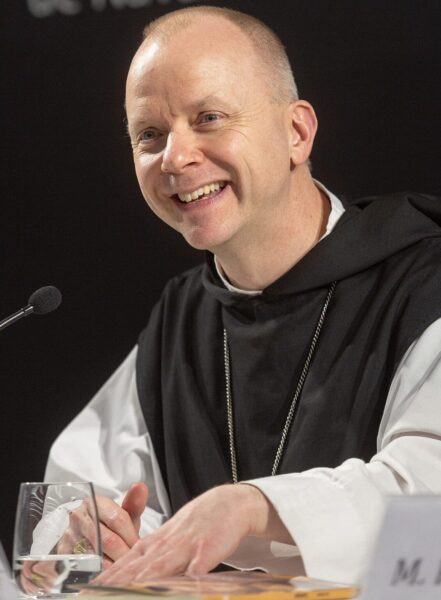
The small but growing Catholic Church in Norway is blessed to now have two bishops, native Norwegians, under fifty-two years old. Bishop Frederik Hansen, appointed bishop of Oslo in July 2025, joins the Cistercian bishop Erik Varden, appointed bishop of Trondheim in October 2019.
Plans are currently underway to celebrate the millennium of the martyrdom of St. Olaf, the canonized king of Norway, an initiative led by Bishop Varden. It would not be inaccurate to say that the Catholic Church in Norway, with the year 2030 on the horizon, is being revitalized by the leadership of these two comparatively young bishops.
Bishop Erik, or Erik of Trondheim, to give him a more exact though more medieval title, is a gentle Viking, though that epithet may sound bellicose. Former abbot of the Cistercian monastery of Mount St. Bernard in England, he is also a former professor of Syriac, a man already highly esteemed as a spiritual writer, teacher, and exemplary bishop.
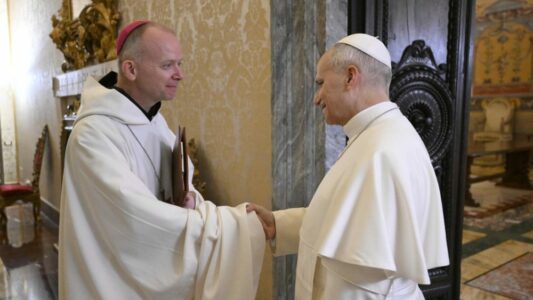
But now, after having been chosen by Pope Leo to preach the annual Lenten Exercises for the Pope and the Roman Curia in the Vatican during the first week of Lent, his prestige—mainly due to the wisdom and depth of his brief reflections—has increased considerably. There is much speculation that he might be called to lead a dicastery in Rome, something he would undoubtedly not desire and which would be a great loss for the Church in Norway.
Almost any line or paragraph from Bishop Erik’s words would be an excellent theme for Lenten reflection. But there were one or two phrases that speak powerfully of a topic that has recently been much discussed in the media, both religious and secular: namely, the emergence of a religious revival, though still small, in the West.
One of the questions that still has no answer is that, despite the evidence that attendance has been much greater at celebrations like Ash Wednesday in many countries, and that this year there will be more baptisms at Easter, how many of these people, predominantly young, will return to regular practice?
It is unlikely that a young seeker, very possibly unbaptized and with little or no knowledge of the Christian faith, will cross the threshold of the local church to hear about synodality, immigration, or debates about communion rails.
Even less will they seek music, or something very much like it, that was popular when their parents were teenagers, but which, as Bishop Erik aptly put it, now sounds clearly “from last season.”
It is more likely that, if they initially seek beauty to lead them to the experience of the divine, the season they seek is one much earlier than the arrival of bell-bottoms.
Varden rightly and insightfully focuses on the reality that, in a highly confusing and technocratic age, people are repeating Pilate’s question: “What is truth?”
The Church, and ancient wisdom, have long taught that, along with truth, beauty and goodness are paths to God. Bishop Erik warned his audience, with Pope Leo seated prominently in front of him, that the Church, or certainly many clerics, imagine that they must imitate fashion to be “relevant” and “attract young people.”
But this is a great danger for any religious revival. And Bishop Varden echoed, in a sense, Chesterton’s conviction—which many seekers probably share: “We do not want a Church that moves with the world, we want a Church that moves the world.”
Bishop Erik, a deeply learned man, knows well what he is talking about, both as a university professor and as an abbot. Is there anything more embarrassing than a cleric trying to be trendy? One thinks of Dean Inge’s phrase that a Church that “marries the spirit of this age will be widowed in the next.” Bishop Varden offers the Church and, I would say, every parish, a program for the seeker.
First, he holds that those seeking truth pose the question [What is truth?] with sincerity—“we cannot leave it unanswered.” This is the function not only of the Church’s magisterium, whether in the clarity of papal statements and doctrinal fidelity, but also, at the “first point of contact,” of preaching and teaching in the parish.
There is no room for objections, as a friend recounted experiencing at the feast of the Assumption, that the Assumption “was invented in 1950.” Instead, Bishop Erik says, “we need our best resources to uphold the substantial, essential, and liberating truth against more or less plausibly shiny substitutes, more or less diabolical.”
Best resources: in the seminary, in ongoing clerical formation, and, as Fr. Richard John Neuhaus used to say, “fidelity, fidelity, fidelity.”
Along with the “liberating truth” proclaimed substantially, Varden’s renewal program points out that the Church has its own language; a language, it must be said, that will be new to many of those approaching it.
That language consists of liturgy and Scripture, which, if well expressed, will make the Church “original and fresh, capable of expressing crucial truths in new ways, with the possibility of orienting culture.”
These new ways have nothing to do with novelty; they are the paths that are “ever ancient and ever new.” This is, in essence, what the expression “new evangelization” really means: it means, once again, the “best resources”: the music, the art, and the experience of the transcendent within the Church’s walls. Restoring all this will cost money, but perhaps less than endless conferences and synods on synodality.
Finally, there is the path of goodness, the “beauty of holiness,” the evidence of lives transformed by the presence of Christ. These, the bishop says, make the proclamation of truth “convincing.”
All this is to proclaim that the “Church reminds women and men of the glory secretly alive in them.” That is a program that will make a seeker return with enthusiasm.
About the Author
Fr. Benedict Kiely is a priest of the Personal Ordinariate of Our Lady of Walsingham. He is the founder of Nasarean.org, which helps persecuted Christians.