


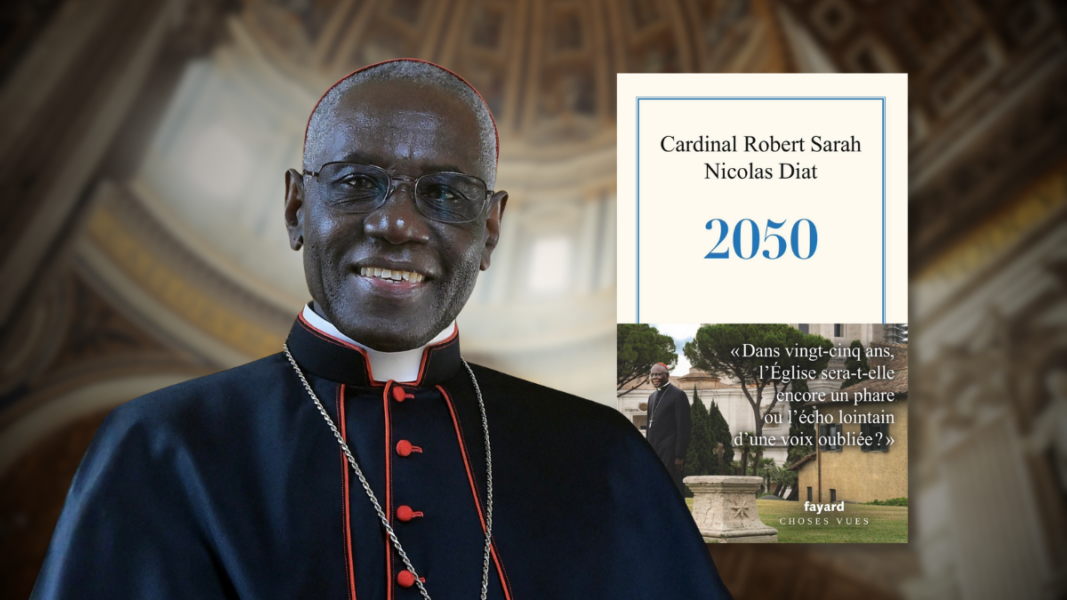
In an interview published by the French weekly Le Journal du Dimanche on the occasion of his new book 2050, the emeritus prefect of the Congregation for Divine Worship, Cardinal Robert Sarah, argues that the Church risks losing its identity if it tries to adapt to the categories and expectations of the modern world.
The center of the Church: returning to God
For the Guinean cardinal, the criterion for judging a pontificate is not administrative decisions or disciplinary reforms, but the ability to put God back at the center of ecclesial life.
As he explains, when the Church speaks first of worship, conversion, and holiness, rather than strategies or structures, it recovers its true axis. Otherwise, he warns, there is a risk of diluting the faith in purely human categories.
Sarah argues that many of the current conflicts in the Church originate from a deeper crisis: the crisis of the language of faith. When doctrinal precision is abandoned—he says—confusion arises among the faithful. Therefore, he insists that doctrinal clarity is not rigidity, but an act of charity toward those seeking guidance.
“The Church is not a worldly institution”
The cardinal denounces that today there is a tendency to judge the Church with categories proper to the contemporary world: efficiency, representativeness, inclusion, or institutional performance.
However, he reminds us that the Church does not exist to reflect the world, but to save it. In that sense, he states clearly:
“We do not need another worldly institution. We need to receive God’s salvation from the Church”.
When its divine dimension is forgotten—he warns—the human weaknesses of the institution become unbearable. But when its supernatural nature is recognized, the Church appears as a sign of contradiction for the world.
The risk of doctrinal relativism
Sarah also warns against what he calls “doctrinal particularism”, that is, the tendency of some local churches to interpret the faith according to cultural contexts or ideological categories.
The result, he explains, is that the unity of the Church weakens when doctrine is relativized and difference is exalted above communion.
“Doctrinal relativism makes unity fragile”, he notes, recalling that Christ himself asked the Father that his disciples be one.
Traditional liturgy as wealth
In the interview, the cardinal takes up one of the themes that has marked his ministry: the liturgy. Following the line of Pope Benedict XVI, Sarah states that the diversity of rites is a wealth when it expresses the same faith.
In this sense, he criticizes what he considers an obsession with eliminating ancient liturgy. In his view, the traditional rite can help rediscover that liturgy is not something that man fabricates, but something received and transmitted by the Church.
“The true liturgical reform is interior”, he states, recalling that the purpose of the liturgy is to give God the first place.
Scandals and conversion in the Church
Regarding the scandals that have affected the Church in recent years, the cardinal points out that they demand truth, justice, and purification.
Nevertheless, he warns that scandals do not eliminate the Church’s vocation. More than structural reforms, he insists that what is needed is conversion of hearts.
At the same time, he underscores the importance of the witness of religious life, which reminds the world that man’s ultimate end is not success or possession, but eternal life with God.
Family, euthanasia, and crisis of hope
Sarah also addresses some of the great cultural issues of the West. On the European demographic crisis, he states that it reflects a profound loss of hope.
A civilization that renounces God—he says—ends up also losing the reason to transmit life.
The cardinal is equally critical of euthanasia legalization projects, warning that they reflect man’s pretension to decide on the value of human life.
“The sick need compassion, not elimination”, he states.
The future of the Church: holiness, not strategies
In concluding the interview, Sarah addresses a message to the catechumens and new baptized: the Church is not simply a human organization, but the very mystery of Christ present in the world.
Therefore, he invites not to be scandalized by the weaknesses of its members, but to look to Christ.
And he launches a final warning about the future of Christianity:
“The future of the Church does not depend on our strategies, but on our holiness”.