


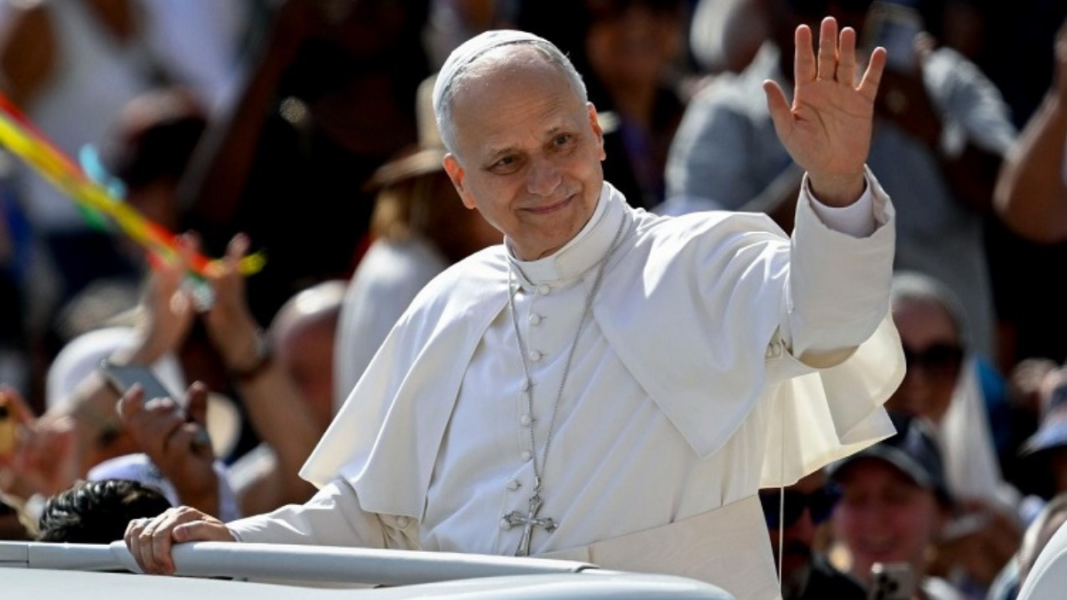
Leo XIV presided over this Wednesday, March 4, the General Audience in St. Peter’s Square before pilgrims from Italy and numerous countries. During his catechesis, he continued the cycle dedicated to the documents of the Second Vatican Council, centering his reflection on the dogmatic constitution Lumen gentium and on the mystery of the Church as a visible and spiritual reality.
The Pontiff explained that the Church has a double dimension, human and divine, inseparable from each other. Through its history, its structures, and the fragility of its members—he pointed out—the action of Christ is made present, who continues to act in the Church and lead men toward God.
We leave below the complete catechesis of Leo XIV:
Dear brothers and sisters, good morning and welcome!
Today we continue to delve deeper into the conciliar Constitution Lumen gentium, the dogmatic constitution on the Church.
In the first chapter, which mainly seeks to answer the question of what the Church is, it is described as “a complex reality” (n. 8). Now we ask ourselves: what does such complexity consist of? Someone might answer that the Church is complex insofar as it is “complicated” and, therefore, difficult to explain; someone else might think that its complexity derives from the fact that it is an institution with two thousand years of history and diverse characteristics compared to any other social or religious grouping. However, in Latin the word “complex” rather indicates the ordered union of diverse aspects or dimensions within the same reality. Therefore, Lumen gentium can affirm that the Church is a well-integrated organism, in which the human and divine dimensions coexist without separation and without confusion.
The first dimension is perceived immediately, since the Church is a community of men and women, with their virtues and defects, who share the joy and effort of being Christians who proclaim the Gospel and become a sign of the presence of Christ who accompanies us on the journey of life. But this aspect—which is also manifested in the institutional organization—is not enough to describe the true nature of the Church, because it also has a divine dimension. The latter does not consist in an ideal perfection or in a spiritual superiority of its members, but in the fact that the Church is the fruit of God’s plan of love for humanity, realized in Christ. Therefore, the Church is at the same time an earthly community and the mystical body of Christ, a visible assembly and a spiritual mystery, a reality present in history and a people pilgriming toward heaven (LG, 8; CCC, 771).
The human and divine dimensions integrate harmoniously, without one overlapping the other; thus, the Church lives in this paradox: it is a reality that is at once human and divine, which welcomes sinful man and leads him to God.
To illuminate this ecclesial condition, Lumen Gentium refers to the life of Christ. Indeed, whoever met Jesus on the roads of Palestine experienced his humanity, perceived his eyes, his hands, the sound of his voice. Whoever decided to follow him felt impelled precisely by the experience of his welcoming gaze, by the touch of his hands that blessed, by his words of liberation and healing. But, at the same time, by following that Man, the disciples opened themselves to the encounter with God. In fact, the flesh of Christ, his face, his gestures, and his words visibly manifest the invisible God.
In the light of the reality of Jesus, we can now return to the Church: when we look at it closely, we discover in it a human dimension made of concrete persons who sometimes manifest the beauty of the Gospel and other times grow tired and make mistakes, like everyone. However, precisely through its members and its limited earthly aspects, the presence of Christ and his saving action are manifested. As Benedict XVI said, there is no opposition between the Gospel and the institution; on the contrary, the structures of the Church serve precisely for the “realization and concretization of the Gospel in our time” (Address to the Bishops of Switzerland, November 9, 2006). There is no ideal and pure Church, separated from the earth, but only the one Church of Christ, incarnated in history.
This is what the holiness of the Church consists in: the fact that Christ inhabits it and continues to give himself through the smallness and fragility of its members. Contemplating this perennial miracle that takes place in it, we understand God’s “method”: He makes himself visible in the weakness of creatures, manifesting and acting. Therefore, Pope Francis, in Evangelii gaudium, exhorts everyone to learn to “take off their sandals before the sacred ground of the other” (cf. Ex 3:5, n. 169). This allows us to continue building the Church even today: not only by organizing its visible forms, but also by building that spiritual edifice which is the body of Christ, through communion and charity among us.
Charity, in fact, constantly generates the presence of the Risen One. “May heaven grant—as St. Augustine said—that all think only of charity: only it conquers all, and without it everything else is worthless; wherever it is found, it draws everything to itself” (Serm. 354,6,6).